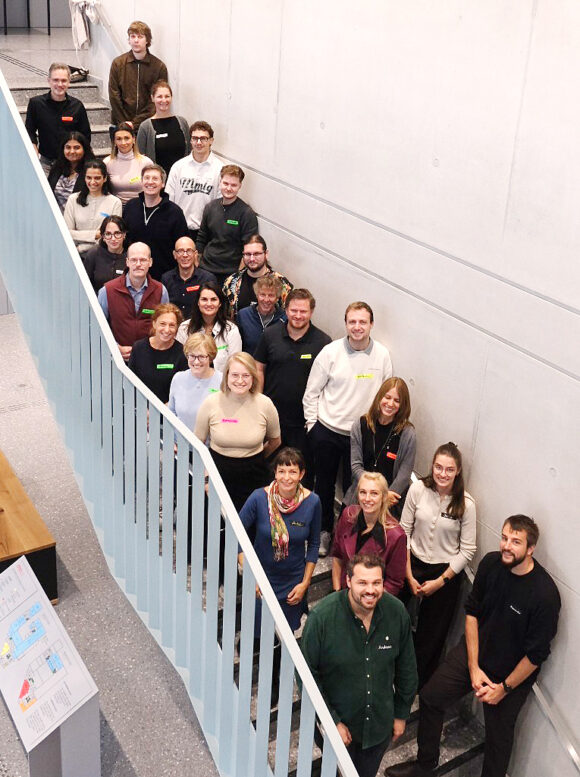


At the 2026 Children’s University at Hof University of Applied Sciences, economics students, under the guidance of Prof. Dr. Christine Brautsch and Prof. Dr. Günter Hilmer, presented their practical projects directly to children for the first time. Here, the students themselves describe this challenge, which was entirely new to them:
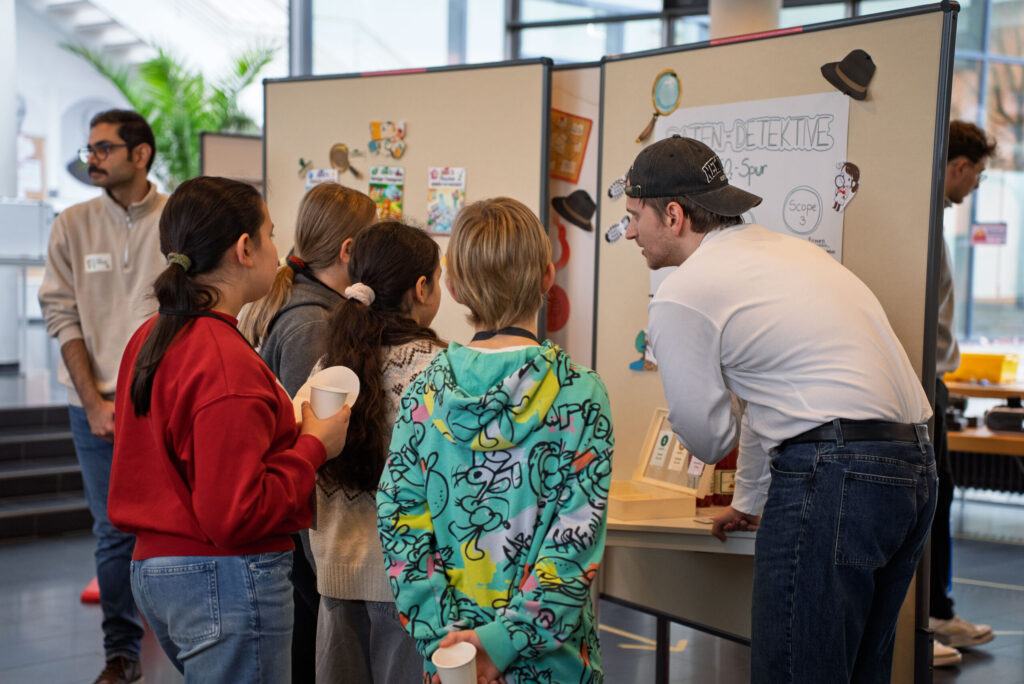
“How do you explain to children the responsible use of artificial intelligence and data, carbon footprint calculation along a value chain, or the development of a new product? At the Children’s University at Hof University of Applied Sciences, we got to give it a try: Imagine you have to explain your current, highly complex digitalization project—not to your professor or your boss, but to a group of curious children who, as we know, approach topics with a completely open mind. No technical jargon, no presentation slides—and at the end, the children even get to help decide how things will proceed. That was exactly our task on November 18, 2026, at Hof University’s Children’s University, under the motto “Practice Meets the Future: Children Decide.”
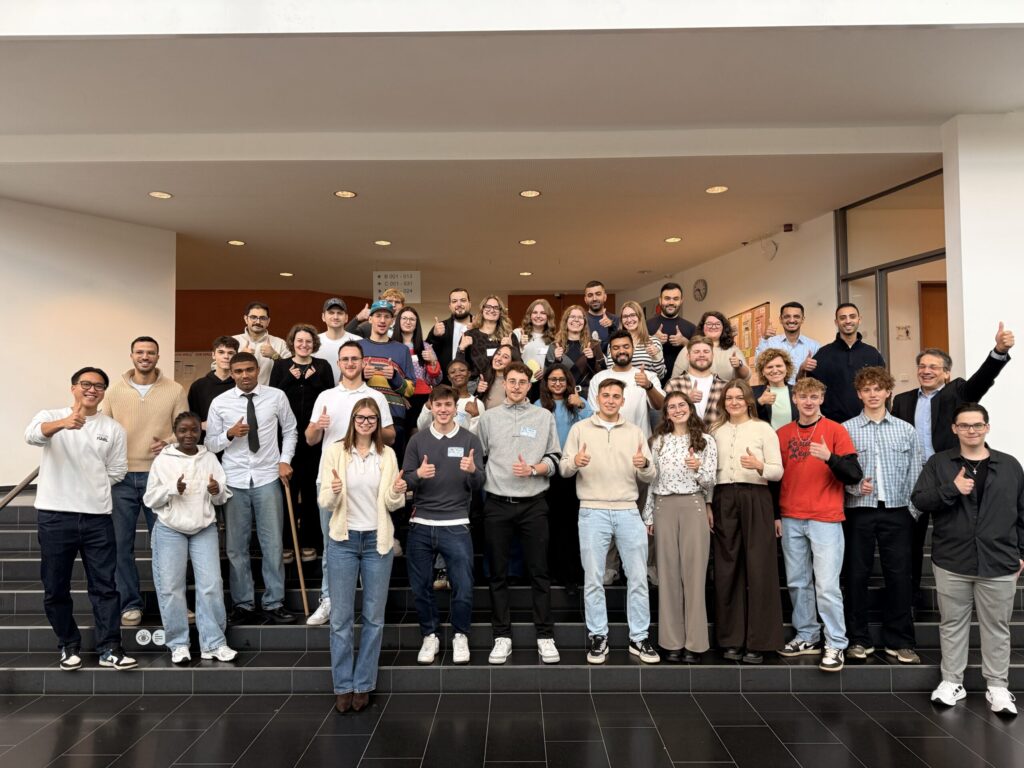
We are bachelor’s students in economics with a digital focus and master’s students in the Digital Business Management program. As part of the modules “Digital Infrastructure and Internet Technologies in Practice” and “Applied Research: Digitalization and IT Technologies,” we are working directly with companies this semester. Together, we’re developing solutions for specific real-world challenges—ranging from IT security and artificial intelligence to carbon footprints.
Our clients could hardly be more diverse: the German Armed Forces, the Kulmbacher Brewery, the digitalization specialist F.EE, the German Ju-Jutsu Federation, the Stadler family as a private project partner, Markgrafen beverage stores, and, last but not least, Hof University of Applied Sciences itself. We work in seven teams, each collaborating with a industry partner. Master’s students serve as project leaders for the individual teams, guiding and coordinating the Bachelor’s students throughout the project. The seminar is led by Prof. Dr. Günter Hilmer and Prof. Dr. Christine Brautsch.
“It is important to us that students not only acquire theoretical knowledge but also apply it in real-world projects. The Children’s University offers a very special opportunity for this: Our students must convey complex economic and digital concepts in an understandable way, respond to spontaneous questions, and adopt the perspective of their target audience. This is a valuable experience that goes far beyond a traditional presentation.”
Prof. Dr. Christine Brautsch and Prof. Dr. Günter Hilmer
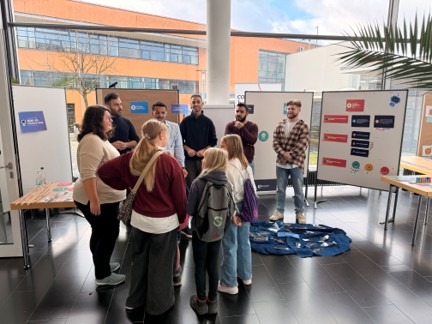
On Children’s University day, we welcomed around 100 children in five groups to our elaborately designed booths in the university’s foyer.
Seven interactive stations: From IT security to carbon footprints
Things got off to a fast start right away. In the “Data Thief Rally,” the children hopped onto Bobby Cars and zoomed from puzzle to puzzle to protect the data in the car from a thief. What sounds like a game has a serious underlying theme: Modern cars have long been rolling computers. Our team is developing an information security campaign for this purpose on behalf of the German Armed Forces.
After that, things got active in a different way. In “Become a Hanbo Explorer!,” the children learned about the Hanbo—a staff used in Jujutsu—and took a quiz. Along the way, they went through the entire customer journey. Our team aims to digitally redesign this very journey for the German Ju-Jutsu Federation so that initial curiosity ultimately leads to club membership.
Is that already AI or just a smart program? And what are you actually allowed to tell an AI? With the Mini AI Driver’s License, the children could decide for themselves. Incidentally, these are exactly the questions at the heart of our team’s training concept for F.EE regarding the EU AI Act.
Then things took a dramatic turn—Dad is sick. Is it a real flu, or is it the infamous “man flu”? At the “End Station: Sofa” station, the children tried out a “men’s flu” test and then voted on whether they would give it to their dad, grandpa, brother, or friend—and what else they would give him along with it. Behind the tongue-in-cheek humor lies a real innovation project by our team for the Stadler family.
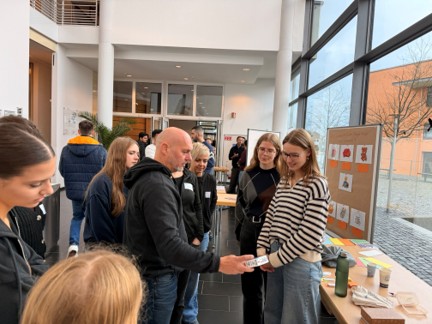
At the “Data Detectives on the CO₂ Trail” station, the kids got creative. The children got to enjoy some delicious lemonade and then wondered just how much CO₂ is actually in a drink like that—from raw materials all the way to the glass. Our team is currently calculating this on a larger scale for the Kulmbacher Brewery, taking the entire value chain into account.
Right next door, the focus was also on drinks. At “No Thirst Goes Unquenched!”, the children planned their own beverage store. What goes on the shelves when space is limited? And will you be able to find what you’re looking for? On a smaller scale, these are exactly the questions our team aims to answer for the Markgrafen beverage stores using data: Which product assortment is optimal for which store?
The last station was all about us. Anyone who knows the kids’ current favorite number will immediately understand the title “Studying at Hof University of Applied Sciences? 67!” Through Twister and colorful display boards, the children discovered our degree programs and campus life. After all, tomorrow’s students are sitting in the Children’s University today—and that’s exactly who our team wants to attract to Hof University of Applied Sciences.
Participate instead of just listening: Kids have a say
There wasn’t a single traditional lecture at any of the stations. The children were encouraged to help make decisions and realize that their opinions really matter. To achieve this, we combined analog and digital ideas: from games we programmed ourselves to VR headsets and hands-on prototypes, all the way to physical activities and votes using traffic lights or thermometers.
By the end of the day, every station had not only been fun but had also gathered plenty of feedback. What worked best? What was unclear? And what would the children do differently?
What Students Take Away from the Children’s University
For the children, it was a day full of movement, experimentation, and having a say. For us, it was probably the most honest interim presentation we’ve ever had. Children don’t just nod politely when they don’t understand something. They ask for clarification or simply move on to the next station. Anyone who can explain a complicated topic in a way that a child understands and wants to help shape it has truly understood it themselves.
And often, the most surprising ideas came from precisely those who had never heard of category management or the EU AI Act. We’re now taking their feedback with us into the second half of the semester and discussing it with our professors and industry partners.
This shift in perspective is also a benefit for teaching:
“When students present their projects to such a young audience, they receive immediate and unfiltered feedback. They learn to question their own assumptions and view solutions from a different perspective. It is precisely this ability to incorporate different points of view that is particularly important in the digital economy and in the development of new products and services.”
Prof. Dr. Christine Brautsch and Prof. Dr. Günter Hilmer
Our conclusion: The Children’s University Day was a complete success—for the children, for our industry partners, and for us. That’s why we plan to repeat this format in the future. We’re excited to see what the next generation of young experts will decide.”