

Over 300 guests from the business, academic, and political communities gathered at the Institute for Information Systems at Hof University of Applied Sciences for the 14th Upper Franconia IT Forum. The central theme: Europe’s technological dependence—and the question of how Germany can regain digital sovereignty.

To kick off the event, University President Prof. Dr. Dr. h.c. Jürgen Lehmann emphasized the event’s significance for the region: “Year after year, the IT Forum demonstrates how important the exchange between research, business, and politics is. Especially when it comes to future-oriented topics like digital sovereignty, we need places where new ideas emerge and partnerships grow.”
In his opening remarks on digital sovereignty, organizer Prof. Dr. René Peinl pointed out that we need to look beyond the usual narrative that market-leading products are the only option and consider how our decisions today will impact the future of the country. Decisions by individuals that seem rational can nonetheless lead to a collective slide toward becoming a digital developing nation.


Digital Dependency as a Strategic Risk
Parliamentary State Secretary Silke Launert opened her statement with a clear diagnosis: Germany and Europe are heavily dependent on U.S. technology companies in key areas of digital infrastructure. “Do you feel digitally sovereign?” Launert asked the audience, citing a series of figures that illustrate the extent of this dependency. 96 percent of companies in Germany use software from the U.S., and more than half of German companies could not survive a single year without American software.
“Most of what we use does not come from Germany and often does not even meet our data protection standards.”
Dr. Silke Launert, Parliamentary State Secretary
The result is structural vulnerability. As an example, she cited a project for digital water management in Bayreuth. An Asian provider had offered a solution that was about 20 percent cheaper than European competitors. However, the economic offer alone should not be the only criterion.


“We also need to talk about resilience,” said the State Secretary. The federal government has since developed its own definition of this within the framework of the High-Tech Agenda, as the resilience of digital infrastructure is crucial for a country’s economic stability. Launert also advocated for a European technology policy—with stronger research, open-source solutions, and our own infrastructure. Germany has a strong research landscape that can serve as the foundation for new technological offerings.
A Look at Asia
Science journalist Eva Wolfangel then took the audience on a journey through global technology policy. For her research, she had visited numerous technology companies in Asia and interviewed, among others, semiconductor pioneer Morris Chang, founder of the Taiwanese chip giant TSMC.
Taiwan’s dominance in chip production was by no means a given, Wolfangel reported. Rather, it emerged from an economic crisis. “Taiwan had hardly any capital back then. It was a bet on the future,” she quoted Chang as saying. Before the development of the semiconductor industry, the country’s economy had been based primarily on textile production. Today, however, Taiwan is one of the central hubs of the global chip industry—despite significant risks. “Without security, we lose everything,” Chang emphasized during the conversation. Even natural disasters like earthquakes could severely disrupt the highly precise production process.
Wolfangel derived a key question for Germany from this: “What is our indispensable factor in the global technology economy?” The answer is currently sobering:
Dependence works—until it doesn’t!”
Eva Wolfangel
At the same time, she warned against underestimating Europe’s capacity for innovation. As an example, she cited the optics and technology group Carl Zeiss AG: Around 80 percent of the lithography systems used worldwide—which are necessary for the production of modern chips—are manufactured in Germany. A key developer behind this technology is engineer Frank Rohmund, who worked on the system for over 25 years through trial and error. “Today, this technology is practically indispensable on the global market—and hardly anyone is aware of this monopoly,” said Wolfangel.

Start-ups present new ideas
In addition to the keynote speeches, the IT Forum also served as a platform for young technology companies. Two startups presented their ideas in short pitches. The company Can.me presented a solution centered on cloud infrastructure, network technology, and identity management. The goal is to make digital identities more secure and, at the same time, easier to manage.


The startup Krasper introduced an AI firewall designed to anonymize browsing using autonomous AI agents. The technology is intended to help better control data flows between users and artificial intelligence in the future.
Gunter Dueck: “We are naive”
The most provocative presentation of the day came from computer scientist and former IBM manager Prof. Dr. Gunter Dueck. His opening remarks were deliberately pointed: “We are so naive.”
Dueck pointed out that many technological developments had long been underestimated. As early as 2016, he had spoken about autonomous vehicles—at the time, his predictions were often met with skepticism. Today, however, vehicles from Google’s subsidiary Waymo are already driving autonomously through everyday life in several U.S. cities.
“I’m not promoting these developments. These are simply facts.”
Prof. Dr. Gunter Dueck
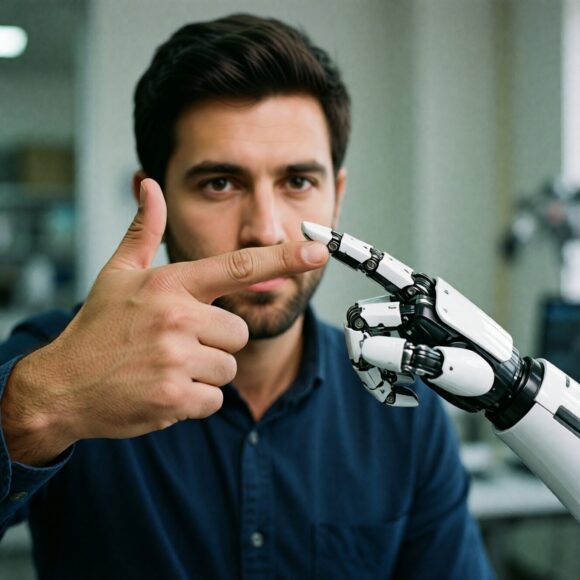
In his view, the next big wave is already on the horizon: robotics and humanoid systems. While Germany has a few so-called “hidden champions,” overall development remains fragmented. One example is robotic gripping technology—a crucial element for many applications.


“The main problem with robots is the hand,” said Dueck. In Germany, only a very small number of companies are working intensively on this topic. At the same time, a new dynamic is emerging internationally. Companies in China, South Korea, Taiwan, and the U.S. are investing heavily in humanoid robots.
There are also cultural differences. While technology is perceived as a symbol of national strength in many countries, Germany has become significantly more skeptical. “We are no longer proud of ‘Made in Germany,’” said Dueck. “Other countries, on the other hand, are.” He summarized his conclusion with a simple principle: “If you want to catch up, you have to be faster than the leaders.”
Four specialized theme rooms
In addition, four parallel thematic rooms at the IT Forum Upper Franconia offered a concise overview of key future fields in digital transformation: from the importance of open source as the foundation of digital sovereignty, to sovereign cloud solutions, to current developments in AI and robotics. The program was complemented by practical insights into modern data strategies for businesses, which illustrated how data can be strategically leveraged as a valuable resource.


Networking and packed exhibition halls
In addition to the presentations, the IT Forum featured an extensive trade fair with companies from the region. The event was aimed at a broad audience from the business community, primarily companies in the region, but also politicians and interested members of the public. Several participants praised the organization and the high quality of the event. Particular mention was made of the well-integrated exhibition booths and the attentive support provided by the Hof University of Applied Sciences organizing team.
“The program was clearly structured and the target audience on site was just right,” reported one participant. Unlike at many events, there was no artificial padding with students—instead, company representatives were predominantly present. The sponsors were also satisfied. Thanks to dedicated time slots for the trade show, visitor traffic at the booths increased significantly.


A Successful Day for the Region
Professor René Peinl, scientific director of the Institute for Information Systems and organizer of the event, gave a positive assessment at the end of the day.
“We are very satisfied with the event. We had around 300 guests here throughout the day. The intensive exchange between academia and industry was particularly valuable. The IT Forum is an absolute asset for the region.”
Prof. Dr. René Peinl, Organizer

The next Upper Franconia IT Forum will take place in 2027 at the University of Bamberg.