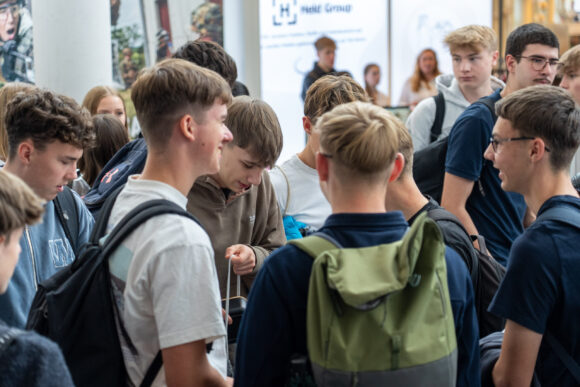


The new PISA results are sparking debate about the future of the German education system. The performance of 15-year-olds in Germany in mathematics, reading, and science is worse than it has ever been since the PISA assessments began. About one-third of students do not even reach the basic proficiency level in reading and mathematics. But today’s teenagers are tomorrow’s college students: If a growing proportion of high school graduates struggles with math, reading, text comprehension, or independent problem-solving, the question of their readiness for college inevitably arises.
Will universities have to compensate more in the future for what schools can no longer provide? Will teaching, course organization, and student support need to change? We discussed this with Prof. Dr.-Ing. Dietmar Wolff, Vice President for Academic Affairs at Hof University of Applied Sciences.
Professor Wolff, the latest PISA results are alarming. When you look at these figures from a university’s perspective, what do they mean for higher education in the coming years?
“The PISA results are a wake-up call that cannot and will not go unnoticed at universities. Of the one-third of 15-year-olds who do not even reach the basic proficiency level in reading and mathematics, some will be coming to our universities in just a few years. We must prepare for increasing heterogeneity among first-year students. Specifically, this means that teaching must be able to accommodate different starting levels—through targeted preparatory courses, flexible learning options, and more individualized support. At the same time, however, we also know that academic readiness is more than just a high school diploma.”
PISA assesses 15-year-olds—it will be several more years before these young people arrive at a university. Is it nevertheless already foreseeable today that universities will have to deal with greater deficits in basic skills in the future?
“Yes, absolutely. The current PISA data are not an isolated event, but rather the preliminary low point of a trend we’ve been sensing at universities for years. Even today, first-year students lack basic skills in simple mathematical operations—and not just in engineering mathematics. Even though these young people won’t arrive at our institutions for another four to six years, we need to set the course now—in how we organize our programs, in the orientation phase, and in the continuing education of our faculty. Anyone who waits until this cohort arrives will have lost valuable time.”
What does “academic readiness” actually mean to you in concrete terms—what skills are primarily required here?
“For me, academic readiness encompasses four areas. 1. Subject-specific fundamentals—a solid foundation in mathematics and the ability to understand and contextualize challenging texts. 2. Methodological skills—abstract thinking, independent problem-solving, and the ability to acquire knowledge on one’s own. 3. Self-management skills—time management, perseverance, and frustration tolerance. And 4. curiosity and a willingness to engage with new ideas. Self-management skills, in particular, are often underestimated—and unfortunately, that’s precisely where we’re seeing the most significant negative changes.”
Are you already observing changes in these fundamental competencies among first-year college students?
“Yes, two developments in particular. First, increasing heterogeneity: the range of initial competencies within a cohort is growing. Second, a shift in learning attitudes—a certain ‘short-term mindset’: many expect quick, immediate solutions. Many are finding it increasingly difficult to engage in longer thought processes, to tolerate and cope with not knowing, and to work through a problem independently. This is not the fault of young people, but rather the result of a learning culture designed for instant access—and, of course, the influence of social media.”
When students arrive at college with significant deficits in math, reading, or problem-solving: To what extent can and should a college even close these gaps?
“A university can and should provide support: through preparatory courses, tutorials, mentoring, and teaching that engages and coaches students. But there is a clear limit—we cannot and must not replace high school. Basic reading and math skills must be acquired before starting college. If these gaps are systematically filled, we’re using resources for remedial education and run the risk of gradually lowering standards. That would be the wrong approach—for the graduates, for the university’s reputation, and for businesses. Therefore, the key is to create opportunities, clearly communicate expectations, and evaluate consistently. Compensating for gaps must not turn into lowering standards.”
At the same time, artificial intelligence is fundamentally transforming learning. Could AI help address skills gaps—for example, as a personal tutor and learning guide? Or is there a risk that students will let AI complete tasks for them without acquiring the necessary skills themselves?
“AI is a powerful tool and can indeed help fill skill gaps—but only when used correctly. A well-designed AI tutor provides individualized feedback, assigns adaptive exercises, and is available around the clock. That’s exactly what students with gaps need: personalized, patient repetition. The danger is just as real: if AI solves the problems instead of supporting the learning process, it creates a false sense of competence. That’s why we need clear rules, which we’re establishing with our AI guidelines. But we also need well-thought-out teaching methodologies and appropriate assessment formats that reveal genuine competence—such as more oral exams or ongoing assessments of learning progress throughout the semester. In short: AI as a learning companion—yes; as a problem-solver—no. And AI literacy is a key academic skill for tomorrow and an essential future competency for the working world.”

, sees an increased need for universities and colleges to adapt in light of the PISA results;
;
; Image: Hof University of Applied Sciences;
Should higher education teaching change in light of this trend?
“Absolutely—and not just because of PISA. Teaching must become more engaging and competency-based: far fewer traditional lectures, more flipped classrooms, project-based work, peer learning, and regular formative feedback. All of this is also reflected in Hof University of Applied Sciences’ new teaching strategy, which has just been rewritten through a collaborative process. After all, especially at a university of applied sciences, we must work closely with real-world practice—this holds great potential for motivation and understanding. In addition, we need to provide better guidance during the introductory phase and support our faculty—with courses on university teaching methods, AI training, time to explore new teaching formats, and a culture of recognition that truly honors good teaching.”
If you could change three things in the German education system to improve future generations’ readiness for higher education, what do you think should be at the top of the list?
“First and foremost: strengthening the fundamentals in school—and doing so early on. Reading promotion, language development, and basic math skills belong in the early years, with consistent assessment and targeted support. Second: teachers. We face a dramatic teacher shortage and an overwhelming workload that makes innovation in schools nearly impossible. We need more well-trained, innovative teachers and better working conditions. Third: rethinking the interface between school and college—less rote memorization, more self-regulated learning, project work, and real-world problem-solving. After all, the ability to learn independently is ultimately the core of academic readiness.”
Thank you very much!