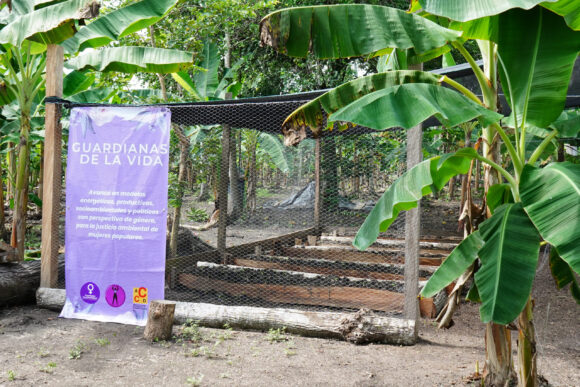


Over twenty women from various communities in the Magdalena Medio region took part in two workshops at the beginning of December as part of the international FRAU-PAZ research project. The aim was to develop ecological peace strategies from a gender-sensitive perspective and to combine local experience with scientific approaches.

The workshops were conducted jointly by the organization Organización Femenina Popular (OFP), the Universidad Santo Tomás, the Universidad Pontificia Bolivariana and Hof University of Applied Sciences. The focus was on a central finding: ecological peace arises where the protection of water, territory and community are considered together.
Water as the key to community and peace
The starting point for the workshops was the question of what role water plays in peace and social cohesion. For the participants, water is far more than just a natural resource. It is the basis of everyday life, an element that creates identity and a unifying factor within the communities along the Río Magdalena.
This perspective became clear right at the beginning of the workshops, when the women described their personal relationship to their territory using symbols from the river landscape. The close connection between water, origin and social cohesion was a common thread running through all phases of the work.
FRAU-PAZ project: Peace as a lived practice
As part of an introduction, representatives of the FRAU-PAZ project presented the research approach. The project investigates how women shape ecological peace processes in everyday life and what role care, organization and collective action play in this (“campuls-digital” reported).
In interactive exercises, the participants reflected on factors that strengthen their well-being, influences that affect peace and security, and collective measures to protect life and the environment.


The results illustrated a common understanding of peace as a continuous process that is anchored in daily actions – especially in the responsible use of water and nature.
Environmental degradation as a cause of social conflict
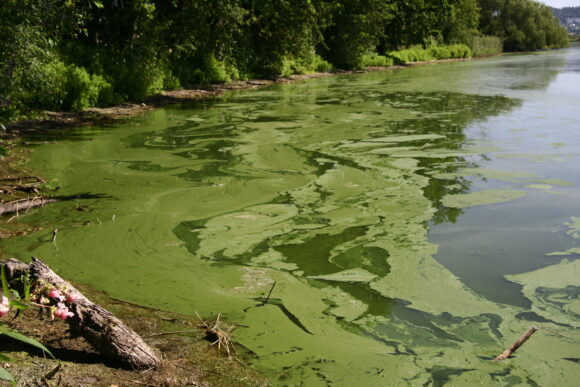
Another focus was on the current ecological challenges in the region. The women reported on illegal gold and coal mining, oil pollution in rivers, deforestation and agro-industrial monocultures as well as health risks from contaminated drinking water. These reports confirmed previous research findings: Environmental degradation, social inequality and violence are closely linked in the Magdalena Medio. The loss of water quality and availability has a direct impact on social stability and security.
Sponge regions: Science in exchange with local knowledge
An educational part of the workshops was dedicated to the concept of sponge regions, which is being researched at the inwa Institute at Hof University of Applied Sciences. This involves strategies with which regions can store, purify and drain water in a controlled manner. The dialog revealed that many of these approaches are already being put into practice in the municipalities – for example through rainwater harvesting, the restoration of wetlands or community filter technologies. The scientific perspective made it possible to classify and further develop these experiences without replacing them.
Mapping water and territory
A central workshop component was the collaborative creation of maps of the territory. The women marked water sources, risk zones, flooding areas and places of collective ecological practice. On this basis, they developed concrete proposals for ecological peace measures, including
- Rain gardens and biofilter systems,
- Re-vegetation of riverbanks,
- community environmental monitoring,
- small-scale solutions for rainwater retention.
These maps now serve the FRAU-PAZ project both as a basis for research and as an expression of a shared vision for sustainable development.
Significance for international research
For Hof University of Applied Sciences and the participating universities, the workshop was an important contribution to international cooperation. It illustrated how local forms of knowledge can enrich scientific research and how gender perspectives open up new approaches to questions of water, the environment and peace.