

Ten students from Hof University spent a project week at Penn State Abington in Pennsylvania at the end of September. Working in mixed German-American teams, they tackled a sensitive question: How can cancer patients be provided with clear information about clinical trials and receive effective support, and how can this be turned into a viable business model for the health technology company Azra AI?
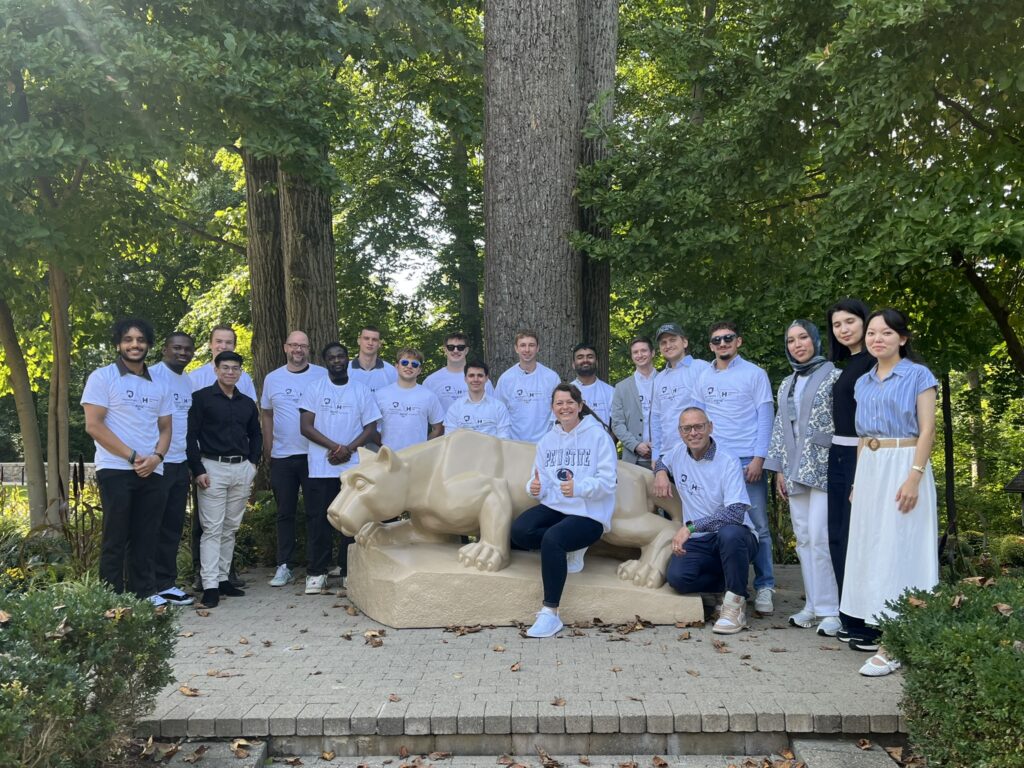
How do you approach people who have just received a cancer diagnosis about participating in a clinical trial? And how can this be turned into a service that is also economically viable for a company? Ten students from Hof University tackled these questions from September 28 to October 2, 2026, at Penn State Abington in Pennsylvania. Together with students from the American partner university, they spent a week working on a real-world, practical challenge.
A Real-World Case from the Healthcare Industry
The challenge was posed by Azra AI, based in Nashville, Tennessee. The company uses artificial intelligence to analyze clinical data from U.S. hospitals. With its Clinical Research Platform, Azra quickly identifies suitable patients for clinical drug trials.
So far, Azra AI has focused on identifying suitable patients for clinical trials. Now, the company wants to expand its business model to also support the subsequent communication with and support for participants. What might such additional services look like? What added value do they offer patients, hospitals, and Azra AI itself? How can AI help improve communication, reduce uncertainty, and support patients in making an informed decision about participating in a clinical trial? And how can this be developed into an economically viable business model?
This required a truly interdisciplinary approach. The students from Hof contributed the business perspective: They analyzed target groups and stakeholders, developed ideas for new services, and drafted a business case. On the American side, students from computer science—as well as other disciplines such as biology—joined the effort and provided the technical and subject-matter expertise.
Three teams, one goal: the search for the best idea
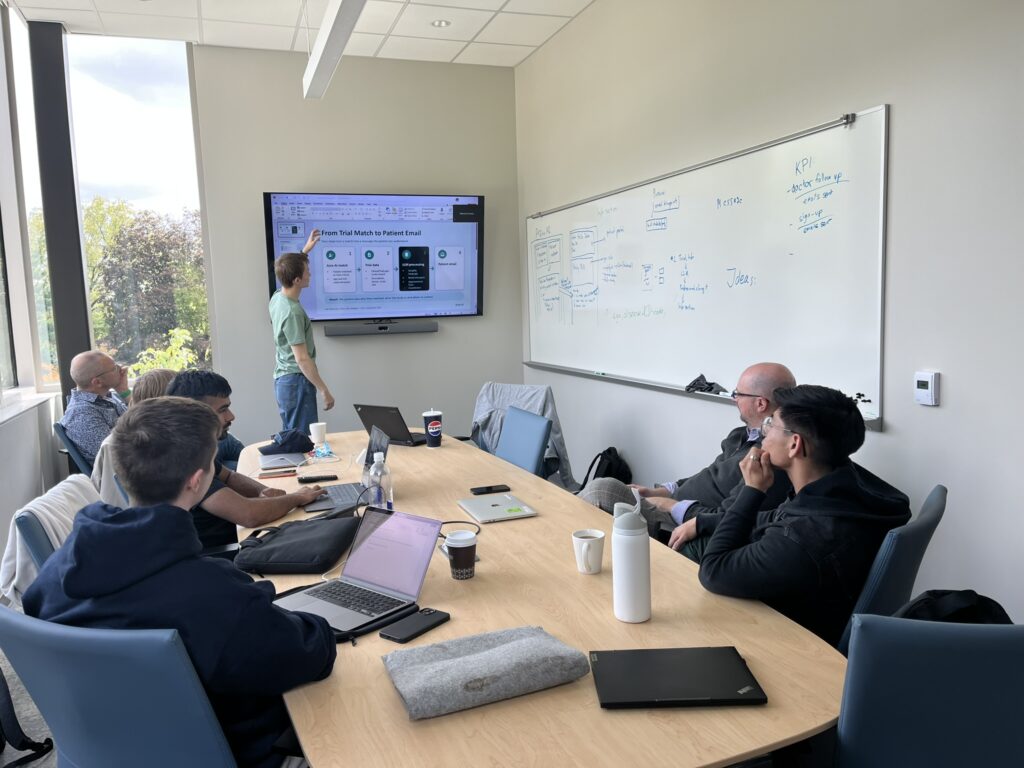
The students didn’t meet until the first day in Abington. Then they got right to work: Three mixed German-American teams, each with five to seven members, competed against one another. In the end, the team with the most convincing solution concept for Azra AI would win. The work took place in the new Penn State Abington building. The light-filled rooms offer plenty of open workspace and group rooms for focused work.
Each day began with a morning briefing led by the instructors for the individual teams. Drawing on the design thinking process, the instructors coached the teams through each phase. They discussed ideas with them and explored appropriate methods for research, brainstorming, and prototype development. When needed, there were impromptu Q&A sessions with representatives from Azra.
At the outset, the students first had to fully grasp the problem. For most, this was uncharted territory: from the U.S. healthcare system to cancer diagnoses and treatment pathways, all the way to the question of what kind of support those affected truly need. The students approached the topic with great seriousness and a high level of commitment. They interviewed relevant groups of people and engaged deeply with the situation of cancer patients—their needs and the challenges involved in communicating with them. All work and presentations were conducted entirely in English.
At the same time, the assignment remained an entrepreneurial one. The ideas were intended to open up new services for Azra and be economically viable. Doing justice to the people behind the data while keeping performance and profitability in mind was, at times, a balancing act. It was precisely this challenge that helped the teams grow.
Just how well the group had bonded was demonstrated by a spontaneous idea: In the middle of the week, the students suggested creating their own project T-shirts and immediately designed them. The instructors then printed the shirts in a last-minute effort at the Penn State Abington Makerspace.
Demo Day: Presenting Results to Company Representatives
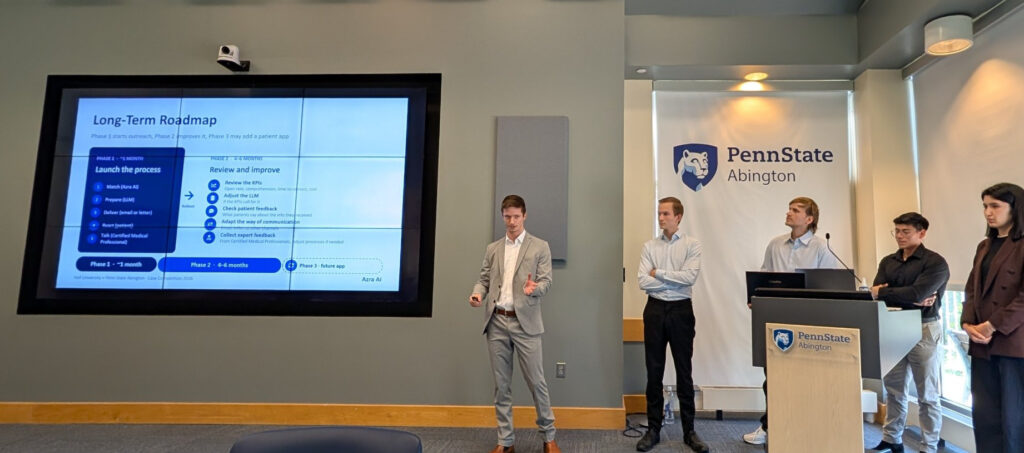
At the end of the week, the three teams presented their findings and strategic recommendations to representatives from Azra AI. The winning team was particularly impressive with its consistently patient-centered approach. Using concrete patient journeys, they demonstrated where communication problems can arise throughout the course of treatment and clinical trials: from the initial contact, through support during a trial, to follow-up therapy. Building on this, the team developed an end-to-end process and presented prototype solutions for each phase.
More Than Just a Project: New York and Philadelphia
The trip also had plenty to offer off campus. Before the project began, the Hof group spent a day in New York. The itinerary included the 9/11 Memorial, Times Square, and Chinatown. The highlight was the view of the skyscrapers at sunset.
During the project week, the group stayed in Philadelphia and explored the city in the evenings. They visited Independence Hall and the Liberty Bell, browsed through the Reading Terminal Market, and sampled the famous Philly cheesesteak. Of course, a visit to the “Rocky Steps” in front of the Philadelphia Museum of Art was a must.

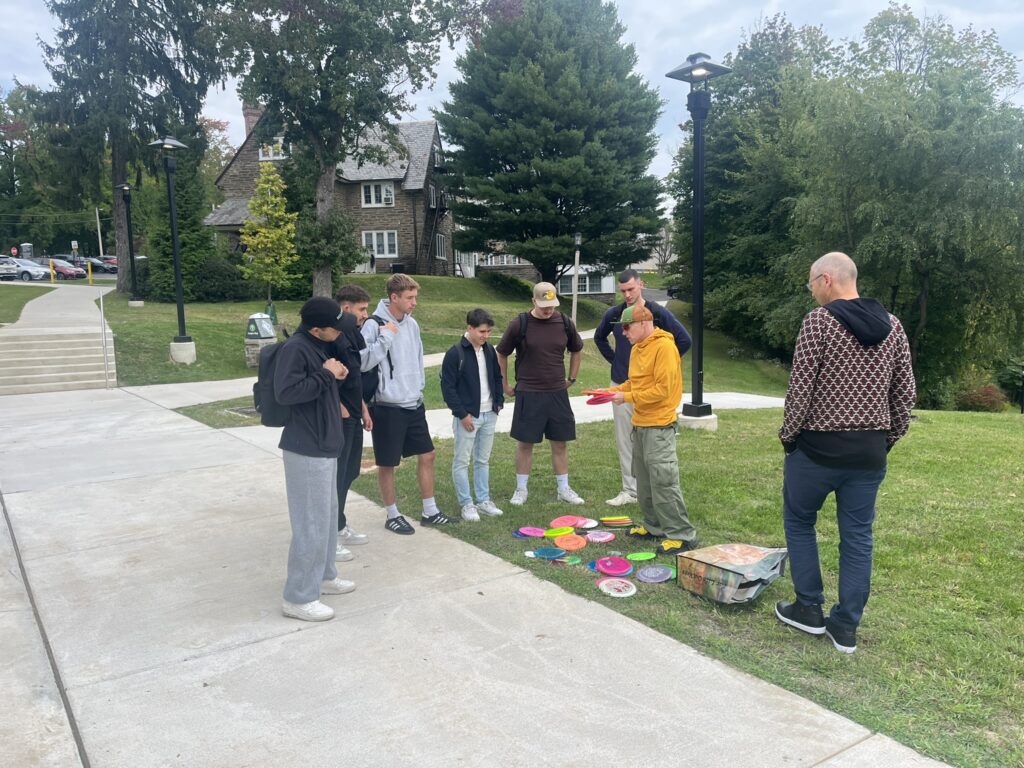
On campus, a round of disc golf with our American colleagues provided a welcome break between work sessions.
Internationalization in Action
The project is a collaboration between Hof University of Applied Sciences and Penn State Abington. Participating students can earn ECTS credits toward their degree. In the process, they learn to identify and analyze novel problems and to develop solutions collaboratively. They present their results to the client, make a case for their ideas, and defend them.
The feedback comes directly from the field: Representatives from Azra AI were visibly impressed by the quality and depth of the wide variety of ideas and proposals. The company plans to put some of them to use.
“The students tackled a topic that requires a great deal of tact and sensitivity, all while maintaining an entrepreneurial perspective. They met for the first time on Monday, and by Friday they had presented solutions that Azra actually intends to use.”
Prof. Dr. Tina Wiegand and Prof. Dr. Oliver Mauroner
Prof. Wiegand and Prof. Mauroner jointly led the project and provided on-site guidance to the ten students from Hof. It is not yet certain whether there will be another project of this kind next year. However, the two are working to continue offering international projects in the future, in which students can learn and work in a practical, case-based, and interdisciplinary manner within an international context. Interested students are welcome to contact Prof. Dr. Tina Wiegand.