

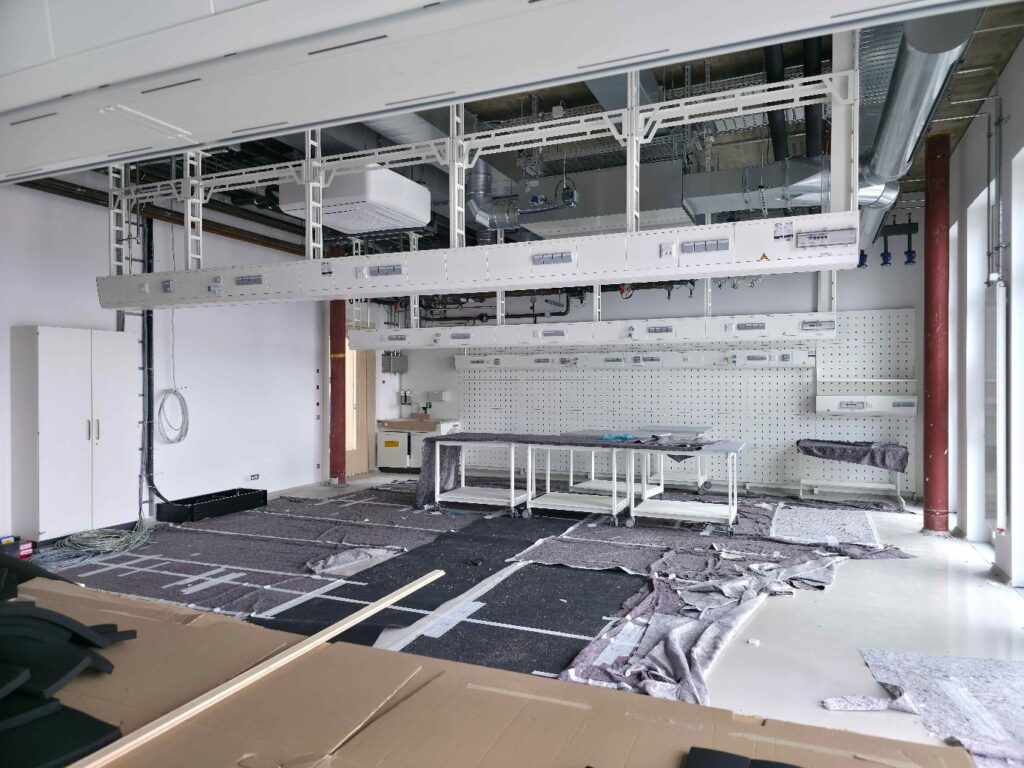
How does a heat pump actually work? What happens inside a fuel cell? And how can hydrogen be produced from electricity and later converted back into electrical energy? In the new teaching lab at the Institute for Hydrogen and Energy Technology at Hof University of Applied Sciences (iwe), students will in the future be able to not only answer such questions theoretically but also investigate them directly using real technical systems. The lab is scheduled to open in early 2027.
Energy and plant systems are becoming increasingly complex. For students, this means it is not enough to understand individual technical components and physical relationships in isolation. It is also crucial to recognize how different systems are interconnected and how they behave under various operating conditions.
“We want to give our students the opportunity to directly link theoretical knowledge to real-world technical applications. When you commission a system yourself, record measurement data, and then analyze it, you gain a different understanding of the interrelationships than if you were to learn about them exclusively from a textbook.”
Prof. Dr. Tobias Plessing, Institute and Project Director at iwe
The lab is therefore not intended merely to demonstrate finished results. Students are encouraged to conduct their own experiments: They plan experiments, carry them out, record measurements, and then analyze the data. In doing so, they work with real components, sensors, and measuring instruments.
When Physics Becomes Visible and Measurable
An important goal is to make physical processes directly tangible. For example, students can investigate how a system behaves under different operating conditions—that is, both during stable continuous operation and during changes and transitions.
Among other things, this involves determining where energy is lost and how efficiently a system operates. Put simply, “efficiency” describes the proportion of the energy input that can actually be used for the intended purpose.
“We want students not only to see that, for example, a system works, but to understand why it functions one way under certain conditions and differently under others. This also includes the limitations of a system and the question of which metrics are actually necessary for a well-founded evaluation.”
Matthias Kreutzer, Research Assistant at iwe
In addition to technical knowledge, the program aims to impart skills that are important for future careers: experimental design, systematic work, data analysis, and teamwork. At the same time, working on the systems encourages thinking across disciplinary boundaries—for example, between heating, cooling, electrical, and hydrogen technologies.
From Pellet Boilers to Hydrogen Fuel Cells
The planned laboratory equipment covers an unusually broad spectrum of modern energy technology. On one side of the room, the focus will be on thermal energy generation and combined heat and power: Among other things, the plan includes a pellet boiler with flameless combustion technology and condensing boiler technology, which will be provided by ÖkoFEN Heiztechnik GmbH on a permanent loan basis. This area will be supplemented by a Stirling engine. This is a heat engine that derives its energy not from combustion within the engine itself, but from an externally supplied heat source. A combined heat and power (CHP) plant is also planned. It generates both electrical energy and usable heat simultaneously. The plant is designed to be capable of operating on both natural gas and hydrogen, thereby allowing for a comparison of different forms of energy supply.
Hydrogen as an Energy Storage Medium
Another focus of the laboratory will be hydrogen technology. The plan is to create a complete cycle that demonstrates the various steps involved in hydrogen utilization. An electrolyzer will use electrical energy to split water into hydrogen and oxygen. The hydrogen produced can then be stored in a tank. A fuel cell performs the reverse process: it converts the chemical energy of the hydrogen back into electrical energy.
The system will be supplemented by a battery storage unit and a central control system. Processes can be monitored and controlled via a user interface. Real-time data will also be available for courses and experiments.
This creates a system that allows the concept of the energy transition to be understood on a small scale: electricity is generated, stored, converted into hydrogen, and later used again to generate electricity. “When it comes to hydrogen in particular, it’s important not just to talk about the technology, but to be able to experience and measure the individual process steps yourself,” says Plessing.
Heat Pumps and Refrigeration Technology
On the other side of the lab, the focus is on refrigeration and air conditioning technology. Among other things, the lab will feature a modern air-to-water heat pump with innovative control systems, also on permanent loan from ÖkoFEN Heiztechnik GmbH. A heat pump extracts energy from a heat source—such as outdoor air—and uses electricity to raise it to a temperature suitable for heating buildings. Students will not only learn how the system works but will also be able to investigate how different operating conditions affect its efficiency. A highly efficient and modular ground-water heat pump is intended to complement the facility. In this system, heat from the ground is transported to the heat pump via a fluid circuit. The equipment is supported by Qvantum Energietechnik GmbH.
In addition, a dedicated experimental setup for a refrigeration cycle and a so-called “transparent refrigeration cycle” are planned. The latter makes the processes within a refrigeration system visible. Students will be able to use it, for example, to observe how the refrigerant changes during various process steps. An adsorption chiller is also planned. It uses heat to generate cold, thereby opening up further access to alternative refrigeration methods.
Mobile Experiments—Even Outdoors
Not all experiments will take place exclusively in the laboratory. In the central area, mobile experimental setups are planned that can also be used on the rooftop terrace if needed. These include, among other things, a setup for solar thermal energy—that is, the use of solar energy to generate heat—as well as a photovoltaic system with electricity storage. In addition, there will be process thermostats and a system for measuring and characterizing zeolites. Zeolites are porous materials that, among other things, can absorb and release water, making them of interest for heating and cooling applications, for example. Of particular technical interest is the planned connection between the laboratory and the rooftop terrace: Through appropriate conduit and cable penetrations, test setups installed there can be linked to the systems in the laboratory.
A Laboratory for Study, Research, and Continuing Education
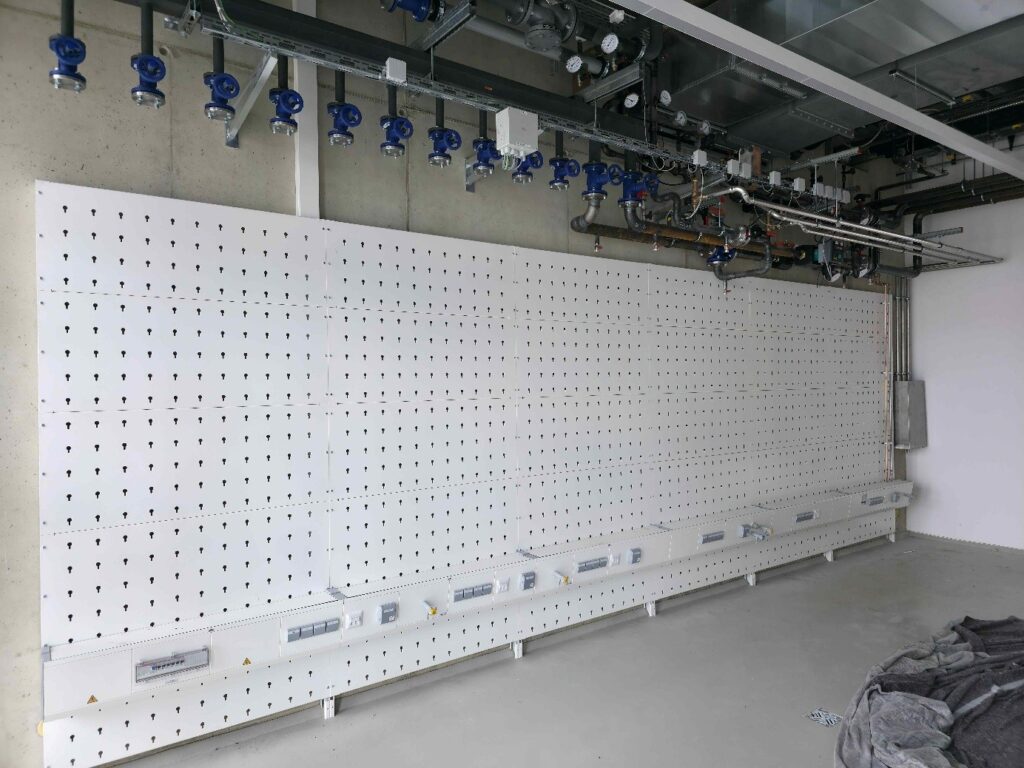
The facility’s design provides the necessary infrastructure for these purposes. This includes air conditioning, a supply of utilities such as natural gas and fresh water, as well as connections for heating and cooling water. The latter are also to be connected to the university’s large-scale thermal storage system.
The teaching lab is not intended to be available exclusively to students at Hof University of Applied Sciences. There are also explicit plans for it to be used by external interested parties—for example, for specialized events, training sessions, and continuing education programs. In this way, the lab could become a place where knowledge from the university and professional practice converge. The target audience includes, among others, professionals in the plumbing, heating, and air conditioning (SHK) trades, refrigeration and air conditioning technicians, energy consultants, and chimney sweeps.
Experience Technology—and Inspire New Students
In addition to teaching, the project therefore pursues another goal: to make technical degree programs more tangible for prospective students. Those who don’t just see a heat pump, an electrolyzer, or a fuel cell on a presentation slide, but can record measurements and examine technical processes themselves, gain direct insight into their future field of work. “A modern lab can demonstrate just how diverse technical degree programs are,” says Kreuzer. “You combine physics and mathematics with concrete technical problems while working hands-on, digitally, and as part of a team.” The institute continues to seek support from industry and the professional community for the planned experimental setups. Companies that would like to provide components or support the project in other ways are expressly welcome.