

Find the right degree program in just a few clicks: Choosing the right degree program is one of the most important decisions young people make in their lives. To help prospective students find their way, Hof University developed its innovative “Degree Program Generator” in March 2025—a tool that has garnered nationwide attention. Instead of wading through countless degree programs, prospective students can quickly find suitable options based on their personal interests and subject areas—and in some cases, they can even customize their degree program. In this interview, Prof. Dr.-Ing. Marco Linß, the project’s initiator, explains how the idea came about, what experiences the university has gained since its launch, and how the program generator contributes to academic guidance.
Professor Linß, how did the idea to develop a degree program generator for Hof University of Applied Sciences come about?
“The very first Study Program Generator was created for our Engineering program, where students can select and combine different fields of study and specializations. When it went live on our university’s website, we quickly received requests from the deans, who wanted something similar for their programs and asked me if I could imagine developing something like that. I recklessly agreed to it! (laughs).
But of course, I was also convinced by the idea myself and believed that a tool like this would help our university move forward.”
What challenges did you and your team have to overcome during the design and technical implementation of the generator?
“At the beginning, I was actually working alone on the university side; Prof. Dr. Sven Rill joined the team for the later versions. The biggest challenge was clearly bringing the many special cases defined by the study and examination regulations into a single system—after all, everything had to fit into one data structure. And in the end, even people without IT knowledge have to be able to understand it, especially when it comes to maintaining the underlying data. Getting everyone internally involved on board along the way was also an enormous communication challenge, since everyone had their own specific ideas about the design or functionality of the generator.”
That sounds very complicated…
“I certainly won’t argue with that. I know several people at large universities who have been working on a solution like this for 10 years and haven’t gotten very far—for a wide variety of reasons.”
It’s great that it worked out for us! What criteria and mechanisms are used to guide prospective students to the degree programs that are right for them?
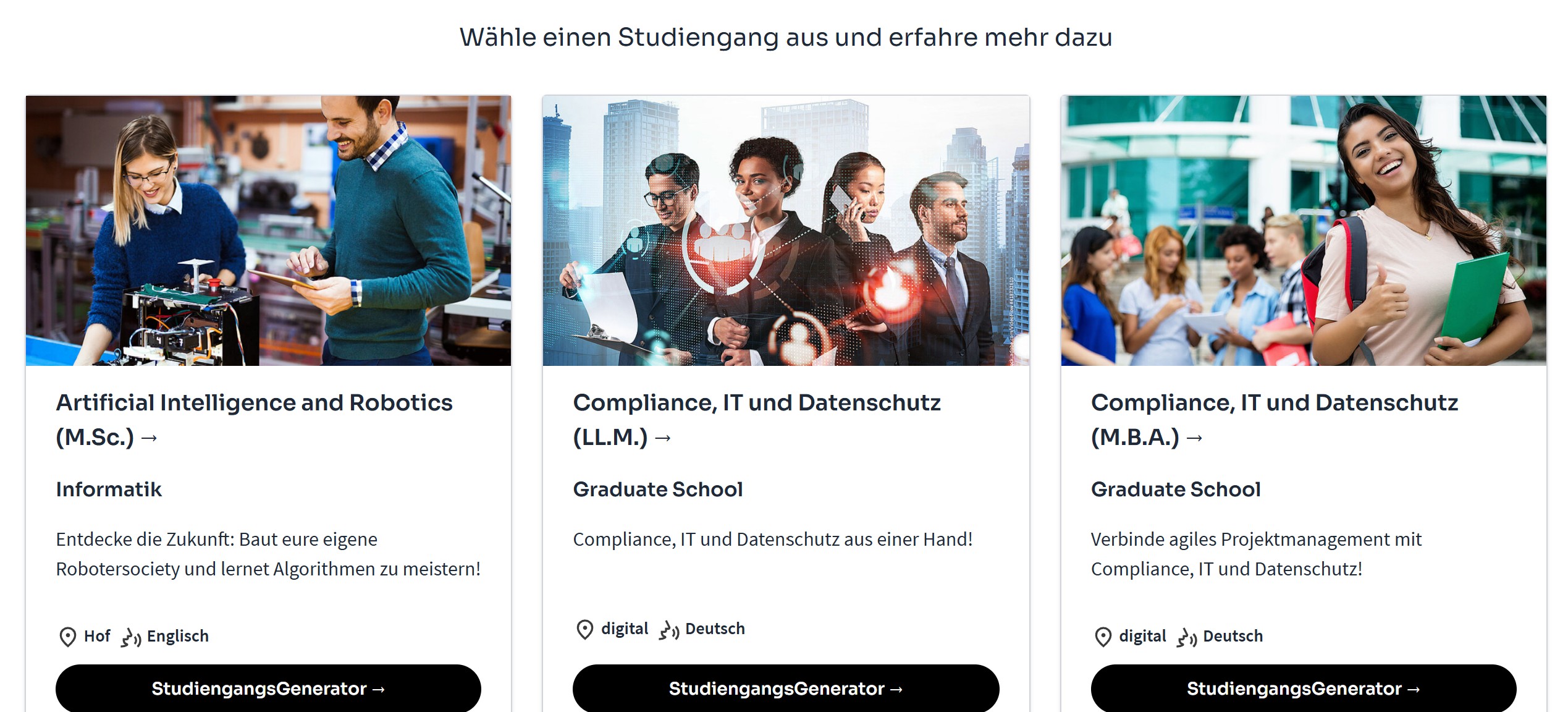
“We offer various entry options. In particular, you can select subject areas that interest you. Many young people have a topic in mind that they want to explore—but they often don’t know what’s involved. So this is a guided tour through our programs.”
What feedback have you received from prospective students, current students, or academic advisors since the generator was launched?
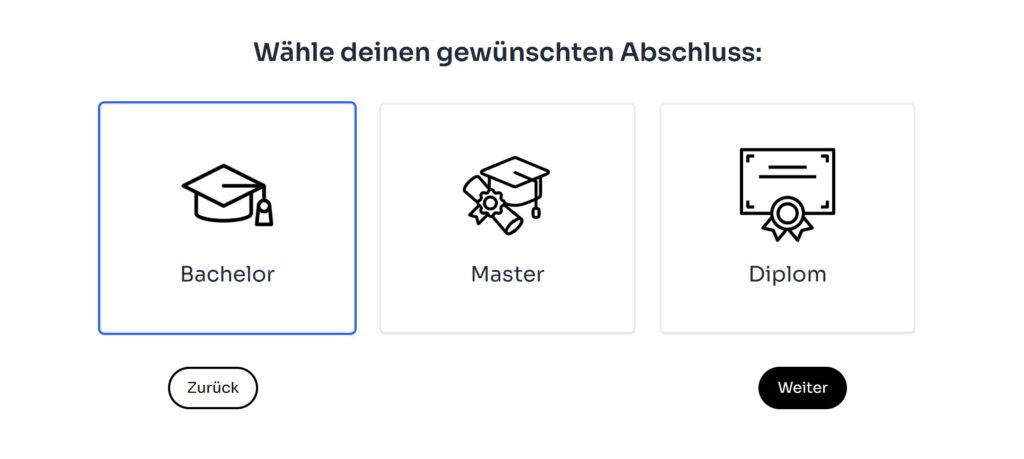
“I, along with many of my colleagues, have noticed time and again that when dealing with complex issues, this type of visualization—as offered by the generator—is a major advantage. It lets you playfully build your future. And, of course, you can quickly undo any choices you make in the generator. In the field of academic advising, this also makes it easier to steer conversations because the suggested solutions are transparent and easy to follow. Our message is always: We don’t just recommend something; we talk with you and take you seriously. By the way, we also had students help develop the tool as part of a project, and their ideas have been—and will continue to be—incorporated into the program generator’s presentations.”
Were there any insights or surprises when using the tool that you hadn’t originally anticipated?
“Actually, plenty of positive surprises and developments! For example, the tool is now integrated into the accreditation of degree programs. This is very effective because it provides a single, shared data source based on the various study and examination regulations. In addition, we can now generate our module handbooks directly within the Generator. This means that, behind the scenes, only a single source needs to be maintained, which simplifies the work overall.”
How has the use of the Study Program Generator evolved since its introduction? Can you identify any trends or changes in user behavior?
“We’re actually still in the early stages of tracking usage. But one trend is already clear: People no longer look at the study and examination regulations; instead, they much prefer to use the visual representation in the generator.”

What specific benefits does the Study Program Generator offer Hof University—for example, in the areas of academic advising, recruiting, or visibility?
“It has a major impact at trade shows and in schools, where it can be demonstrated very effectively. This is, of course, a completely different experience than, for example, presenting dry slides. The Degree Program Generator is very well received by this target audience. Prospective students can put together their own degree program entirely on their own and implement it intuitively.”
Looking back at the project today, what further developments or new features would you like to implement in the Degree Program Generator in the future?
“We’re constantly gathering feedback, of course. My colleagues Prof. Rill and Prof. Günther had their students work on this as part of a module and asked, for example, what the generator’s interface should ideally look like. We’re still getting lots of new ideas, and the project is growing. Of course, the question of an app also comes up, and we’re discussing to what extent we’d like to integrate our AI in the future.”
Thank you very much for the interview!