

The EUROPA-FORUM at Hof University of Applied Sciences celebrated its tenth anniversary on October 16 – and with it a decade of intensive commitment to dialog, values and partnership between Europe and its neighbors. This year, the focus was on cooperation between Europe and the Middle East.

University President Jürgen Lehmann opened the event with an appeal to preserve the European culture of values as a unifying foundation. “Hof University of Applied Sciences sees itself as a stronghold of values,” said Lehmann. “We should always reflect on what treasures we have in which countries.” For the next edition of the forum, he hoped that after the topic of the Middle East, “culture of values” would become the main theme.
Father of the EUROPA FORUM
European law expert Professor Dr. Peter Schäfer, who has been shaping the event for a decade, was honored as the “father of the Europa Forum”. “Ten years of commitment – very altruistic,” said Lehmann about Schäfer, “his dedication has made him ‘Mister Europe’.” Schäfer himself thanked all his supporters and companions and made a link to the geopolitical situation: “Europe must not only think economically, but must actively defend its values.”
In his analysis of the MENA region (Middle East and North Africa), Schäfer noted that political instability, climate change and democratic deficits remain key challenges. At the same time, there is potential:
The question is whether we are resolute enough in defending our values – or whether we are sometimes too tolerant.”
Prof. Dr. Peter Schäfer
The Middle East as a place of opportunity for companies
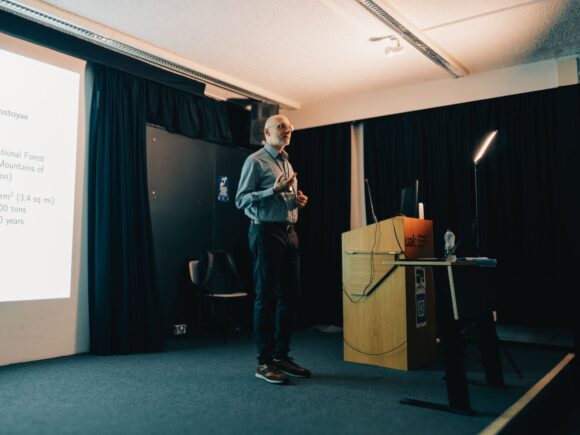
Middle East expert Alexander Klaß, who has lived in Syria, Iran, Tunisia and Turkey for many years, emphasized the importance of trust in international business. “First comes the tea, then the trust – and only then the business,” he quoted Helene Rang, Managing Director of the German-Middle East association NUMOV. Klaß, who works for the association, spoke about opportunities for German companies in the region – from medical technology in Qatar to infrastructure projects in Iraq, he had many examples in his luggage. Countries such as Oman are also underestimated but stable partners. “There is no reason not to engage economically with the region,” he said.

Common interests sought
Sonja Fontaine from the Gesellschaft für Internationale Zusammenarbeit (GIZ) emphasized that development cooperation has changed in the direction of genuine partnership. “We are looking for overlapping interests in government negotiations,” said Fontaine. Issues such as climate, energy supply and migration are increasingly shaping the work. She also lived in the Arab region for many years. It is particularly important to her “that markets are fair” – and that local experts are involved. 80 percent of GIZ employees come from the partner countries themselves.

Good experiences in Tunisia
A strong regional signal came from Upper Franconia: Timo Piwonski, founder of the automotive supplier Iprotex, reported on his experiences in Tunisia, where his company has been operating for many years. “We are textile manufacturers – we can’t do anything else,” he said with a wink. Tunisia offers moderate wage costs and tax advantages, which is particularly interesting for medium-sized companies.

Vice President Prof. Valentin Plenk from Hof University of Applied Sciences added how open and cooperative he had found the people there to be. On a 3200 kilometer research trip, he found “41 starting points for joint projects”. With the European Horizon project ‘Phoenix’, the university is currently working on using digital information systems to reduce crop failures in Africa in the future.

The anniversary event with well over a hundred guests was moderated by Matthias Will from the Frankenpost newspaper. At the end of the forum, after extensive discussion, there was the realization that Europe is not only a market, but also a community of values – and that dialogue with neighbouring regions means more than just economic cooperation. Europe can only preserve its values if it shares them – with respect, dialog and economic cooperation. Or, as Klaß put it:
‘The raised index finger is always difficult. We should break down borders – and build relationships.”
Alexander Klaß, Middle East expert