

The most important thing about college is—obviously—studying and learning. But here at campuls.digital, we believe that leisure time during your studies shouldn’t be neglected either. Especially on days off, students should explore the region around the university, because “Hof—at the top of Bavaria” and its surrounding area have some great destinations to offer. We’ve put together our top 11 best excursion tips for you.
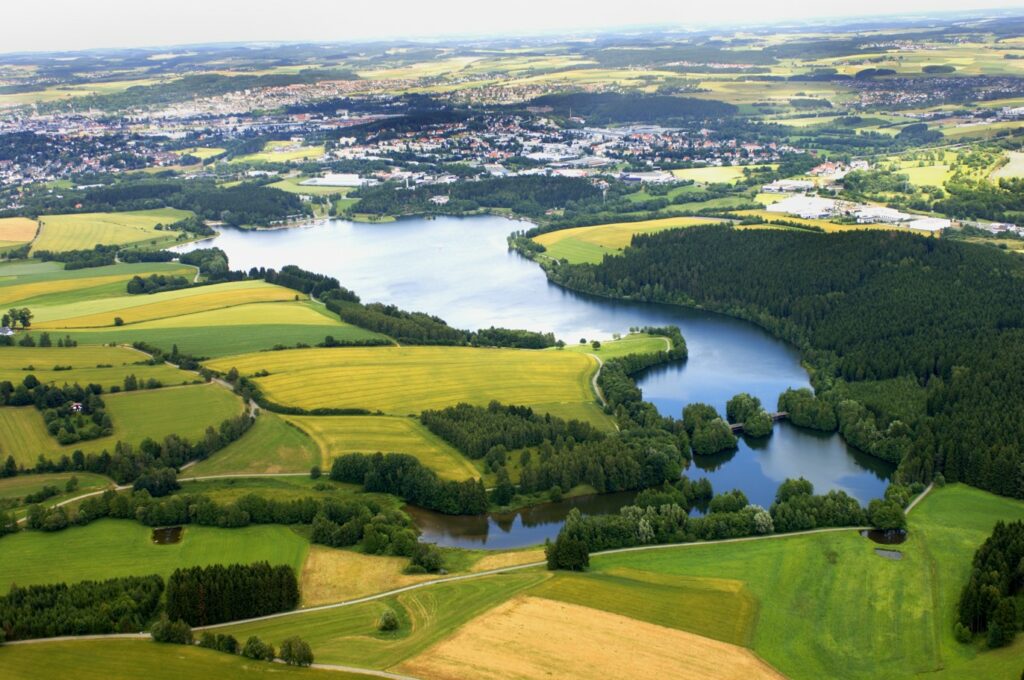
Students looking to explore Hof definitely don’t need a car, as exotic animals, green oases, ruins, parks, and lakes can all be explored on foot or by bike.
1. Untreusee Recreational Area
A visit to Untreusee is an absolute must for students at Hof University of Applied Sciences. The reservoir was built between 1976 and 1979 as a recreational and leisure facility. It gets its rather unique name from the Untreubach stream that feeds it.
The lake, which is two kilometers long and 700 meters wide, covers an area of approximately 600,000 square meters. Water sports enthusiasts take note: almost all sports, except motorboating, are permitted on Lake Untreusee, so bring out your surf gear or pedal boat. Speaking of boats—once a year (provided the water level cooperates), the Dragon Boat Regatta takes place on Lake Untreusee in Hof. A dragon boat can accommodate 20 paddlers, a drummer, and a steersman. Two boats, each manned by amateur teams, then compete against one another. It’s a spectacle for everyone involved and the spectators alike—an experience not to be missed. By the way: The next dragon boat regatta is on July 4, 2026; registration is still open.
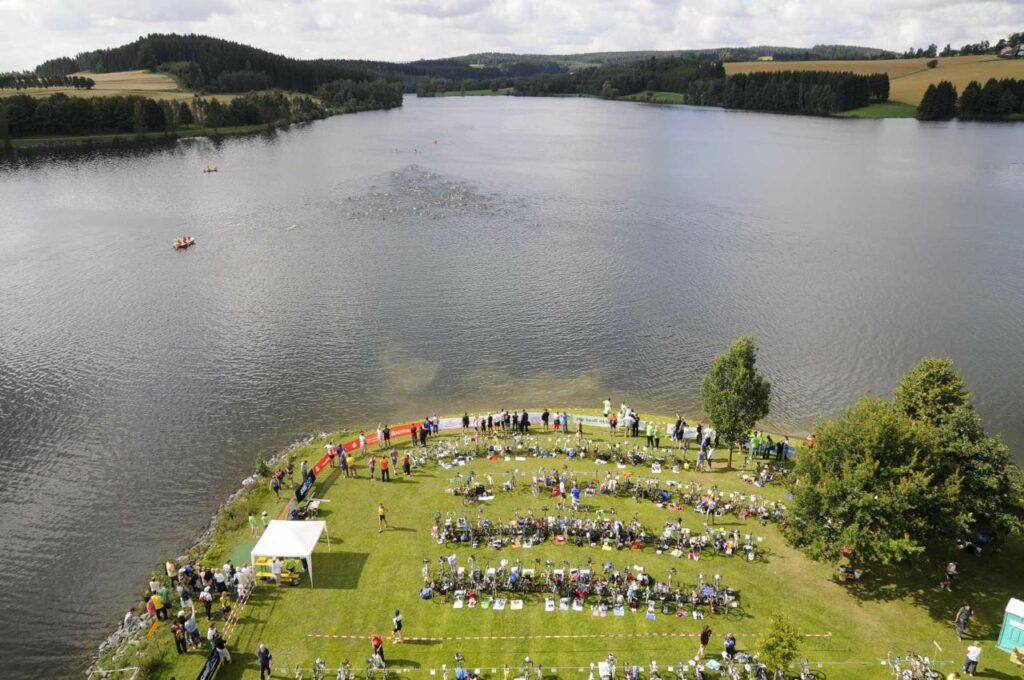
Jogging enthusiasts will also find plenty to enjoy at Untreusee, and best of all—you can even choose the length of your route. Those looking to really push themselves can opt for the 6.6-kilometer course. Those who prefer a more relaxed pace can take the shorter route around the lake, which is “only” 4.4 kilometers.
Those who prefer to aim high can do so at the climbing park, located right by the lake. Hidden in the treetops across 9 different courses at heights of up to 11 meters, both beginners and advanced climbers can put their climbing skills to the test or overcome their fear of heights.
Right next to the climbing park are a basketball court and a beach volleyball court, as well as barbecue areas for relaxed evenings grilling with fellow students.
Germany’s only walkable maze stretches for 2.6 kilometers, and all mini-golf and boules fans will find plenty to enjoy at Untreusee.
For more information about the lake and the activities there, check out the following links:
www.untreusee-hof.de
www.kletterpark-untreusee.de
www.labyrinth-untreusee.de
www.drachenboot-untreusee.de
2. Theresienstein Public Park
Just a few minutes’ walk from the city center (and also from the university) lies Hof’s green oasis—Theresienstein Public Park. A historic park laid out in 1819, it has already been voted Germany’s most beautiful park once. Surrounded by trees, flowers, and paths, it also offers a wonderful view of the city of Hof.
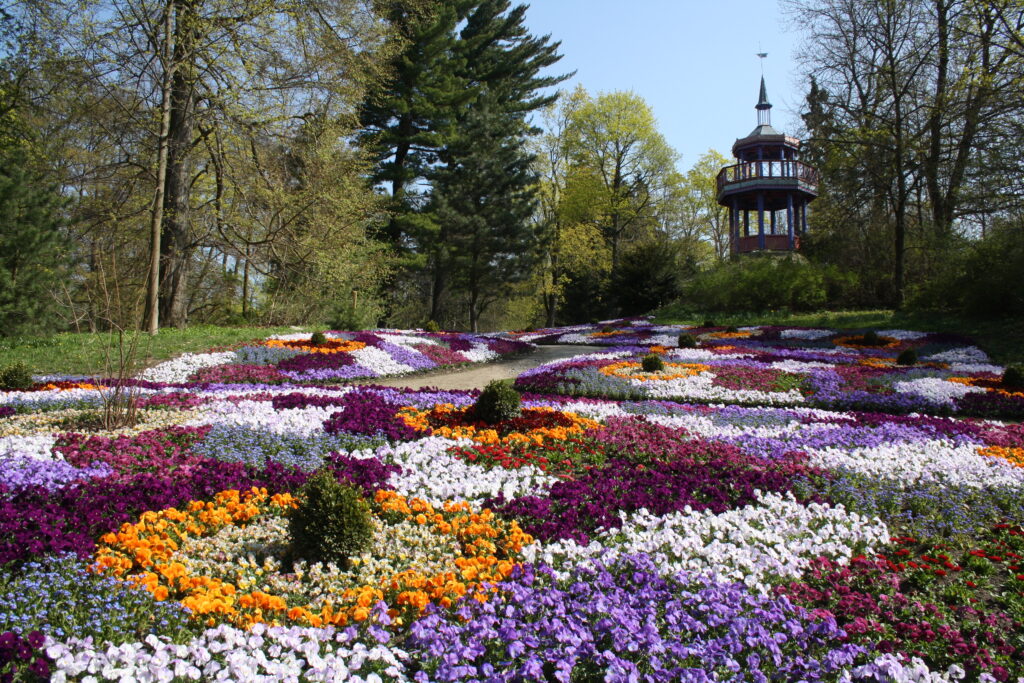
The approximately 70-hectare recreational area invites you to unwind during long walks and take a break from your daily studies, at least for a little while. But that’s not all—concerts are also held from time to time in the small bandstand.
If you explore Theresienstein a bit more closely, you’ll come across the Labyrinth Ruins inside—an artificial ruin featuring a 16-meter-high tower from which, on a clear day, you can even see as far as Saxony and Thuringia.
For more information about Theresienstein Hof, visit: https://www.hof.de/hof/hof_deu/theresienstein.html
3. Botanical Garden
Right next to Theresienstein Public Park is the Botanical Garden. Established in 1929 for natural science classes at Hof schools, the 1.88-hectare site now offers visitors a sea of flowers, blooms, and colors, as well as a fragrant medicinal herb garden, a large water feature, and a fairy-tale fountain.
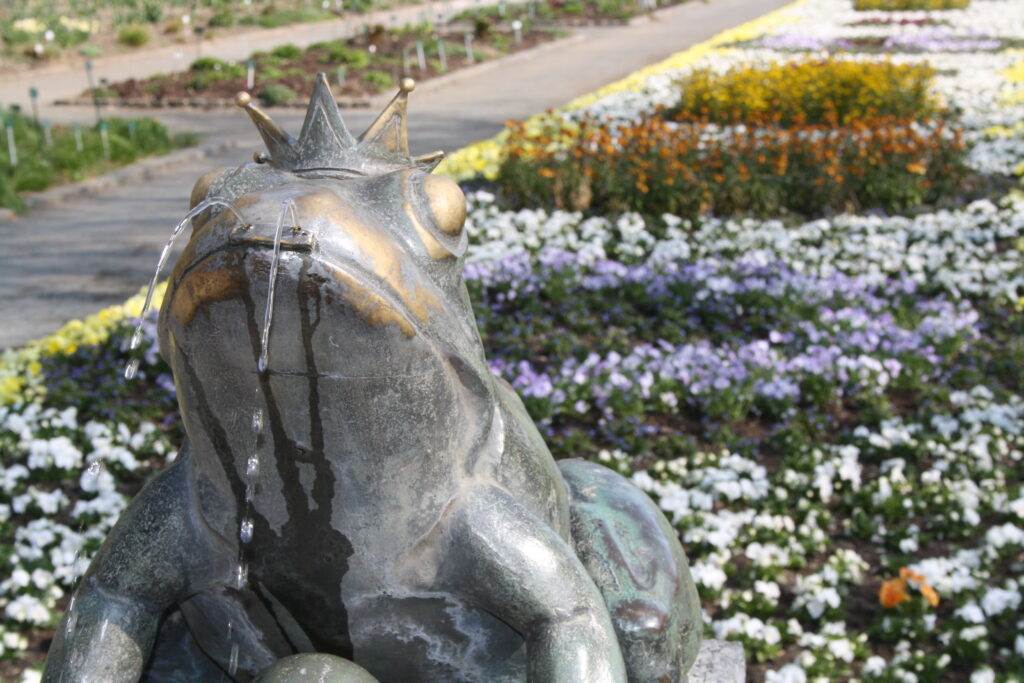
In 1994, the Botanical Garden was even part of the Bavarian State Garden Show. A little tip from us: be sure to stop by in June—around 100 different varieties of roses bloom simultaneously in the Rosarium. An absolute feast for the eyes and nose.
Learn more about the Hof Botanical Garden here: https://www.botanischer-garten-hof.de/
4. Hof Zoo
When you’re in the Botanical Garden, you often hear unusual animal sounds that you might not immediately recognize. Here’s the explanation: Right next door is Upper Franconia’s only zoo. In the Savanna House—unique in Europe—you can experience many other savanna animals alongside flying birds and free-roaming white-rumped marmosets.
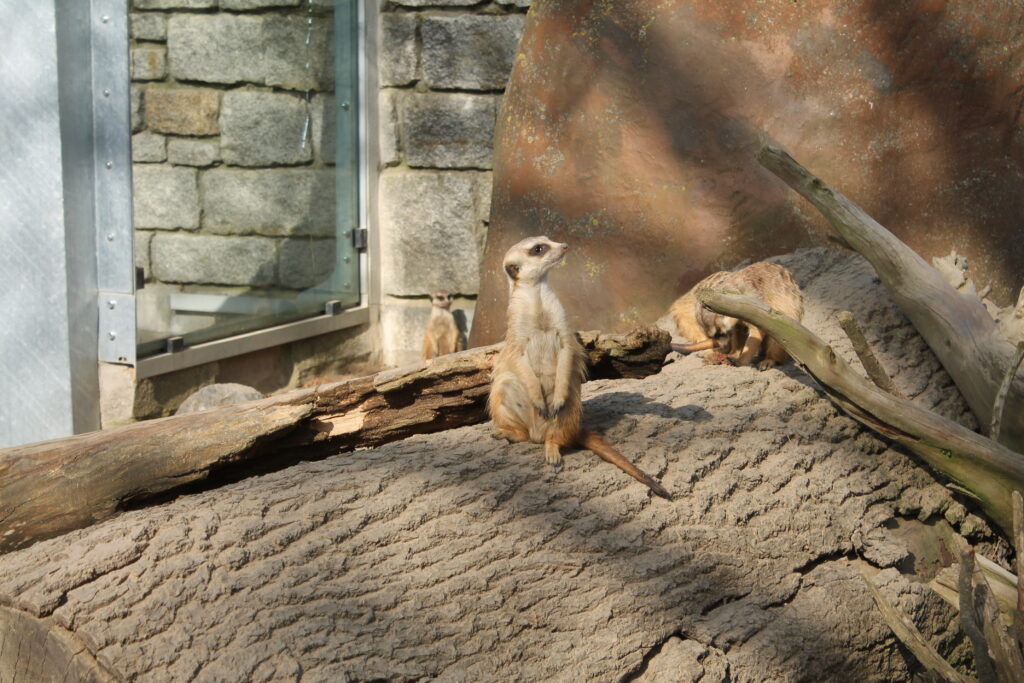
Brush-tailed rock wallabies can be admired in the nocturnal animal house, and Australian birds show off their best side in the walk-through free-flight enclosure. Meerkats like Timon and porcupines like Pumbaa are also waiting for a visit at Hof Zoo, as are raccoons, prairie dogs, and coatis. But we don’t want to give too much away.
All information about Hof Zoo is available here: https://www.zoo-hof.de/
Day trip ideas around Hof
But it’s not just the city—the area around Hof also has great places to visit. Along the Saale Cycle Route, for example, there are a few stops you definitely shouldn’t miss.
5. Tauperlitzer Lake
Grab your bike and let’s go. The Saaleradweg takes you to the first stop, Quellitzsee, also known as Tauperlitzer See. Although the 640-meter-long and 70-meter-wide lake is quite a bit smaller than Untreusee, it still serves its purpose—it’s the perfect place to unwind and let your mind wander. You can do this on the large sunbathing lawn around the lake or on the numerous seating areas. Those who want to get active can use the fitness equipment permanently installed on the lawn, and water sports enthusiasts won’t be disappointed either, because whether it’s canoeing or stand-up paddling—pretty much anything is possible here.
6. Fernwehpark Oberkotzau
From Tauperlitz, the Saale Cycle Route continues to Oberkotzau—and here, there’s a touch of Hollywood in the air. Heino, Peter Maffay, Henry Maske, Sarah Connor, and even the Dalai Lama—they’ve all left their mark forever at the Fernwehpark Oberkotzau.
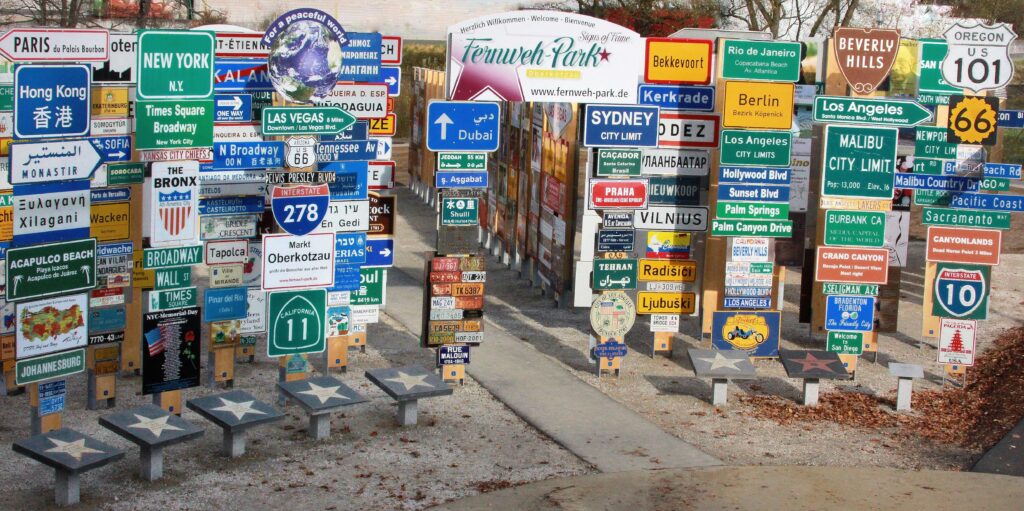
The sign park is a collection of place name signs from all over the world, intended as a peace project that brings people together. In various themed areas, you can view place name signs, club signs, and celebrity signs, as well as the funniest and most curious place names in the world—and we can promise you, there are some real gems among them.
Here’s all the info on Fernwehpark Oberkotzau: www.fernweh-park.de
7. Förmitzspeicher
From Oberkotzau, along the Saale floodplains, the Saale Cycle Route leads via Schwarzenbach an der Saale directly to the Förmitz Dam, also known locally as the Förmitzspeicher. The reservoir, artificially created in 1978, is 1.2 km long and just as wide, making it even larger than Lake Untreusee. Especially in the evening hours, you can often admire wonderful sunsets here on the 4.5-kilometer circular trail around the reservoir.
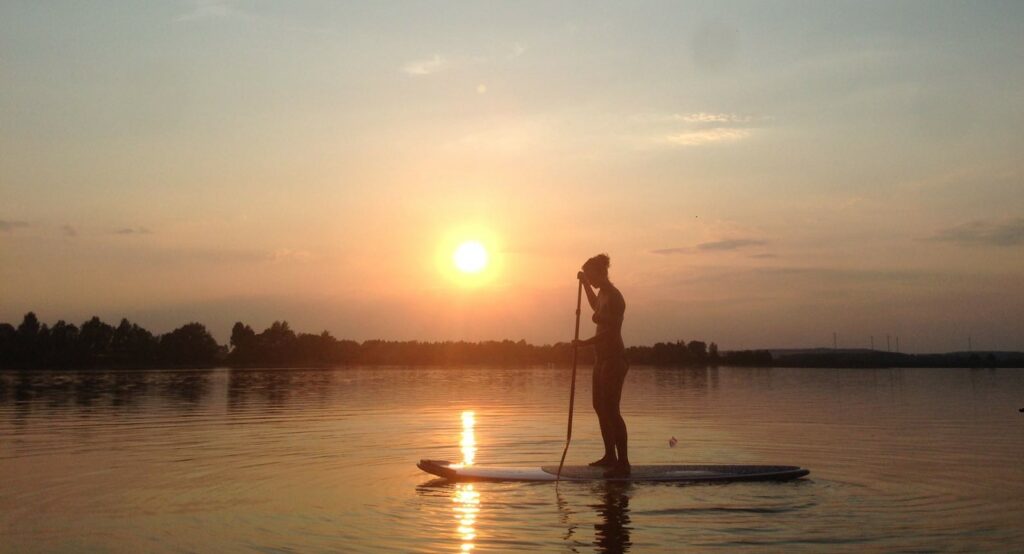
The swimming season runs from May 15 to September 15. During this time, virtually all water sports are permitted. Here’s another little tip from us: Stop by when it’s windy and stormy—surfers and kiters show off their best tricks there. But especially in summer, the Förmitzspeicher is an absolute dream for swimming, relaxing on the huge sunbathing lawn, or for cheerful barbecue evenings at the fire pit.
Find out more about the Förmitzspeicher here: www.förmitzspeicher.de
8. Rohrbühl Münchberg
If you’re still up for it, hop back on your bike and ride directly from the Förmitzspeicher to the campus in Münchberg. Even though Münchberg, with around 11,000 residents, is significantly smaller than Hof, it has a great charm and, on top of that, a 23-meter-high tower, the Rohrbühl. Built as a memorial to those who fell in World War I, visitors today, after climbing the 121 steps, can enjoy a magnificent view of the Fichtelgebirge and the Franconian Forest from the large terrace. On a clear day, you can even see the Elster and Ore Mountains.
You can read all about the town of Münchberg and the Rohrbühl here: www.muenchberg.de
9. Fichtelgebirge and Franconian Forest
Whether hiking, biking, or winter sports, all of this is possible in the Fichtelgebirge and the Franconian Forest. Both low mountain ranges are located in the immediate vicinity of Hof. A visit is a must for all nature lovers.
Fichtelgebirge: The Fichtelgebirge covers an area of approximately 1,600 square kilometers. The majority of this low mountain range extends across the districts of Hof, Wunsiedel, and Bayreuth. The highest and most famous peaks are the Schneeberg (1,051 m), the Ochsenkopf (1,024 m), the Kösseine (939 m), the Großer Waldstein (877 m), and the Großer Kornberg (827 m). Each mountain captivates visitors with its beautiful hiking trails and bike routes. Worth a visit are Germany’s only surviving bear trap on the Großer Waldstein, the Alpine Coaster at the Ochsenkopf, or the recently reopened Kornberghaus.
Find more excursion tips in the Fichtelgebirge here: www.fichtelgebirge.bayern
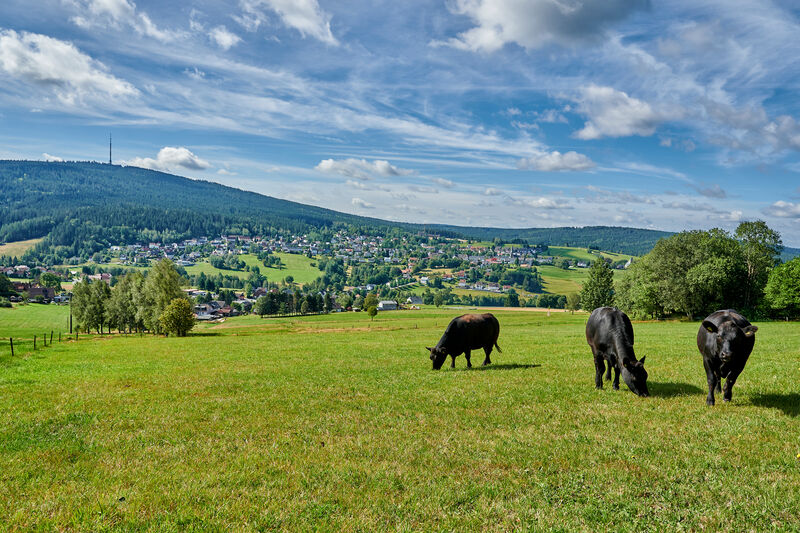
Frankenwald: Stretchingbetween the cities of Kronach, Kulmbach, and Hof, the Frankenwald region covers an area of about 1,200 square kilometers, extending from the Main River along the Green Belt—the former East-West German border. At 795 meters, the Döbraberg near Schwarzenbach am Wald is the highest peak in the Frankenwald. However, the Frankenwald region is particularly famous for its rafting. A trip down the wild Rodach River in Wallenfels in the Kronach district is an experience you won’t soon forget.
You can find even more interesting facts about the Franconian Forest here: www.frankenwald-tourismus.de
10. Rosenberg Fortress, Kronach
Nestled in the heart of the Franconian Forest Nature Park lies the town of Kronach, which has plenty to offer students on the local campus. One of the most beautiful and largest fortress complexes in Europe, for example—Rosenberg Fortress, whose origins date back to the 13th century. There’s a great route for biking or walking around the fortress. You can also recharge your batteries on the “Fitness Trail for the Soul,” located in the heart of the fortress woods. If you’d like to explore Rosenberg Fortress in more detail, you can join one of the guided tours. Best of all: students get discounts, of course.
You can find all the information about the city of Kronach and Rosenberg Fortress here: www.kronach.de
11. Selb: City of Porcelain and Ice Hockey
With around 16,000 residents, the city of Selb is slightly smaller than Kronach. While it may not be a metropolis, it is definitely world-renowned. That’s because Selb, located in the Wunsiedel district, is the capital of “white gold”—porcelain. Even today, 60 percent of European porcelain is produced in Selb. At the Porzellanikon, Europe’s largest porcelain museum, you can immerse yourself in the history and production of porcelain and learn more about the lives of the porcelain makers.

If you’re more interested in sports, Selb is the perfect place for you, because a visit to the Wolfsbau is an absolute must for all ice hockey fans. Even though the Selb Wolves are currently on their summer break, the NETZSCH Arena will be buzzing again by October at the latest when the wolf pack takes the ice.
For more information about Selb and the activities there, check out the following links:
www.selb.de
www.porzellanikon.org
www.verselb.de
Of course, there is much more to see and discover around Hof University. We at Campuls.digital will continue to introduce you to more destinations in the future—so stay tuned . We’ve already got a few leisure tips for you here.
Cover photo: Annette Köhler;