

Using innovative technology, a consortium in Upper Franconia—in collaboration with Hof University of Applied Sciences—aims to convert biogas directly into liquid hydrocarbons at agricultural operations. A demonstration plant in Hof-Pirk is intended to show how regionally produced biogas can become a building block for sustainable fuels in the future. To this end, the project partners are seeking additional companies, technology partners, and investors.
What if agricultural biogas plants could not only generate electricity and heat in the future, but also produce liquid feedstocks for diesel and jet fuel? This is precisely the vision being pursued by the Upper Franconian collaborative project BioFiTrop. Five partners from the fields of science, technology, agriculture, and aviation aim to develop a technology that converts biogas into liquid hydrocarbons directly at the point of production. What makes this project unique is that the required technology is designed to be modular and can be connected directly to existing biogas plants in compact containers.
A New Perspective for Biogas Plants
The starting point is promising: Biogas plants continuously produce a gas mixture consisting mainly of methane and carbon dioxide. Until now, this gas has been used primarily to generate electricity and heat. For many operators, however, the question of how to operate their plants economically in the long term is becoming increasingly pressing. This is because, after 20 years, the legally guaranteed EEG feed-in tariff ends for many plants.
BioFiTrop aims to develop an additional utilization pathway for this purpose. Instead of using the biogas exclusively for energy, it will be converted into liquid hydrocarbons using a chemical process. These can then serve as feedstocks for the production of fuels. This could be particularly interesting for the aviation industry, as aircraft will continue to rely on liquid fuels with high energy density in the long term. “We want to demonstrate that a product of national significance can be produced from a regionally available raw material. The goal is not to replace existing biogas plants, but to open up an additional economic use for them,” is the guiding principle of the project.
“Milk Tour for Fuel” — Many Small Plants, Shared Value Creation
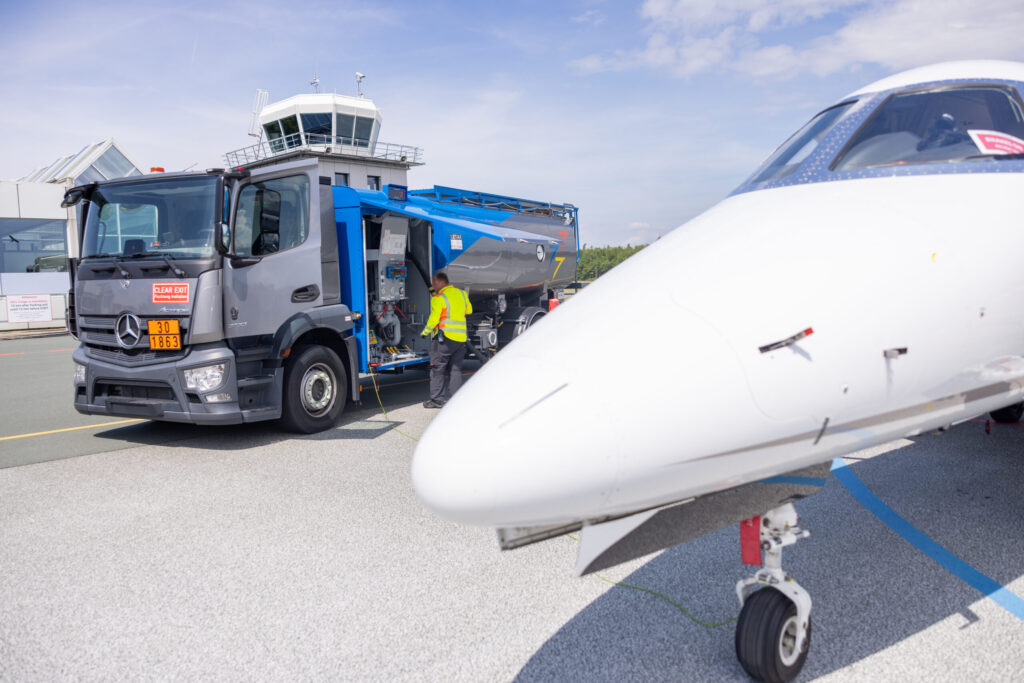
The long-term vision extends far beyond a single demonstration plant. The project partners refer to a sort of “milk run for fuel.” The principle is simple: just as milk is currently collected from numerous farms and transported to dairies, tanker trucks could in the future pick up the liquid fuel precursors from various biogas plants in a region. The conversion of biogas would thus take place decentrally, directly on the farms. Further processing into finished fuels such as gasoline, diesel, or kerosene, on the other hand, could take place in existing refineries. There, the liquid precursors would be appropriately treated and refined.
In this way, the concept combines the advantages of regional production with existing industrial infrastructure. An additional market could emerge for agricultural operations, while refineries would gain access to bio-based raw materials. At the same time, value creation would remain more firmly within the regions.
Innovative Chemistry as the Technical Core
Technologically, BioFiTrop relies on the so-called Fischer-Tropsch synthesis: In this process, hydrogen and carbon monoxide—collectively referred to as synthesis gas—are converted into liquid hydrocarbons under specific conditions. For the project, the biogas is first processed and converted into this synthesis gas in a so-called steam reformer. The actual conversion then takes place in a specially designed synthesis reactor. This process produces liquid hydrocarbons of varying chain lengths, as well as paraffins and waxes.
Heat management poses a particular technical challenge. The Fischer-Tropsch synthesis generates significant reaction heat, which must be dissipated in a controlled manner and integrated as efficiently as possible into the overall process. At the same time, the varying properties of the biogas, product quality requirements, and the conditions for maximizing automation must be taken into account.
The concept therefore calls for a compact, containerized plant consisting of several coordinated modules. Its size is designed to be flexibly adapted to the available biogas throughput. This makes the technology fundamentally attractive for small and medium-sized biogas plants as well.
From Model Calculations to the Demonstration Plant in Hof-Pirk
A planned demonstration plant at the Langheinrich farm in Hof-Pirk is intended to show how the process works under real-world conditions. Both a biogas plant and Hof-Plauen Airport—a potential future user of the products generated—are located in the immediate vicinity. The planned demonstration plant is initially designed to process a partial stream of approximately 20 cubic meters of biogas per hour. Based on a throughput of 100 cubic meters of biogas per hour, current model calculations estimate a yield of approximately 15 kilograms of liquid hydrocarbons and an additional 5.7 kilograms of paraffins and waxes per hour. However, the actual quantities achievable during demonstration operations have yet to be verified.
The plan is to proceed in several steps. First, the reactors and the overall process will be modeled on a computer and verified in laboratory tests. Next, the technical facility is scheduled to be constructed in Bayreuth. There, tests will be conducted on, among other things, leak tightness, temperature control, automation, and safety. Only then will the plant be transported to Hof-Pirk and connected to the existing biogas plant. The goal is to increase the technology’s maturity level from the current stage of laboratory and model studies (TRL 3) to demonstration operation under real-world conditions (TRL 6 to 7).
Five Partners Pool Their Expertise in Upper Franconia
Behind BioFiTrop is a consortium of five partners who contribute diverse expertise across the entire value chain. Their geographical proximity is a particular advantage: All participants are located in Upper Franconia and can reach one another within about an hour’s drive. Hof University of Applied Sciences, through its Institute for Hydrogen and Energy Technology (iwe), is responsible for coordinating and integrating the entire project. Prof. Dr.-Ing. Tobias Plessing and M.Eng. Anton Sack are working on, among other things, modeling the entire process chain, thermal management, and the integration and permitting of the facility at the intended site.
The University of Bayreuth, through its Department of Chemical Engineering and the Center for Energy Technology, is contributing the scientific expertise required for the development of the synthesis reactor. Prof. Dr.-Ing. Andreas Jess and Dr.-Ing. Christoph Kern are responsible for the modeling and experimental investigation of the innovative synthesis process.
InVerTec e.V., the Institute for Innovative Process Engineering in Bayreuth, is responsible for the technical implementation and plant construction. Dipl.-Ing. Achim Schmidt-Rodenkirchen focuses in particular on container engineering, automation, remote monitoring, and the safety concept. The Langheinrich farm in Hof-Pirk is providing the biogas plant and thus the planned demonstration site. Christian Langheinrich also contributes the perspective of a practical plant operator. Flughafen Hof-Plauen GmbH & Co. KG complements the consortium by providing the user perspective from the aviation sector. Managing Director Ralf Kaußler contributes insights into the requirements for sustainable aviation fuels and supports the transfer of research results toward potential future applications.
Additional Partners Sought
BioFiTrop is still in the early stages of a development that could, in the long term, extend far beyond the actual research project. To ensure that the technological concept becomes an economically viable application, the project partners are therefore actively seeking additional collaborators. Of particular interest are companies in the plant and mechanical engineering sectors that can contribute their expertise in design, manufacturing, and automation. Manufacturers and suppliers of catalysts, components, and measurement systems, as well as companies in the energy and fuel industries, are also of interest. Refinery operators and players in the aviation industry could play important roles, particularly in the evaluation and subsequent acceptance of the products generated.
Furthermore, the call for partners is explicitly directed at biogas plant operators interested in new ways to utilize their biogas. Investors and financial backers who wish to participate in the financing and further development of the project are also welcome.

The forms of potential collaboration are deliberately left open. Possible options include technical cooperation and the provision of components, as well as financial participation or the joint development of specific applications.
“We do not view BioFiTrop as an isolated research project, but rather as a starting point for a new value chain. To achieve this, we need companies that can contribute their experience and technologies, operators who want to explore new ways of using biogas, and investors who recognize the economic potential and want to help us develop it further.
Prof. Dr.-Ing. Tobias Plessing
Expressions of Interest for Future Collaborations
Interested companies, institutions, and individuals can contact Anton Sack (Hof University of Applied Sciences, Institute for Hydrogen and Energy Technology) by email at anton.sack.2@hof-university.de or by phone at 09281 / 409-4598.
Further information about the project and opportunities for participation is available at https://bio-fitrop.info/.