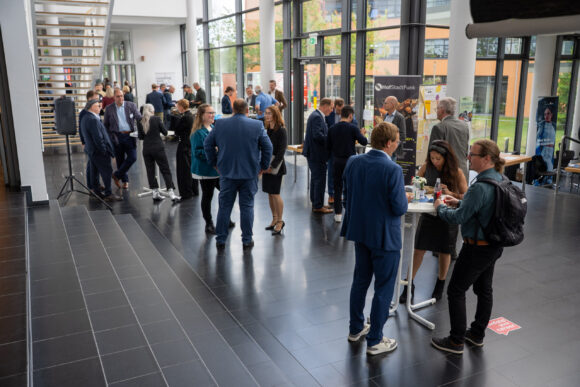


The sixth Institute Colloquium took place in the Audimax of Hof University of Applied Sciences on 12 November 2025 – this year organized by the Institute for Economic and Organizational Research (iwo) under the direction of Prof. Dr. Jens Kirchner. Once again, all six of the university’s research institutes were invited to submit their projects in advance. “An impressive 62 research projects were documented – a really great achievement,” said Prof. Kirchner at the opening ceremony.

The aim of the annual event is to network researchers, promote interdisciplinarity and bring more transparency to research work.
It quickly became clear that the breadth of current research at Hof University of Applied Sciences is impressive. The Institute for Information Systems (iisys) submitted 7 projects, the Institute for Circular Economy of Bio:Polymers (ibp) 17, the Institute for Materials Science (ifm) 10, the Institute for Sustainable Water Systems (inwa) 17, the Institute for Hydrogen and Energy Technology (iwe) 9 and the still young Institute for Economic and Organizational Research (iwo) still 2 projects.
In the end, it was once again the projects that had won the voting that were presented.
Junior research group EISBiR
(Dr. Alexander Rudnick – ibp)
The EISBiR junior research group presented current results on the weathering and long-term stability of bioplastics. The aim of the research work is to develop sustainable polymer compounds that remain durable even under real environmental conditions – without fossil additives. The presentation focused on the two biopolymers polylactide (PLA) and polybutylene succinate (PBS), which were mixed with various biogenic additives such as wine pomace, coffee husks or wood flour. Over a period of several months, a total of more than 100 film samples were weathered under outdoor conditions and then tested for thermal, oxidative and mechanical stability.


The results show that Biogenic additives can significantly improve oxidative stability without seriously impairing material strength. PBS compounds in particular proved to be robust and stable over the long term, while PLA benefited in terms of antioxidant properties but was more susceptible to mechanical ageing. With this work, the group is contributing to the overarching EISBiR goal of combining radiation modification, fiber reinforcement and biogenic additives to develop bio-based materials with high ageing resistance – an important prerequisite for the use of sustainable plastics in technical applications.
“RuPert – Round needles and braiding as a novel process combination for permeation pipes in water management“
(Karline Großer and Felix Hackner standing in for Thomas Hühnel – ifm)
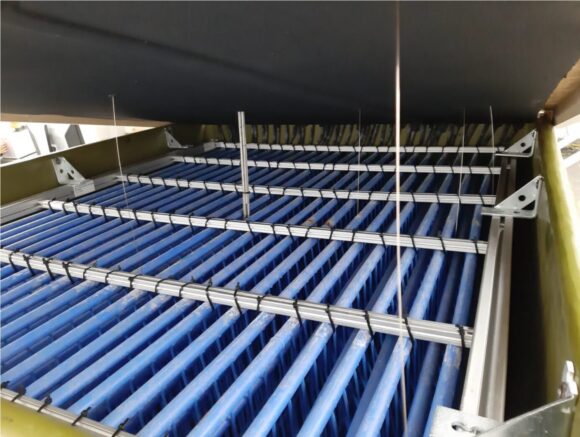
The project is dedicated to the topic of sustainable and nature-oriented solutions in water management as a response to extreme weather events in climate change. The focus is on the development of textile pipe systems instead of conventional PVC or PE drainage systems. The combination of circular needling and radial braiding techniques – for example with wool or willow wood threads – is intended to help store and distribute rainfall. The aim is to retain, transport and redirect water in a targeted manner, for example to reduce the risk of flooding. Initial tests have shown that circular needling and radial braiding can be combined well.


“Energy self-sufficient university – the innovative energy concept at the Hof campus“
(Oliver Stark – iwe)
In light of the climate protection obligations of Bavarian universities and the goal of climate neutrality, the Institute for Hydrogen and Energy Technology (iwe) is developing a forward-looking energy concept for the Hof campus.
The focus is on maximum self-sufficiency and optimized energy efficiency. To this end, comprehensive photovoltaic potential analyses were carried out for buildings, open spaces and parking areas. Based on this data, various scenarios for the future energy supply were developed and evaluated with the help of system simulations. These simulations show the effects of different strategies – from a “business-as-usual” approach to a strong focus on self-sufficiency – and enable targeted optimization to achieve the climate targets.
Another milestone is the introduction of an energy management system in 2026, which will build on the energy data from 2025. This will see Campus Hof take a decisive step towards energy self-sufficiency and sustainability.
“Tech meets Brand – How new technologies are changing branding for best agers” (Lorenz Neupert & Lukas Brosch – iwo)
This project focuses on the ageing target group (50 ). It examines how technological innovations – such as conversational agents, i.e. AI-based text and voice assistants or augmented reality (AR) – can change the brand image and brand loyalty of best agers. The older target group is particularly interesting: it has high purchasing power and enormous growth rates in the industrialized countries of the USA, Japan and Europe due to demographic change. New technologies are intended to deliver personalized offers, speed up problem solving, improve the brand experience and reduce the return rate through AR experiences (“try before buy”). Surveys are used to investigate how brand loyalty and brand image change as a result and how high technology acceptance actually is.


“EMILIA – Choice of transportation”
(Stephanie Kitzing – iisys)
The “EMILIA” project investigates, among other things, which means of transport are used in rural areas in the Hof region and why – with the aim of developing digital tools to simulate and optimize intermodal transport systems. A digital twin is being created in order to understand whether and to what extent the choice of means of transport depends on factors such as source-destination connection, travel time, number of transfers and alternative means of transport. Reliable data from traffic counts, floating car data, Hofer Landbus data and timetable data are used for this purpose. The aim is to achieve more efficient and sustainable mobility in rural areas – in cooperation with the city and district of Hof.


“Strategies for ecological peacebuilding based on the concept of the feminine” (Paola Acosta Carrascal – inwa)
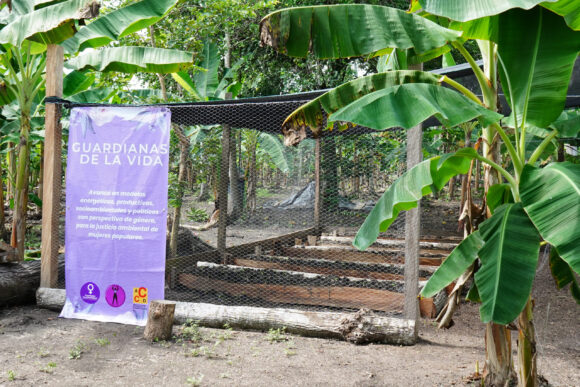
This is an international research project in the Colombian region of Magdalena Medio in cooperation with the women’s organization Organización Femenina Popular (OFP). The aim is to identify, analyze and promote peace strategies developed by local women in environmental and water resource management. The focus is on the “feminine” as a concept for peace, environmental and resource use in conflict areas. The region is characterized by high biodiversity and decades of conflict; the university contributes its expertise in the field of water management – in particular the concept of the “sponge region”. Methodologically, participatory field research, workshops and hybrid-based formats are used to combine local knowledge with scientific analysis. The aim is to make women’s perspectives in environmental and peace processes visible – both nationally and internationally.