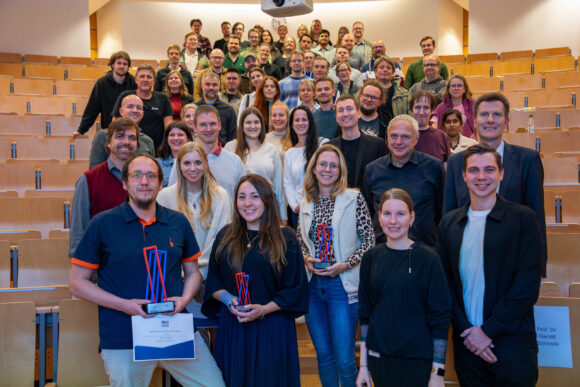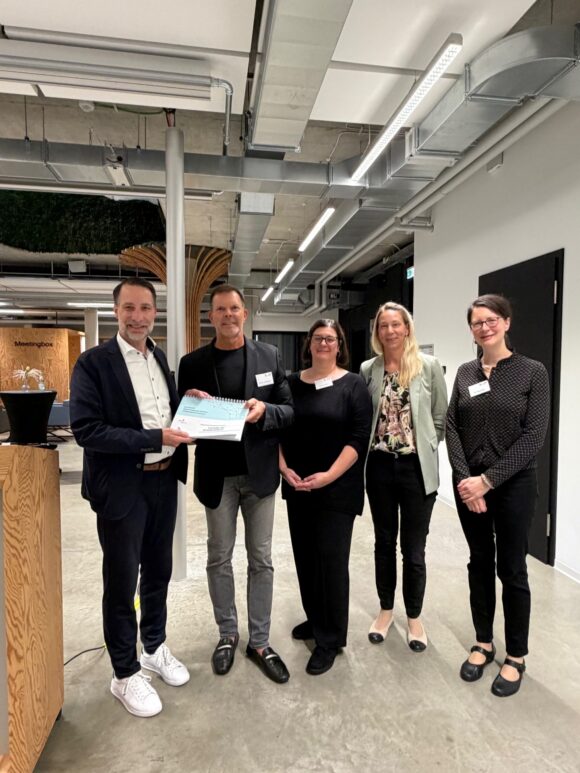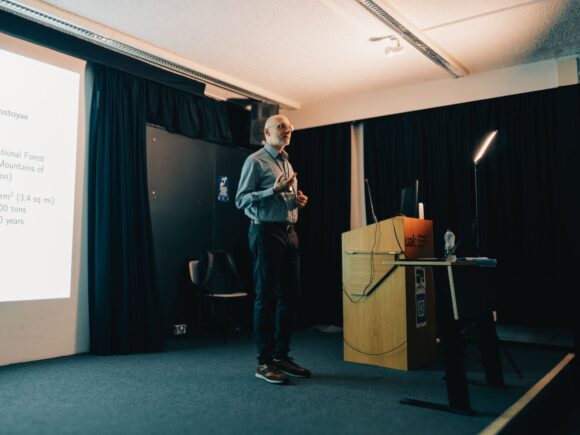


The 2026 Southwest Thuringia Startup Idea Competition demonstrated just how diverse and innovative the region’s startup scene is. This year, 32 business ideas were presented—ranging from creative and social concepts to technological solutions in the fields of machine learning, artificial intelligence, and innovative applications. In the category for technical startup ideas, the team from OnSpectra, a spin-off from Hof University of Applied Sciences, secured second place.
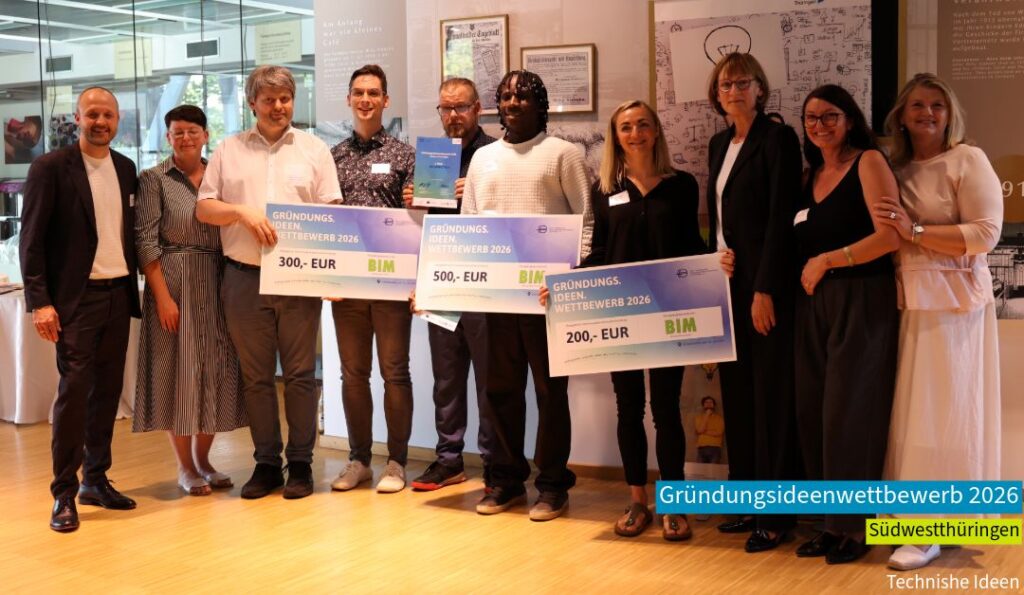
We spoke with Prof. Dr. Tobias Schnabel about his spin-off, the idea behind it, and the next steps.
Congratulations on your award! What exactly is OnSpectra—and what problem are you aiming to solve with your startup?
“Thank you very much! We were delighted to receive the award, and it confirms that our idea is striking a chord. With OnSpectra, we’re developing intelligent optical sensor systems for environmental monitoring. Our goal is to be able to monitor water resources and other environmental compartments continuously, cost-effectively, and with high spatial resolution.”
That sounds very interesting. What’s new about it?
“Today, many environmental analyses are still conducted through time-consuming laboratory tests or using very expensive measurement technology, meaning that measurements often take place only sporadically or at long intervals. At the same time, our water resources are under increasing pressure from climate change, extreme weather events, and new pollutants such as PFAS. This is exactly where we come in: We want to make high-quality environmental information available where it’s actually needed—right on site, in real time, and at a fraction of the previous costs.”
How did this idea come about?
“The idea emerged from our many years of research at Hof University of Applied Sciences. For many years, we’ve been working on optical environmental analysis, photonics, and smart sensor systems. It became increasingly clear that there’s a significant gap between the measurement methods available in scientific research and the solutions actually used in practice. Together, we therefore began developing our own sensors, electronics, and evaluation algorithms. The Kick-Start Initiative at Hof University was a great help in developing the first prototype.”
What makes your technological solution unique, and what specific added value does it offer potential customers or users?
“Our approach combines several innovations. We develop optical sensor systems entirely in-house that, for the first time, combine UV-VIS spectroscopy and fluorescence spectroscopy, which are then analyzed using modern AI methods. This allows us to extract significantly more information from complex spectral data than with traditional single-parameter sensors.
Our goal is to derive numerous water quality parameters simultaneously from a single measurement and to detect changes at an early stage. The sensors operate continuously, require virtually no maintenance, and can be powered autonomously as well as connected via wireless networks such as LoRa.
For operators of water treatment plants, wastewater treatment plants, municipalities, or environmental agencies, this means, above all, greater transparency and faster decision-making. Problems can be detected before they become critical. At the same time, operating costs can be reduced, resources can be used more efficiently, and environmental impacts can be identified early on.”
Who actually does what on the team?
“Our diverse backgrounds complement each other perfectly. I bring the scientific perspective to the table and have been working for many years in the fields of optical environmental measurement technology, sensor development, and water analysis. My focus is on developing new measurement methods and scientifically validating our technologies.

Daniel Martschoke is specifically responsible for the technical development of our hardware and software platforms, the implementation of electronic systems through to near-production prototypes, and the design
Sven Fießer contributes his experience, particularly in the areas of business development and strategic growth, and ensures that innovative research is transformed into marketable products. He also serves as the company’s CEO.
It is precisely this combination of science, engineering, and entrepreneurship that defines our team.”
How important was participating in the startup idea competition for OnSpectra—regardless of the award?
“The competition was valuable to us in several ways. Of course, we’re very happy about second place. But almost more important was the opportunity to have our business idea critically scrutinized and to receive valuable feedback from the jury, experts, and other startup teams.
In addition, events like this lead to numerous connections with companies, investors, funding organizations, and potential collaboration partners.”
What are the next concrete steps? Where is the journey headed in the coming months?
“In the coming months, we’d like to further develop our first products and prototypes and test them under real-world conditions together with pilot customers. At the same time, we’re working to secure additional funding and development partners to bring the technology to market faster. In the long term, we aim to establish OnSpectra as an innovative provider of smart environmental measurement technology. Our vision is comprehensive, digital environmental monitoring that enables us to protect water resources more efficiently and better understand environmental processes. We see great potential here—not only in Germany but also internationally.”
What advice would you give to other students, researchers, or university staff who are also considering starting a spin-off company?
“I would recommend that everyone at least seriously consider taking this step. Every year, universities generate many excellent ideas with great potential. Often, however, people lack the courage or the knowledge of how to turn a research idea into a marketable product or even a company. It’s important to engage with potential users early on and understand their needs. Good technology alone isn’t enough—it has to solve a specific problem. Equally crucial is a team whose members bring diverse skills to the table and complement one another.
It’s a major advantage to take advantage of the support services offered by the university. TheStartup Lab at Hof University of Applied Sciences supports aspiring entrepreneurs from the initial idea all the way through to founding a company. We received valuable support there. Furthermore, the Makerspace in Hof is a great facility for developing initial prototypes.
My most important piece of advice is therefore: Just get started. Don’t wait until everything is perfect; instead, develop initial prototypes, gather feedback, and take advantage of the available support services. Universities today offer excellent conditions for turning a good idea into a successful startup.”