

Wood in cars doesn’t just look high-quality—in the future, it could also respond to touch. Through the WoodTouch research and development project, academia and industry are collaborating to develop innovative user interfaces that combine sustainable materials with modern electronics. The project officially kicked off at a kickoff meeting at Hof University of Applied Sciences.

The collaborative project, in which the Institute for Circular Economy of Bio:Polymers (ibp) at Hof University of Applied Sciences is participating as a scientific partner, aims to develop a multifunctional, translucent real-wood interior module with integrated printed sensors on a bio-based substrate. The focus is on sustainability, modern manufacturing technologies, and ease of use.
When Wood Becomes a Touchscreen
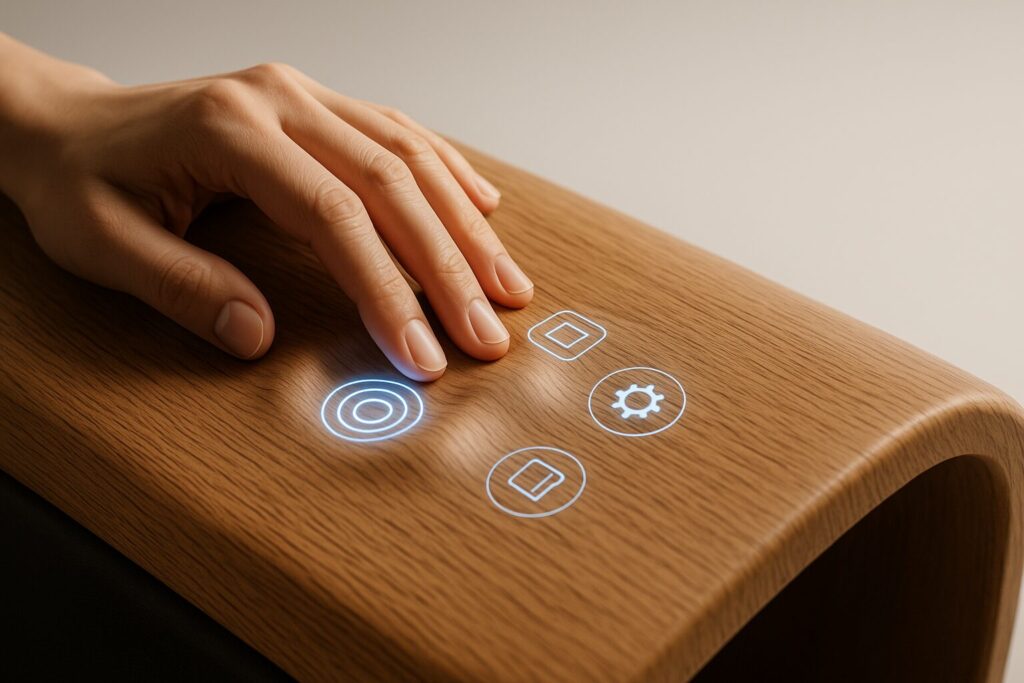
At the heart of the project is a novel capacitive control panel. Sensors detect touch in a manner similar to that of a smartphone—but hidden beneath a high-quality real wood surface. This surface is backlit, so that control elements become visible only when needed. The sensors used for this are not mounted as traditional electronic components but are printed directly onto the material using conductive inks. Experts refer to this as printed sensor technology. Combined with so-called translucent veneers—particularly thin layers of wood that allow light to shine through—this creates a natural wood surface that also serves as a modern control panel.
A Sustainable Alternative to Existing Technologies
One innovative approach involves further developing existing MID (Molded Interconnected Devices) technologies. These are plastic components into which electronic circuit paths and functions are directly integrated. While such components have so far consisted primarily of petroleum-based plastics such as polycarbonate (PC) or polybutylene terephthalate (PBT), WoodTouch relies on a combination of real wood, biopolymers—that is, plastics made from renewable raw materials—and conductive pastes with material compositions that conserve resources as much as possible.
“Our project addresses several challenges facing the automotive industry at once: the responsible use of resources, improved recyclability, the integration of additional functions, and high-quality design.”
Project Manager Annette Wimmer-Schuster
Many Partners—Pooled Expertise
At the kickoff meeting at Hof University of Applied Sciences, the project partners first coordinated their common goals, work packages, and areas of collaboration. An initial focus is the development of a requirements profile for a door trim panel featuring backlit, sensor-based controls and additional functions. Based on this, a demonstrator is to be created—a functional prototype that combines technical, ergonomic, design, and vehicle-specific requirements.
The project consortium was established with the support of neowistra GmbH, which also provides administrative support. Participants include KOMOS GmbH, Freudenberg Industrie Siebdruck GmbH, Fritz Kohl GmbH & Co. KG, Hof University of Applied Sciences with its Institute for Bio-Circular Economy, and Eberswalde University for Sustainable Development with its Research Group on the Chemistry and Physics of Wood. Motherson DRSC Deutschland GmbH is supporting the project as an associated partner.
Role of Hof University of Applied Sciences
Hof University of Applied Sciences contributes its many years of expertise in the fields of bio-based plastics, circular economy, and sustainable manufacturing technologies. Among other things, the team at the Institute for Circular Economy of Bio:Polymers is developing the circuit layouts for the printed control elements and investigating the mechanical and electrical properties of the new material combinations. In this way, the university is making a significant contribution to the scientific foundation of the overall system.
The other project partners are also taking on specialized tasks: Eberswalde University of Applied Sciences is researching deformable and translucent wood-based materials; Freudenberg is developing suitable screen-printing processes and conductive inks; and Fritz Kohl is contributing its expertise in high-quality veneers and real wood surfaces and developing suitable processing and finishing techniques. KOMOS focuses on tooling and injection molding technologies. As an automotive supplier, Motherson contributes requirements from industrial applications as well as those relevant to future mass production.
More Than Just Touch: The Car of the Future Appeals to Multiple Senses
WoodTouch is not limited to traditional touch-based operation. The project is also researching haptic feedback—that is, specifically designed tactile reactions and changes to the user interface. In addition, there are so-called morphing surfaces, whose shape can be deliberately altered, as well as controllable warm and cold effects. This creates a multisensory control concept in which visual, haptic, and functional elements are intelligently combined. The goal: a user interface that not only looks high-quality but also functions intuitively and sustainably.
Research for Tomorrow’s Mobility
With the successful launch of the project, the foundation has been laid for close interdisciplinary collaboration. WoodTouch demonstrates how natural materials and modern electronics can merge to create entirely new user interface concepts. The technologies developed open up new possibilities for innovative vehicle interiors—and could also be applied in other areas of use in the future.
“WoodTouch offers the opportunity to rethink wood as a sustainable and high-quality material. We want to combine functionality, design, and sustainability.”
Bernd Trinkwalter, Motherson DRSC Deutschland GmbH.
The project is funded by the Federal Ministry for Economic Affairs and Energy (BMWE) as part of the Central Innovation Program for SMEs (ZIM).