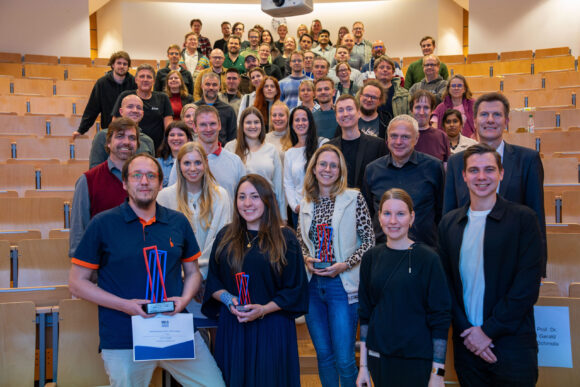


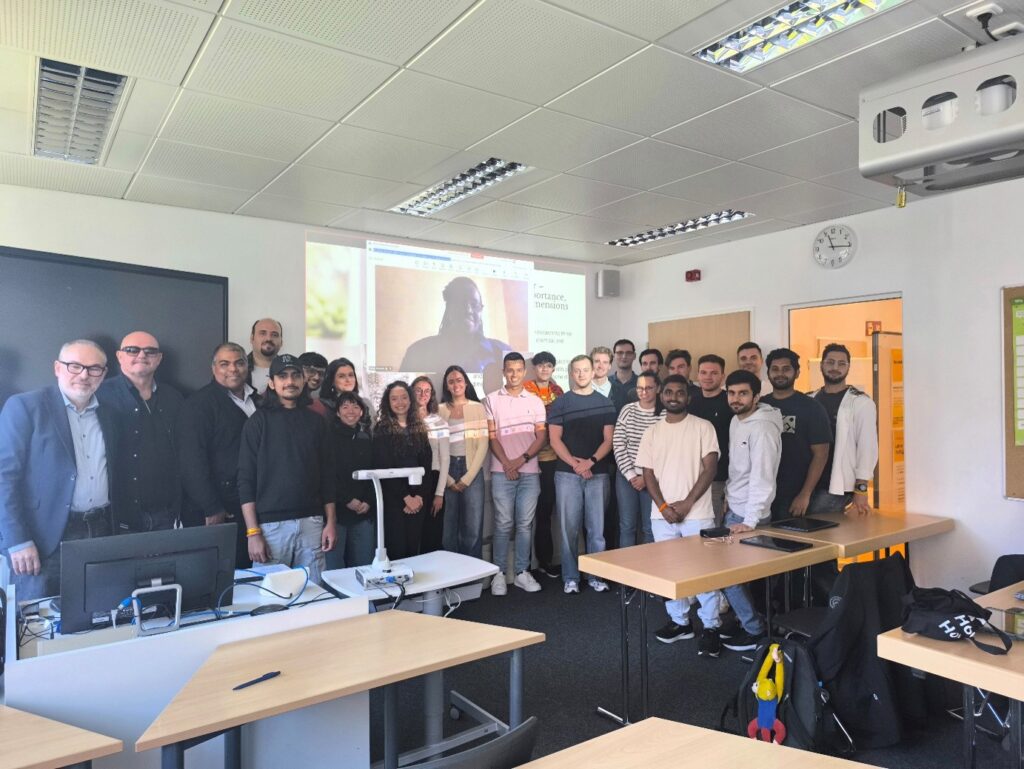
For 22 students, the new winter semester got off to an unusual start. To the students’ surprise, two guests from the Water Is Right Foundation were in attendance for the English-language course “Water, Climate, and Society” in the master’s program in Sustainable Water Management and Engineering. One was Rolf Stahlhofen, singer and co-founder of the well-known German band Söhne Mannheims and founder of the Water Is Right Foundation. The other was Karun Körnig, chairman of the foundation’s board of directors.
It was no coincidence that both were in Hof. Hof holds special significance for Rolf Stahlhofen:
“This is where it all began with the WaterIsRight Foundation, when Thomas Willuweit from Söll got me interested in the topic of water.”
Rolf Stahlhofen
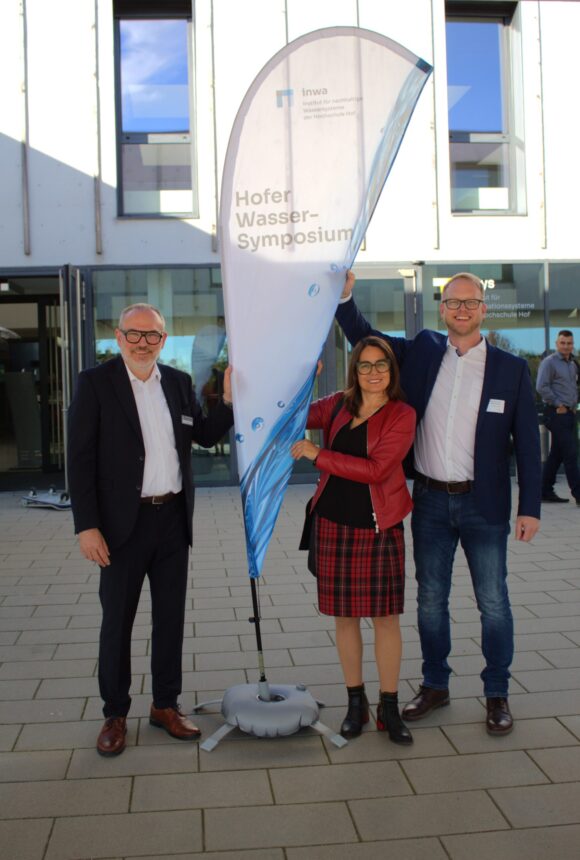
And it was in Hof about three years ago, at a water conference, that Rolf Stahlhofen, Karun Körnig, and Prof. Müller-Czygan from the Institute for Sustainable Water Systems at Hof University of Applied Sciences (inwa) met and discovered their shared interest in the “Culture of Maintenance.” This topic primarily addresses the problem that water technology supplied from industrialized countries often ceases to function after only a short time when used in emerging and developing countries, or that operational issues arise during day-to-day use.
The experiences of the Water Is Right Foundation, which supports projects aimed at addressing inadequate water supply—particularly in rural areas of Africa—indicate that the main cause of these operational problems is a lack of understanding among users—who are typically non-technical—regarding proactive maintenance and strategically planned repairs. In professional and academic circles, this phenomenon is referred to as the “culture of maintenance.” The causes of poor or lacking maintenance lie not only in what is usually insufficient funding or a shortage of technical parts. They are more strongly shaped by local cultural conditions, including religious influences.
Even in highly developed industrialized countries such as Germany or Canada—the home of Karun Körnig—there is a more or less problematic culture surrounding maintenance and repair as soon as regular preventive inspections of technical equipment cost money and time. In such cases, people sometimes prefer to take their chances on whether a pump will fail or not, and only take action once the damage has already occurred. In developing countries, this can be life-threatening when it comes to water supply systems—if no one takes care of keeping the system operational, the water supply can be cut off for days on end.
To date, the Water Is Right Foundation and its partners have focused on ensuring that disadvantaged regions and communities in Africa receive financial support to establish a basic water supply system. Nancy Sikukuu, a water engineer from Kenya who joined the lecture online, oversees this work on the ground. She witnesses firsthand the impact that a lack of understanding of maintenance and upkeep has on water supply infrastructure—and thus on the livelihoods of many people. After more than 15 years of working to establish a local water supply system, the foundation now intends to focus more on raising awareness about proper maintenance and upkeep of these infrastructure facilities, which are financed by donations and public funds. The goal is to ensure that the water supply remains secure and can be operated effectively for the long term.
“As a musician, I reach people’s hearts and can stir their emotions about the issue of water. Over the next 10 years, I want to work with the foundation to improve the safety and reliability of access to water and sanitation for 5 million people. To turn my ideas into reality, I need people like Karun, Nancy, and Günter—people who are not only as passionate about water as I am but who can also put my ideas into practice.”
Rolf Stahlhofen
As soon as they met, they came up with the shared idea of combining the foundation’s hands-on commitment with the university’s expertise in continuing education. Over the past two years, initial studies on the various aspects of the “Culture of Maintenance” have been conducted, and a master’s thesis on the topic has already been completed at Hof University of Applied Sciences. In addition, initial concepts were jointly developed for an online training program for the Water Is Right Foundation’s local African partners. Building on this, further concrete steps—such as the foundation’s participation in the lecture series—are now being implemented.
“A well-functioning water supply in emerging and developing countries involves more than simply donating and installing Western technology. We need a consistent focus on sustainable maintenance and upkeep—from product planning through selection and procurement all the way to installation and operation. ‘Culture of Maintenance’ is not just a catch-all term; it’s also a community of people dedicated to this cause.”
Karun Körnig
Furthermore, young people—as academically trained water specialists—must also engage with the topic of the ‘Culture of Maintenance.’ Proper maintenance and upkeep do not begin only after the technology has been installed. They must already be factored into the concepts and planning of the respective solutions, especially when a typical Western technical education is lacking. Academic continuing education and hands-on, on-site training must be coordinated.
The “Water, Climate, and Society” course in the Master’s program in Sustainable Water Management and Engineering was selected as the launchpad and test bed for academic continuing education on the “Culture of Maintenance” in the winter semester of 2026/27. It is an excellent fit not only in terms of content, as the “Culture of Maintenance” encompasses all three elements of the course: water, climate, and society. The student body, comprising students from more than 10 nations, also reflects the diverse global approaches to and assessments of public water infrastructure.
“Although water is a very scarce resource in many African regions, many people lack sufficient awareness of its value. I see almost every day that there is a lack of willingness to invest money, time, and effort into ensuring the long-term functionality of the donated technologies. If we change that, people will be much better able to help themselves.”
Nancy Sikukuu
Over the next four months of the winter semester, students will explore the various facets of the “Culture of Maintenance.” This will go beyond mere theory. Karun Körnig and Nancy Sikukuu will guide the entire course and work closely with the students on sample projects drawn directly from the Water Is Right Foundation’s fieldwork. Together with the students, they will examine various projects, identify the respective challenges and problems related to maintenance and upkeep, and develop potential solutions to improve the Culture of Maintenance. Professor Müller-Czygan will provide the necessary theoretical foundation and guide the scientific analyses. And Rolf Stahlhofen will certainly stop by in Hof again to observe the students at work.
For the students, the active participation of Rolf, Karun, and Nancy is a stroke of luck. It is hardly possible to gain deeper insights into the practical problems and challenges of everyday water management than through NGO-funded projects. “Culture of Maintenance” also offers research a broad field of unanswered questions and solutions yet to be developed.”
Prof. Günter Müller-Czygan
A week later, Rolf Stahlhofen and Karun Körnig were back in Hof. Karun Körnig took over part of the lecture and presented the basic idea behind “Culture of Maintenance” from the perspective of the WaterIsRight Foundation. Nancy Sikukuu joined the session live from Kenya once again and reported on the challenges of local water supply.
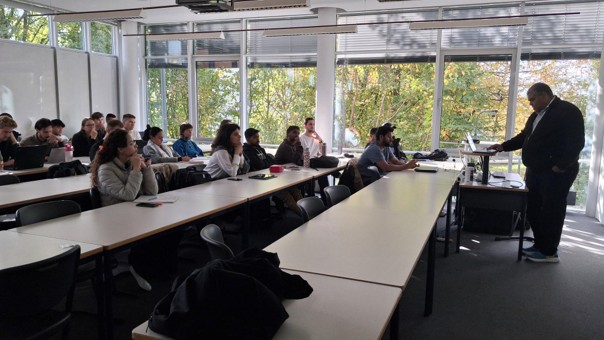
Photo: Hof University of Applied Sciences;
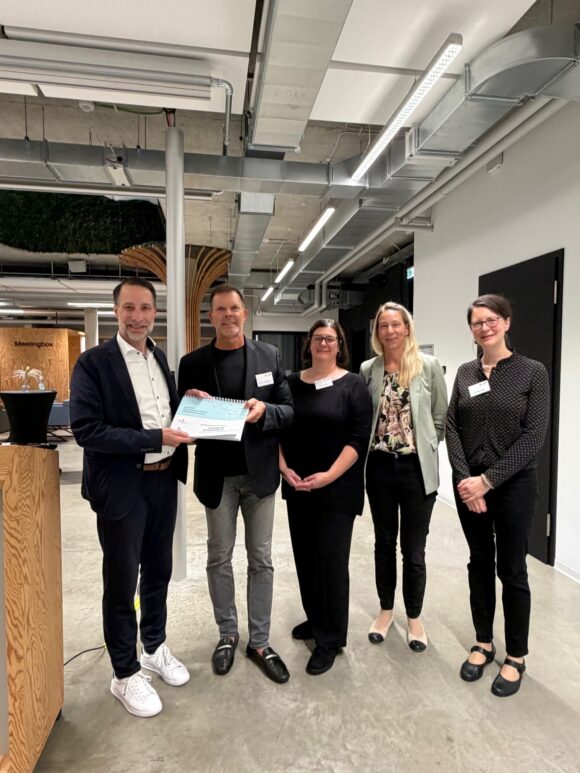
To provide the necessary framework for future joint activities, an official cooperation agreement between the university and the Water Is Right Foundation will be signed in the near future. Plans include a dedicated master’s-level course on the “Culture of Maintenance” as an elective within the Sustainable Water Management and Engineering program, which will then be made available to other universities—particularly in Africa—for academic instruction on this important topic. This topic will also be the subject of joint research.
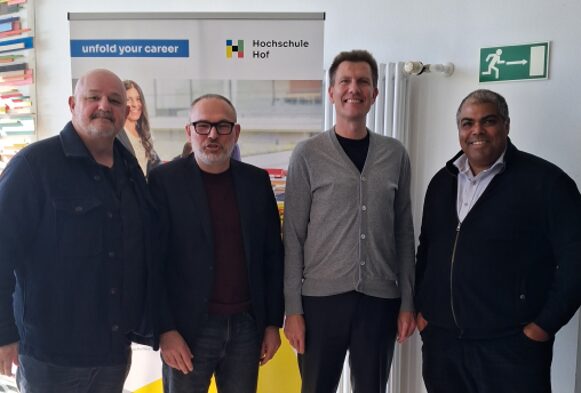
“The combination of music, development aid, and science is an excellent way to highlight the importance of ensuring the sustainable functionality of water systems. The collaboration with the Water Is Right Foundation is a real asset for both our students and our research, and it underscores the significance of the university’s expertise in water management.”
Prof. Dr. Gerald Schmola, Vice President, Hof University of Applied Sciences
The professional community is increasingly discussing a rise in complexity. However, this often seems too abstract and requires tangible solutions and concepts. The collaboration between Hof University of Applied Sciences and the Water Is Right Foundation in the “Water, Climate, and Society” course of the master’s program in Sustainable Water Management and Engineering breaks new ground and makes the phenomena and consequences of complexity in water management visible and tangible. The active teaching support provided by Karun Körnig and Nancy Sikukuu brings international development aid vividly into the university classroom and enables students to integrate the “Culture of Maintenance” into their skill development through an effective learning process.
After the course concludes, the university and the Water Is Right Foundation will jointly use the results to develop a scalable continuing education course at the academic level, which will then be incorporated into the curriculum at African universities. At the same time, work is underway on a continuing education program for local practitioners, because, as the saying goes: theory alone is not enough.