

Ski touring is all the rage. But the very skins that provide traction during the ascent are leaving a problematic mark on the natural environment. A research project aims to change that: Together with two industry partners, Hof University of Applied Sciences is developing a ski touring skin that contains no microplastics and can be fully recycled back into the material cycle at the end of its life cycle.
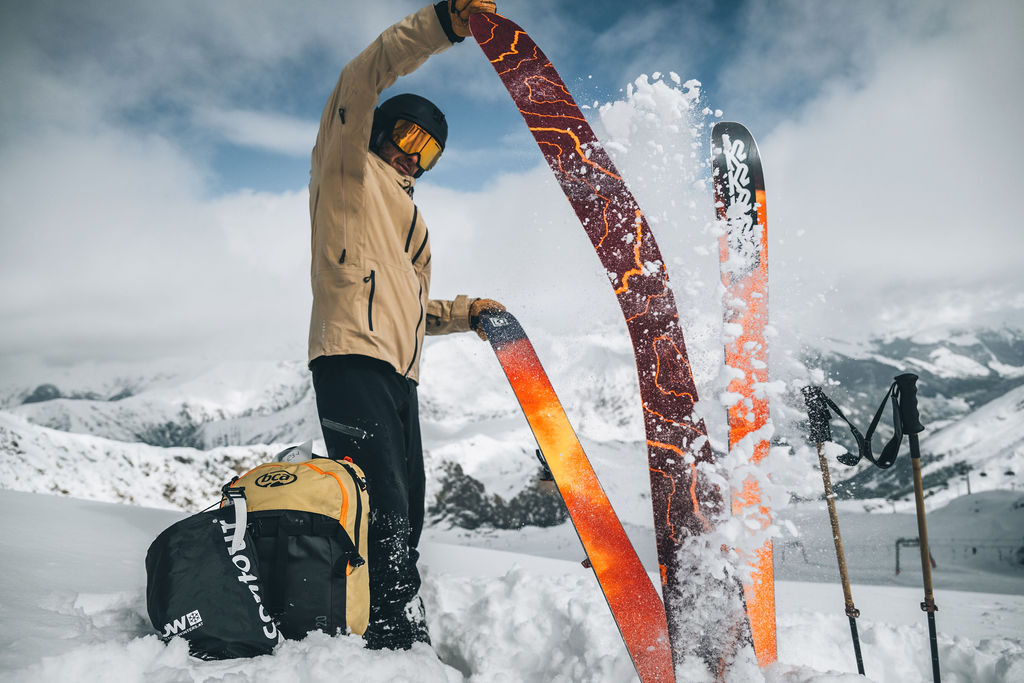
Anyone who goes ski touring is familiar with them: the skins that are attached to the bottom of the skis and prevent them from sliding backward during the ascent. However, what is indispensable for ski tourers has an ecological downside. Conventional ski touring skins consist of different materials that are firmly bonded together. During use, microplastic particles can be released; in the end, what remains is a composite material that is virtually impossible to recycle and usually ends up in the general waste.
This is precisely where the research project“Processing Sustainable Climbing Skins” (SCS) comes in. Scientists at Hof University of Applied Sciences are collaborating with two companies to develop an environmentally friendly alternative. The idea: a high-performance ski touring skin whose components are either biodegradable or can be separated by type and recycled.
“Today, a ski touring skin is an inseparable composite material that ultimately ends up in the general waste. We want to show that there’s another way. Our goal is a skin whose components are either biodegradable or can be separated by type and recycled.”
Prof. Dr.-Ing. Claus-Ekkehard Koukal, Project Leader
Biodegradable Yet High-Performance
The challenge is a demanding one. After all, a sustainable ski touring skin must not only be environmentally friendly but also perform effectively on the mountain. It must provide reliable traction during the ascent while simultaneously allowing for forward glide with as little friction as possible. It must be robust, not too heavy, and easy to handle. To achieve this, all components must be reimagined: from yarns and fabrics to adhesives, coatings, and waterproofing treatments.
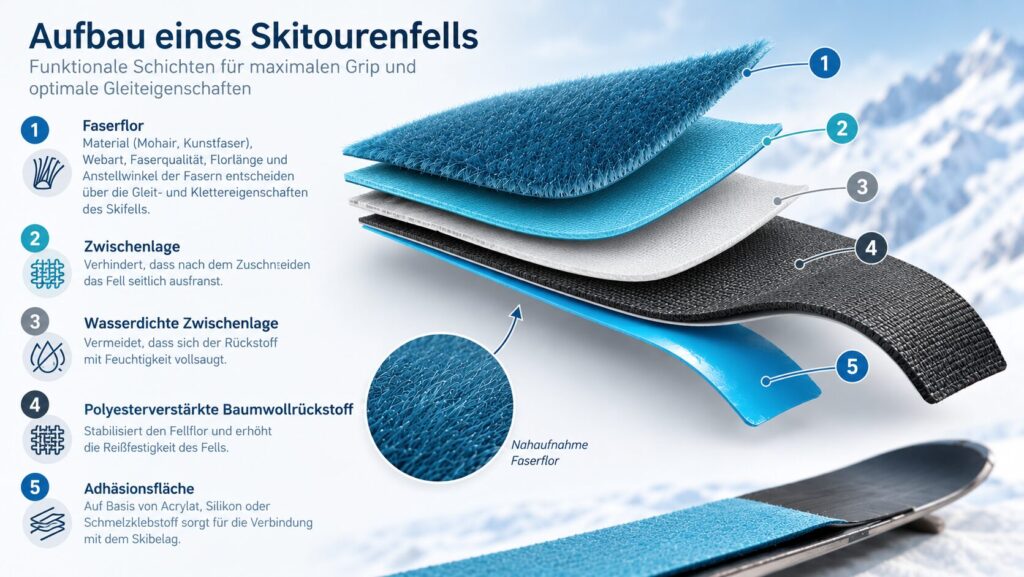
The so-called “pole fabric”—the surface that comes into contact with the snow—presents a particular challenge. Here, the fiber arrangement and material properties must be coordinated in such a way that the desired climbing and gliding properties are maintained. The chemical components are also the subject of research. “The adhesive must be biodegradable, provide lasting adhesion, and still be removable from the ski without leaving any residue,” explains Dr. Molla Abate, a research associate at the Institute for Materials Science (ifm) at Hof University of Applied Sciences. The waterproofing treatment should also be free of fluorochemicals while still reliably repelling water.
Another approach concerns the construction of the skin. Instead of inseparable composite materials, mechanical fasteners such as screws, rivets, clamps, or plug-in connections are to be used. This allows the individual components to be separated from one another at the end of their service life. Dyeing the materials is also to be avoided.
Research from Münchberg, practical expertise
Hof University of Applied Sciences is collaborating on the project with POPP Velourstex GmbH from Stammbach and Koch alpin GmbH from Mils, Tyrol. The responsibilities are clearly divided: The university is primarily responsible for material development, laboratory testing, and testing procedures. POPP develops and weaves the pile fabrics. Koch alpin, known for its Contour brand, contributes its expertise in ski skin production and handles lamination, assembly, and field testing.
A significant portion of the research takes place at the Institute of Materials Science at Hof University of Applied Sciences in Münchberg. Among other things, yarns and twisted yarns are developed there, biological adhesives and impregnations are tested, and the biodegradability of various materials is investigated. In addition, plans are underway to build a dedicated test rig that will allow the gliding properties of the developed samples to be compared under consistent laboratory conditions. “A good skin must grip on the slope and glide on flat terrain,” says Bernd Frinzel, a research associate at the ifm. “With the test rig, we can compare fabrics and coatings in the lab before testing them in the field.”


The collaboration with a regional company is no coincidence. Textile research has a long tradition in Upper Franconia. POPP Velourstex GmbH from Stammbach brings decades of experience in the production of sophisticated velour and pile fabrics to the project.
“As a small weaving mill from Upper Franconia, we know just how much expertise goes into a good pile fabric”
Thomas Popp, Managing Director of POPP Velourstex GmbH
Without the funding and collaboration with research partners, the project would be nearly impossible for his company to undertake.
From the Lab to the Mountain
The project began in April 2026 and will run through September 2028. It is funded by the Federal Ministry for Economic Affairs and Energy as part of the Central Innovation Program for SMEs (ZIM). In the first phase of the project, the requirements for circular ski touring skins were defined, and suitable organic materials, yarns, adhesives, and waterproofing treatments were investigated.
The idea originated with Maximilian Gemsjäger of gemsjaeger.ski, who is advising on the project. As a ski tourer and ski builder, he understands the possibilities for making sports equipment more sustainable—and the limitations of existing solutions.
“But with the skins, we’ve hit a wall: they’re a composite material that no one can recycle, and when you walk, microplastics are left behind in the snow.”
Maximilian Gemsjäger
A ski touring skin that meets the same sustainability standards as a zero-waste ski is therefore the logical next step.
By the end of the project, a functional prototype is to be developed that will serve as the basis for future industrial production. POPP is already involved as the manufacturer, and Koch alpin is set to distribute the ski touring skin. Werner Koch of Koch alpin is also convinced that sustainability and functionality need not be a contradiction:
“A skin free of microplastics and fluorochemicals that can ultimately be returned to the circular economy would be an important step for ski touring.”
Werner Koch, Managing Director of Koch alpin GmbH
It will be crucial that the new product not only meets ecological standards but also withstands the demands of users on the mountain.