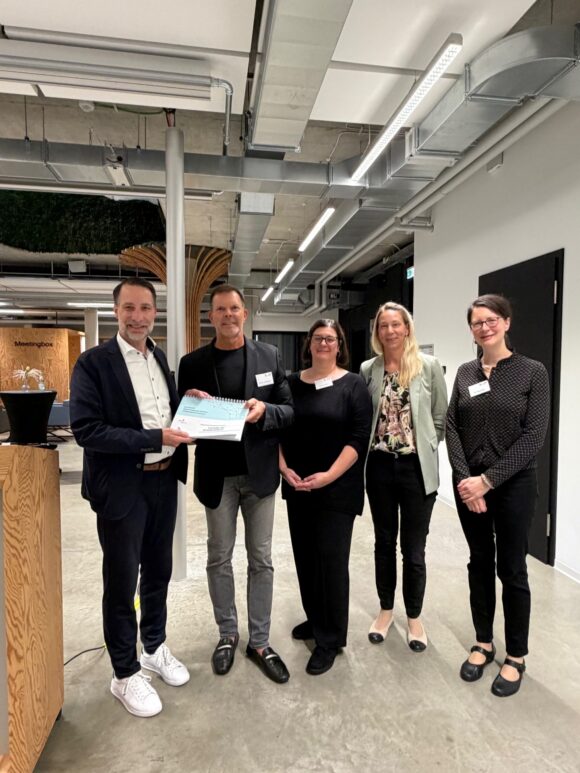


With a digital installation, the Richard Wagner Museum Bayreuth is setting new impulses in the communication of music history: a conductors’ gallery pays tribute to the musical directors of the Wagner Festival to date. Hof University of Applied Sciences made a decisive contribution to this: Prof. Michael Zöllner’s “Interaction & Data Driven Design” research group developed the platform and hardware for the interactive presentation of the gallery of all festival conductors since 1876.

In future, visitors will be able to navigate through a virtual timeline of conductors via four movable displays along a wall. Portraits, biographical data and information on performances will appear on the screens.
My research group has a lot of experience in developing new interactive display systems that adapt their appearance to the ambience and therefore do not come across as cold technology. This principle is called Shytech.”
Michael Zöllner, Professor of Interaction Design
He continues: “We have already implemented the concept in the Maximilian von Welsch exhibition in the Fürstenbau of the Rosenberg Fortress in Kronach and in the Fichtelgebirgsmuseum Wunsiedel. Floating displays were used there, which conveyed virtual and augmented reality in the form of historical picture frames. For the Richard Wagner Museum, we have now designed four interactive displays including a positioning system and produced them in the Interaction Lab at Hof University of Applied Sciences.”
The display software for the new conductors’ gallery was developed by Bayreuth-based company Emergo Entertainment. This close collaboration between science, business and culture has resulted in a pioneering installation that fits seamlessly into the museum’s exhibition architecture.
The new solution complements the already popular “Interactive Score” in the museum. In addition, a playful application offers the opportunity to slip into the role of a conductor and try out musical forms of expression such as tempo, rhythm and articulation – an example of how technology and cultural education can be successfully combined.
The project was supported by the Landesstelle für die nichtstaatlichen Museen in Bayern, the Oberfrankenstiftung, the Stiftung der Sparkasse Bayreuth and the Bayerische Sparkassenstiftung.