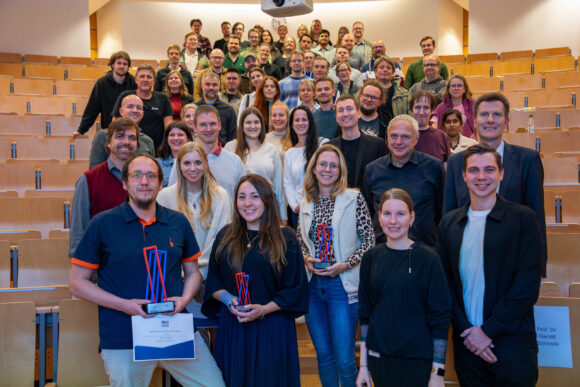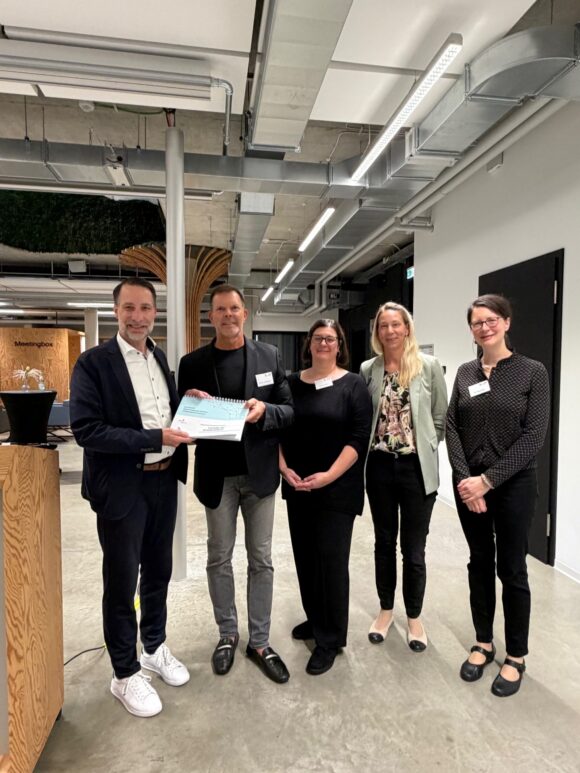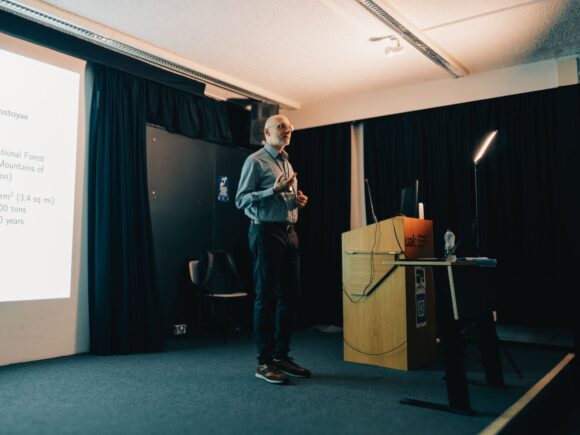


The new project “EnerTECH – Knowledge Transfer for Future Technologies” kicked off at Hof University of Applied Sciences with a well-attended launch event. The goal of the project, initially planned to run for three years, is to systematically transfer the latest research findings to small and medium-sized enterprises (SMEs) and to support them in implementing key technologies for the energy transition.

In his welcoming remarks, University President Prof. Dr. Dr. h.c. Jürgen Lehmann highlighted the strategic importance of the project:
Energy is one of the major global issues of our time. For us, the topic is interesting in many respects. The crucial question here is: What does the economy need? At the same time, we also want to provide companies with new insights from research.”
Prof. Dr. Dr. h.c. Jürgen Lehmann
A central component of the project is the establishment of an active network between research and industry. Companies gain access to free training and information opportunities as well as ongoing professional exchange. Through workshops, events, and practical formats, new technologies are intended to be put into use more quickly, thereby making a concrete contribution to the transformation of the energy system.
Dr. Stefan Bayer, research associate at the Institute for Hydrogen and Energy Technology (iwe), emphasized the social dimension of the energy transition:
“The richest one percent of humanity produces as much CO₂ as the poorest 66 percent.”
Dr. Stefan Bayer, iwe
The goal of the project is therefore to offer Bavarian companies practical training opportunities in forward-looking technologies. To this end, two annual network meetings and five workshops are planned, focusing on decentralized hydrogen supply, energy efficiency technologies, and energy storage technologies. In addition to Dr. Stefan Bayer, project participants include iwe Institute Director Prof. Dr.-Ing. Tobias Plessing, Diana Stein, and Nicole Bierwert. “EnerTECH” is funded as part of the ESF STEP2 program for Strategic Technologies.


Companies are actively shaping the network
During the kick-off event, the project’s key focus areas, planned workshop formats, and initial offerings for companies were presented. Nicole Bierwert provided information on the network development process. In a design thinking phase, companies were also able to contribute their own ideas and areas of interest, thereby actively shaping the network’s future content.
Focus on Hydrogen, Energy Storage, and Energy Efficiency
In terms of content, “EnerTECH” focuses on so-called STEP technologies, which address key challenges of the energy transition—including security of supply, system stability, and resource efficiency.
The project is structured around the following key themes in particular:
- Decentralized hydrogen supply
- Energy storage technologies
- Energy system-related energy efficiency technologies
It covers both the technological fundamentals and the regulatory and strategic framework. The goal is to provide companies with guidance in a dynamic and increasingly complex market environment.
New iwe Building as the Region’s Innovation Hub
Prof. Dr.-Ing. Tobias Plessing, who also presented new doctoral opportunities at Hof University of Applied Sciences as well as the iwe’s key areas of focus, referred to the predecessor projects “ADerN,” “EnerNET,” and “HyBaBo,” which have already fostered a valuable network.
“With EnerTECH, we are continuing this successful approach and, in particular, strengthening the exchange of knowledge and experience between research and industry.”
Prof. Dr.-Ing. Tobias Plessing
He also explained the role of the new iwe building, which is intended to serve as the network’s central hub in the future. Among other features, the building includes a modular research facade, a rooftop laboratory, an underground tank for solar ice storage, a 140,000-liter thermal storage tank for self-sufficient heat supply, modern laboratories, a heat pump test bench, a climate chamber, a large-scale thermal storage tank, and a combined heat and power laboratory, as well as much more. The goal is to closely link the building with the region and the network partners. Robin Fick from iwe provided a detailed overview of the energy supply and technical design of the new building.
Challenges in the ramp-up of the hydrogen economy
The technical presentations by external experts also offered practical insights. Dr.-Ing. Andy Gradel, Managing Director of BtX Energy GmbH, spoke on the topic “Hydrogen Supply Between Politics, Market, and Technology.” He explained the current challenges in scaling up the hydrogen economy. He noted that procurement and infrastructure remain very cost-intensive. He identified the well-known “chicken-and-egg problem” as a central challenge:
“Is the refueling station infrastructure suffering because the vehicle fleet is so small, or is it exactly the other way around?”
Dr. Andy Gradel, BtX Energy
Regulatory requirements such as the RFNBO criteria, reduced subsidy programs, and a GHG quota market burdened by fraud cases have also slowed the ramp-up. Gradel pins his hopes, among other things, on a reform of the GHG quota system, new subsidy programs, the development of import markets, and accelerated approval procedures through the Hydrogen Acceleration Act.


Research on Energy Storage and Hydrogen Technologies
Energy storage technologies were another key focus. Alexander Feldner and Nora Elhaus presented current developments in research, regulation, and implementation. Feldner, who studied energy engineering at FAU Erlangen-Nuremberg and has been conducting research at the Chair of Energy Process Engineering since 2021, focuses in particular on catalytic energy conversion and the conversion of biogas into hydrogen and methane. The presentation covered various storage technologies—from pumped-storage power plants to battery storage—as well as hydrogen production methods, such as electrolysis, thermochemical processes, or methanation. It became clear that the demand for storage technologies to bridge periods of low renewable energy feed-in will increase massively in the future. The speakers also explained the regulatory framework.
Contribution to the regional and national energy transition
The “EnerTECH” project is funded under the European Social Fund Plus (ESF) and specifically addresses a central challenge of the energy transition: the transfer of scientific findings into practical application. In particular, small and medium-sized enterprises are to gain early access to sound technological know-how, thereby enabling them to realistically assess and implement innovation potential.
With “EnerTECH,” Hof University of Applied Sciences is further expanding its activities in the field of knowledge and technology transfer. The Institute for Hydrogen and Energy Technology (iwe) pursues the overarching goal of more quickly translating innovative energy technologies from research into practice and thus actively shaping the energy transition.


Upcoming Events
As part of the Bavarian Energy Days, the Institute for Hydrogen and Energy Technology at Hof University of Applied Sciences (iwe) will present the EnerTECH project to the general public on Saturday, July 18, from 10 a.m. to 4 p.m. The event, titled “Hands-On Energy Transition,” will take place on the grounds next to the summer restaurant at Untreusee (“Die Wertschaft”) and is being organized in collaboration with the Water and Energy Competence Network e.V., the Climate Protection Coordination Office of the Hof District, and the Upper Franconia Energy Agency e.V. Interested visitors will receive a free, hands-on insight into current developments, innovative technologies, and future prospects in the energy sector.
Another milestone of the project is the planned network meeting on November 11, 2026, at the Wilo company site in Hof. There, the three cluster areas of EnerTECH will be brought together, and the interdisciplinary exchange between science, industry, and regional stakeholders will be further developed in a targeted manner.