

A new research project on sustainable thermal insulation and improving room acoustics is being implemented at Hof University of Applied Sciences: Under the title “WAVE” (thermal insulation and acoustic improvement through the use of residual materials as fillers in near-final 3D fabric structures for textile panels), the university and regional partners from Upper Franconia have joined forces to develop functional textile insulation solutions based on regional wool. The project, which started at the beginning of the year, is scheduled to last two years and is funded as part of the Central Innovation Program for SMEs (ZIM).

With WAVE, we are addressing a highly topical issue that sensibly combines ecological requirements, material innovation, and regional value creation.”
Prof. Dr. Frank Ficker, project manager and head of the Institute for Materials Science (ifm) at Hof University of Applied Sciences
The demand for environmentally friendly products for thermal insulation and acoustics is growing, as many conventional solutions are made from petrochemical raw materials, contain composites that are difficult to separate, and are often not recyclable or biodegradable. The market is therefore demanding a new generation of insulation products that are made from renewable or recycled raw materials, do not require adhesives or critical additives, and remain recyclable or compostable – without compromising on thermal and acoustic performance. This is exactly where the WAVE research project comes in.
“We see a clear market need here, but also enormous untapped potential in regionally available raw materials such as wool. Our approach is to make this resource functionally usable in a targeted manner and transform it into a marketable textile system.”
Isabell Korn, research assistant and project manager at ifm
Innovative solution: Textile 3D panels made from regional wool
The aim of the project is to develop a completely textile 3D panel system that combines thermal insulation and acoustic effectiveness – based on regionally available wool fibers. In addition to high functionality, the textile structure also promises design freedom and mechanical stability that goes beyond classic insulation materials. The project not only addresses the functional requirements of modern insulation materials, but also utilizes a locally available surplus of raw materials: wool that is produced in the region and has hardly been used in functional building products to date.
Textile structures offer the possibility of combining function, stability, and design in a single material system. This opens up new avenues for sustainable insulation and acoustic solutions in interior design.”
Corinna Anzer, Deputy Project Manager and Technical Manager of the Weaving, Braiding, and Yarn Development departments at ifm

Source: Hof University of AppliedSciences
From the laboratory to industrial application
The development process includes a laboratory phase at ifm, during which functional textile structures and filling concepts are developed and tested. This is followed by transfer to industrial scale at the furniture fabric weaving company Reich e.K., accompanied by continuous knowledge exchange and evaluations. At the end of the project, the aim is to have a market-ready prototype that demonstrates its acoustic and thermal effectiveness and meets the requirements of modern interior design solutions.
“For us, the close integration of research and practice is a key success factor. Early involvement in the development process creates the basis for turning a good idea into an industrially viable product.”
Claudia Schödel-Reich, Möbelstoffweberei Reich e.K.
Opportunities for the interior design of the future
The textile insulation panels resulting from the project could thus represent a sustainable alternative to conventional products in office, educational, or cultural buildings in the future and contribute to better room acoustics, thermal comfort, and ecological construction.
“There is a growing demand for flexible, sustainable, and aesthetically appealing solutions, especially in interior design,” adds Isabell Korn. She continues: “Textile panel systems can offer real added value here.” WAVE aims to deliver an innovative solution that combines sustainable use of materials, regional value creation, and technological excellence—sending a positive signal for the future of the textile industry in Upper Franconia and beyond.

A happy coincidence at the TextilTreff Oberfranken
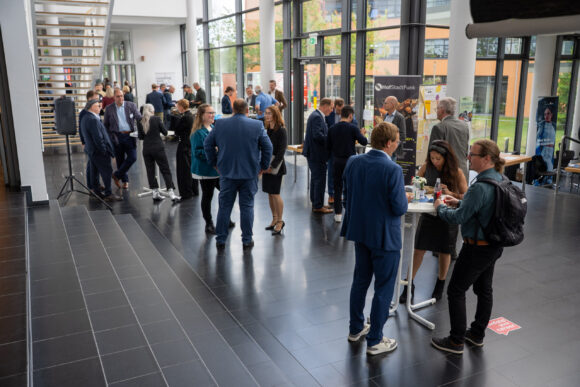
The project idea arose from a meeting at a “TextilTreff Oberfranken,” a networking event organized by Bayern Innovativ GmbH and the Association of the Bavarian Textile and Clothing Industry (VTB), which regularly invites participants to exchange ideas on current trends and innovations in the textile industry. The exchange between those present from the Reich weaving mill, the ifm, and Felix Meier from neowistra led to the initiative for a joint research proposal and subsequent approval under the ZIM program. “The TextilTreff has once again demonstrated how important personal encounters and open discussions are for innovation,” emphasizes Prof. Dr.-Ing. Frank Ficker. The innovative project strengthens the regional textile industry and promotes knowledge transfer between universities, small and medium-sized craft businesses, and technology experts.
The project partners
The project combines expertise from science, textile production, and funding consulting:
• ifm – Institute for Materials Science, Hof University of Applied Sciences
Project management: Prof. Dr.-Ing. Frank Ficker and Corinna Anzer (M.Eng.)
Project management: Isabell Korn (M.Eng.)
The Institute for Materials Science contributes its many years of experience in textile engineering, weaving and recycling technology, and innovative manufacturing processes, and provides scientific management for prototype development and testing.
• Möbelstoffweberei Ewald Reich e.K.
Owner: Ewald Reich, Commercial Management: Claudia Schödel-Reich (certified business economist IHK), Technical Management: Andreas Reich (state-certified textile technician)
The traditional furniture fabric weaving mill in Gefrees has extensive process knowledge in textile production, which is crucial for the industrial implementation and scaling of the newly developed panel structures.
• neowistra GmbH
Funding advice and project support
Contact: Felix Meier (M.Eng.) – active networking, project strategy consulting, and responsible for funding logistics.