

About 100 experts from research and industry gathered at the 18th Narrow Textile Conference (NTC) in Hof to discuss new technologies for narrow textiles—and the question of how quickly research and mechanical engineering must respond to a changing world.
Narrow fabrics, braids, and textile structures are the focus of the Narrow Textile Conference. But the questions behind them are far-reaching: How can textile products be made smarter? What new materials and manufacturing processes are needed? And how can an industry heavily influenced by mechanical engineering and international production keep pace with the speed of technological change?
About 100 participants from roughly 40 companies, research institutions, and organizations attended the 18th edition of the conference. The event kicked off on August 31 with a guided tour of the technical facilities at the Institute of Materials Science in Münchberg, followed by a get-together, before the conference took place on September 1 and 2 in Hof. About ten percent of the guests traveled from abroad, including from the U.S., Switzerland, Austria, France, and Iran. The conference language was English.
For the first time, Hof University hosted the event, which takes place every two years at a different location as a traveling conference.
“We are delighted by the strong international participation and the diversity of professional attendees at the Narrow Textile Conference. It is particularly gratifying that we were able to double the number of participants. The successful hosting of the conference is also a great recognition and appreciation of our research work in the field of narrow textiles.”
Prof. Dr. Frank Ficker, Director of the Institute of Materials Science (ifm)
NTC began in Switzerland and has been touring ever since
Its history dates back to 2001. The first conference was held to mark the opening of the Jakob Müller Institute of Narrow Fabrics in Frick, Switzerland. After additional conferences hosted by the Jakob Müller Group in Frick, the event moved to various locations, including the Niederrhein University of Applied Sciences in Mönchengladbach and the Technical University of Dresden. This year’s conference was organized by the Institute for Materials Science (ifm) at Hof University of Applied Sciences in collaboration with the Niederrhein University of Applied Sciences, the Technical University of Dresden, and the Jakob Müller Group.
It was certainly the intention that the conference would return on a larger scale after a hiatus.
“A breath of fresh air, a new name, and significantly more participants than at the last conference.”
Romy Ottiger, organizer from Hof University of Applied Sciences
A scientific advisory board comprising representatives from the participating partners—including the Niederrhein University of Applied Sciences, the Technical University of Dresden, the Jakob Müller Group, and Hof University of Applied Sciences—had helped to further develop the conference.
Guided tour of the Münchberg textile campus
To kick things off, participants at the Münchberg campus gained insights into the research being conducted there. In the machine halls and technical facilities, they were able to see braiding machines and 3D weaving machines in operation, among other things. So it wasn’t just about lectures on new technologies: Visitors were able to see firsthand what research and development is taking place in the region.
On the second day, the focus shifted to Hof. Professor Frank Ficker, scientific director of the Institute for Materials Science (ifm), introduced Hof University of Applied Sciences and the ifm before Dr. Janpeter Horn from the German Engineering Federation (VDMA) delivered a keynote address that looked beyond the textile industry to the development of mechanical engineering.
His message was clear:
“The world is changing faster than we thought.”
Dr. Janpeter Horn, German Engineering Federation (VDMA)
In particular, the dynamism of the major economic regions of China and the U.S. is forcing German and European industry to adapt more quickly. When production is relocated, investments often follow, Horn warned. This is problematic for an industrial hub like Germany.
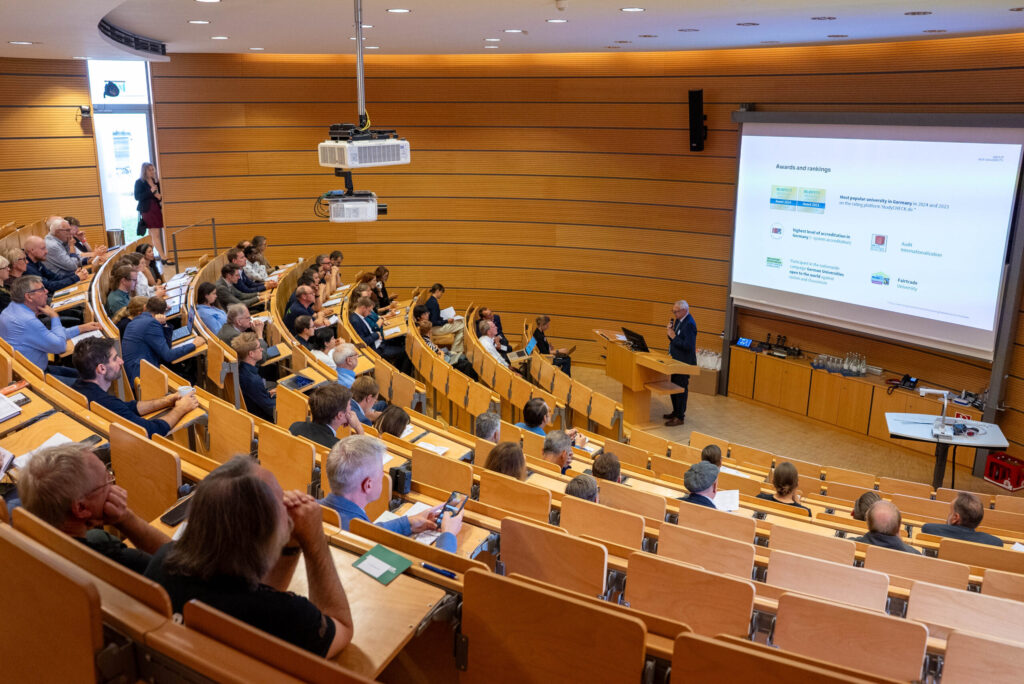
He made another appeal to companies and the research community: innovation must happen faster. It doesn’t always have to be perfect. Germany, in particular, excels at optimizing existing products. The crucial question, however, is whether it can also succeed in developing truly new products and markets.
In doing so, Horn touched on a point that is also relevant to Hof University of Applied Sciences: the close connection between research and industry.
“As an institute at a university, we have established a strong industry focus and have been able to develop long-term and successful partnerships with industry. For companies, we always strive to find and facilitate new avenues.”
Prof. Dr. Frank Ficker
Between Research and Industry
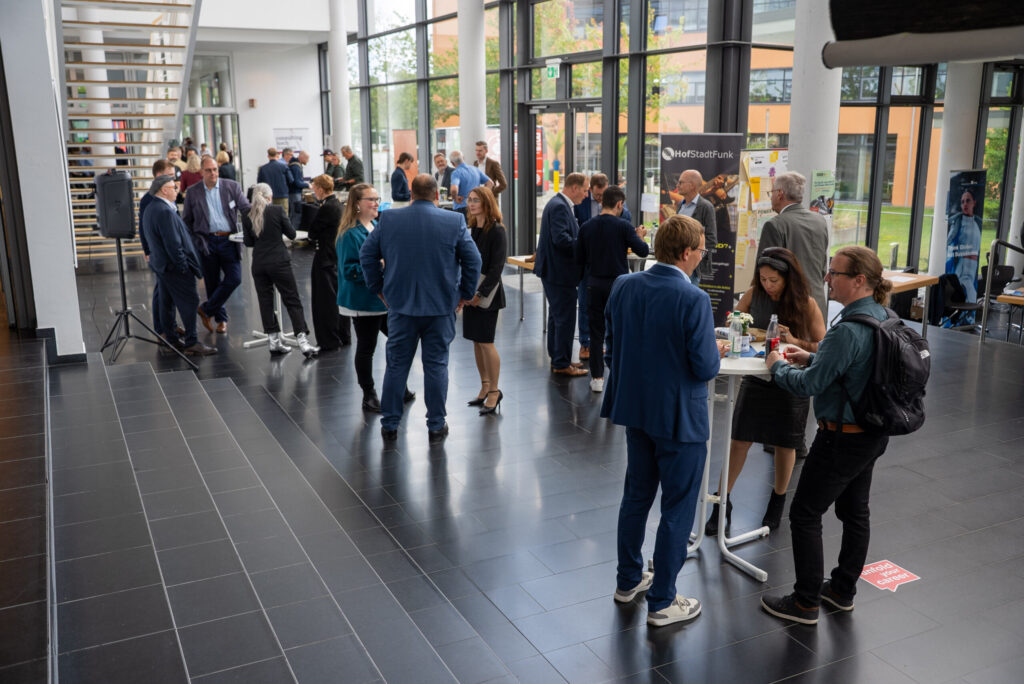
The conference took place precisely at this intersection: between materials research, mechanical engineering, and concrete industrial applications. Developments from the past two years, new projects, and technological approaches for narrow-width weaving, braiding technology, and functional or smart textiles were presented and discussed. A poster exhibition complemented the technical presentations and offered younger researchers, in particular, an opportunity to present their work. In an accompanying trade exhibition, companies and research institutions showcased their technologies, products, and current developments at information booths.
The value of the event lies not only in individual research results. The conference brings together stakeholders who otherwise often work in different spheres: mechanical engineers meet materials researchers, universities meet companies, and developers meet users. This can lead to new projects, products, and collaborations.
The next edition of the Narrow Textile Conference is scheduled for the first quarter of 2028 in Switzerland at the Jakob Müller Group.