

Extreme weather events such as heavy rain, flooding, or drought are occurring with increasing frequency. To respond effectively, government agencies and infrastructure operators rely on reliable data. This includes hydrometeorological measurements—that is, data on precipitation as well as other climatic and water-cycle-related parameters. Two interconnected projects at the Institute for Sustainable Water Systems at Hof University of Applied Sciences (inwa) address precisely this issue.
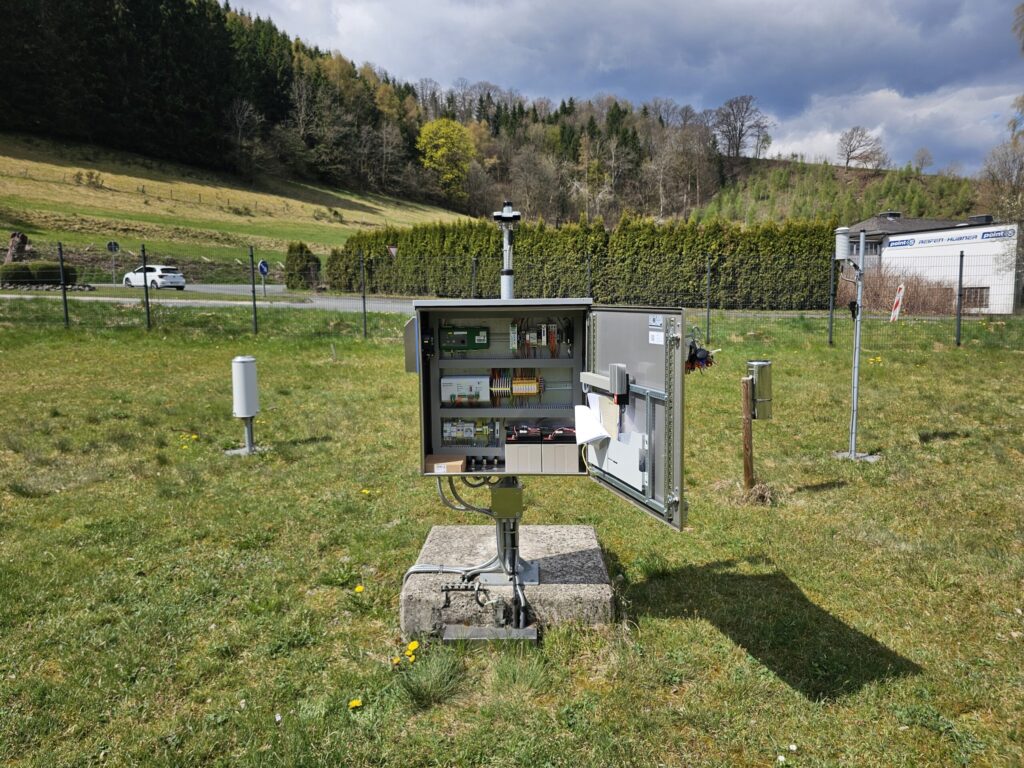
It is a growing problem: Many hydrometeorological measuring stations still operate with outdated technology, have varying configurations, or provide inaccurate data. This creates uncertainties that can directly impact decisions—such as in the case of flood warnings.
Modern technology for a digitized hydrometeorological measurement network
This is where the “DMeStHyA” project (Development of a Digital Measurement and Control System for Hydrometeorological Applications, Application-Oriented Upscaling with Field Testing) comes in. The goal is the modernization, standardization, and digitization of an existing hydrometeorological measurement network, as implemented using the example of the measurement network of the State Office for Nature, Environment, and Climate of North Rhine-Westphalia (LANUK NRW).
The focus is on the technical renewal of the measuring equipment, a standardized station design, and the digitization of operational processes. This includes standardized control cabinet solutions, modern communication structures, and the integration of the stations into digital systems for monitoring and managing the operation of the measurement network. This will technically standardize the measuring stations and connect them digitally. This simplifies maintenance and operation, improves data availability, and enables the early detection of malfunctions.
The Institute for Sustainable Water Systems at Hof University of Applied Sciences (inwa) is providing scientific support for the project. Its tasks include analyzing project implementation, evaluating surveys and interviews with measurement network staff, and transferring the results into research and practice.
“The reliable collection and evaluation of hydrometeorological data is becoming increasingly important in light of climate change, extreme weather, and the protection of critical infrastructure. This is precisely why Hof University’s participation in such projects is of particular significance: We bring together scientific analysis, practical relevance, and the transfer of results.”
Prof. Günter Müller-Czygan, Scientific Director

Thanks to the modernization, malfunctions can be detected more quickly, data processed more rapidly, and operational processes made more efficient. A particular focus of the scientific support is on how digitalization is being adopted in practical operations. To this end, LANUK staff were surveyed to systematically evaluate experiences from their daily work and incorporate them into the further development of the systems.
Our involvement in both projects from the outset allows us to continuously monitor the development of digitalization in the operation of the monitoring network. This reveals how the role of employees at the hydrometeorological stations is changing and how they are increasingly being integrated into digital processes.”
Dr. Viktoriya Tarasyuk (inwa)

Validation of precipitation data using AI
The follow-up project NIQKI (Precipitation Data Quality Control with Artificial Intelligence) builds on this foundation. The focus is on the automated plausibility checking of precipitation data using AI.
This means that the system automatically checks whether measurement data is realistic and complete. For example: If a section with missing data or anomalous values suddenly appears in a measuring station’s time series, the system automatically checks whether this is due to a technical malfunction, a transmission error, or a real-world event. The goal is to develop methods that allow measurement data to be evaluated more quickly and reliably. Plausibility checking combines physical thresholds, heuristic verification rules derived from operational experience, and artificial intelligence methods. This allows measurement errors, sensor failures, or transmission problems to be identified early on and the quality of the data to be systematically evaluated.
The Institute for Sustainable Water Systems at Hof University of Applied Sciences (inwa) is providing scientific support for the project. Its tasks include analyzing the current state of research and technology, assisting in the evaluation of the developed methods, and assessing potential application areas.
“We combine physical limits, empirical values, and AI to detect measurement errors, sensor failures, or transmission problems at an early stage. This allows us to significantly improve the quality of the data.”
Prof. Günter Müller-Czygan
A solution with an impact beyond the region
Both projects are closely intertwined: While DMeStHyA establishes the technical foundation through a modernized and standardized measurement network, NIQKI enables the systematic assessment of data quality through automated plausibility checks. Together, they thus improve the reliability of hydrometeorological data and its usability for operational applications. “Our participation in both projects allows us to provide scientific support from the very beginning and to directly translate findings into practice,” emphasizes Günter Müller-Czygan.

The significance of this work extends far beyond the region. Reliable hydrometeorological environmental data is not only important locally but is also gaining increasing significance in an international context—for example, in flood forecasting or disaster management.
Collaboration as the Foundation of Project Implementation
Both projects are being implemented through close collaboration between research, public administration, and industry. Participants in the DMeStHyA project include the State Office for Nature, Environment, and Climate of North Rhine-Westphalia (LANUK) and HST Systemtechnik GmbH & Co. KG. The follow-up project NIQKI is coordinated by the Cologne University of Applied Sciences; other partners include LANUK NRW, hydro & meteo GmbH, and HST Systemtechnik GmbH & Co. KG.
The Institute for Sustainable Water Systems at Hof University of Applied Sciences (inwa) provides scientific support for both projects and helps to systematically evaluate the results and make them available for further applications.