

“Studying Means 2027: Making Concrete Float!” Does that sound like a major challenge? It’s meant to be—and it’s designed to give students the opportunity to apply their personal skills. An interdisciplinary team of students from Hof University of Applied Sciences tackled this problem. In just 10 weeks, nine students with diverse expertise developed floating prototypes made of lightweight concrete that could serve as support systems for crops in the future.
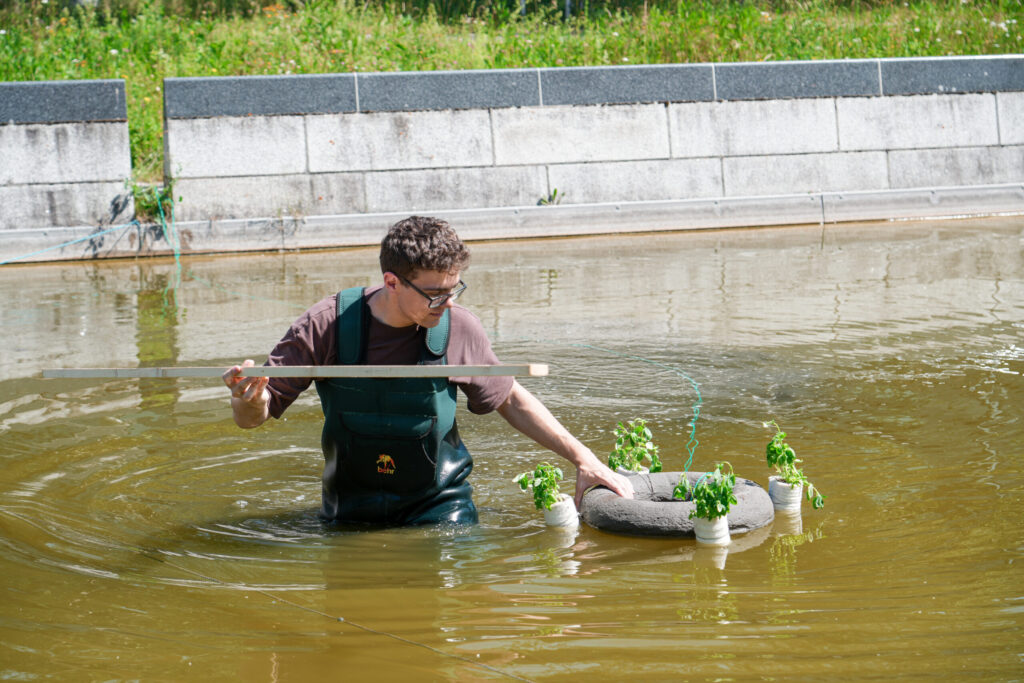
The goal of the project was to develop floating prototypes that can be used on bodies of water and open up new possibilities for urban food production. Following a testing phase in water, the insights gained were to be used to develop, in the future, a larger floating platform measuring approximately 1 x 1 meter. At the same time, the project aimed to avoid the use of peat-based substrates and to investigate a durable material that is as environmentally friendly as possible.
The project was initiated and supervised by Dr. Harvey Harbach. In his research, he and his team focus, among other things, on sustainable plant production in peat-free substrates. In his role as deputy director of the Institute for Sustainable Water Systems at Hof University of Applied Sciences (inwa), as well as head of a research group and adjunct lecturer, he considers it important for students to bring prior experience to the table. Even more important to him is that this prior experience is recognized as expertise.
WOOLSTONE was integrated into a course taught by Prof. Dr. Manuela Wimmer. Participants included students from the bachelor’s programs in engineering as well as from the master’s program in International Project Management.
“A project demonstrates that it takes more than just an idea, a plan, and knowledge—above all, it requires creativity and a wide range of skills to achieve the goal. With this unusual problem statement, the students showed that they were able to develop fantastic solutions, particularly by drawing on skills they hadn’t learned during their studies,”
Dr. Harvey Harbach.
From Idea to Floating Prototype
The project began with research, brainstorming, and initial material tests. The students investigated which shape, material, and construction method might be suitable for a floating island. This led to the creation of three circular prototypes, which were tested in practice as the project progressed.
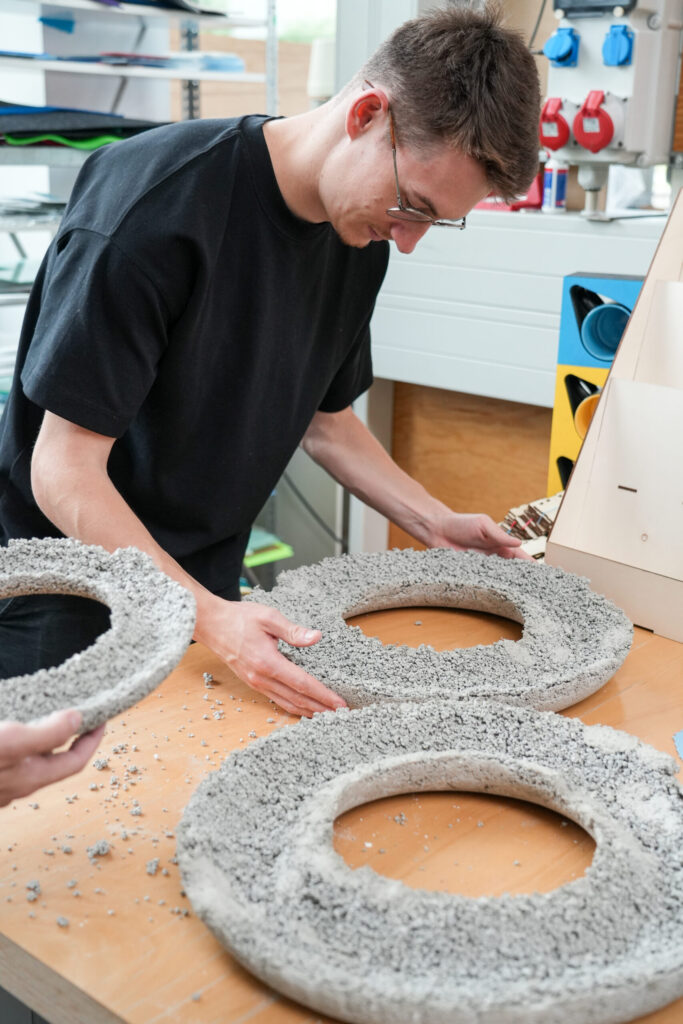
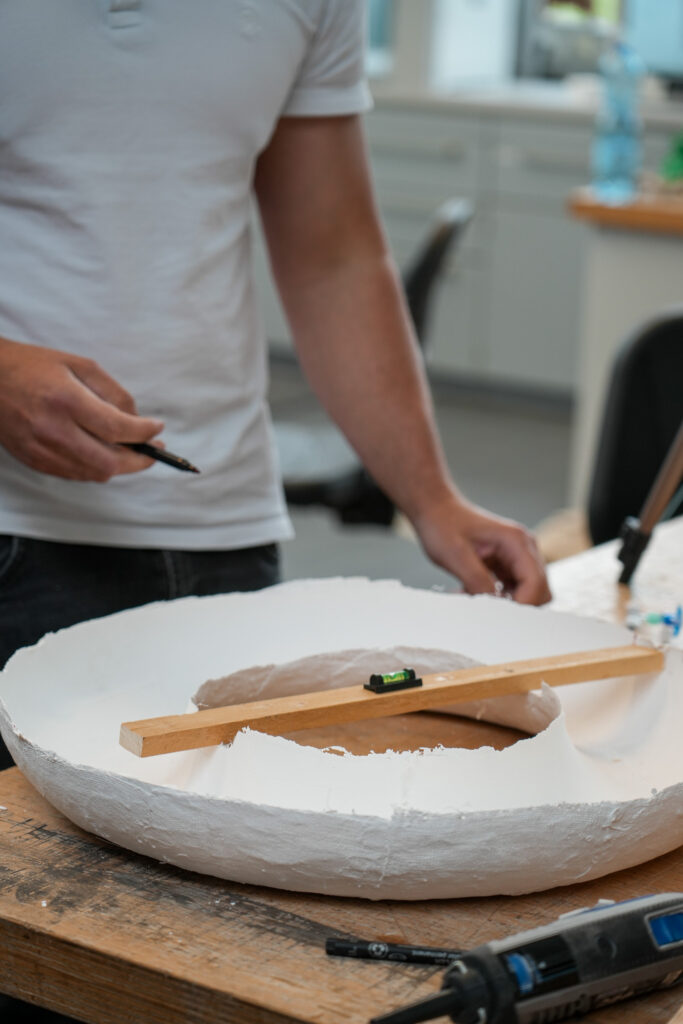
Plaster molds and modern 3D printing techniques were used to produce the prototypes. The team used lightweight concrete and a mixture of expanded clay and cement as building materials. The main aspects tested were shape, stability, and buoyancy. The mineral-based materials were chosen deliberately: The prototypes were designed to be robust, to serve as a long-term alternative to less durable support systems, and to have as little environmental impact as possible.
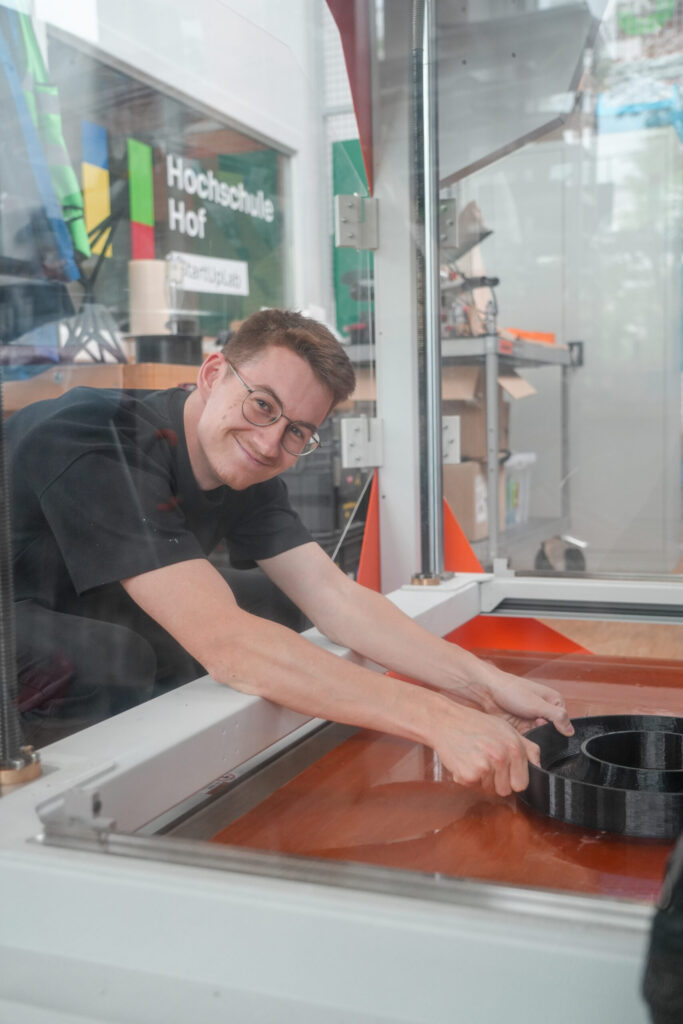
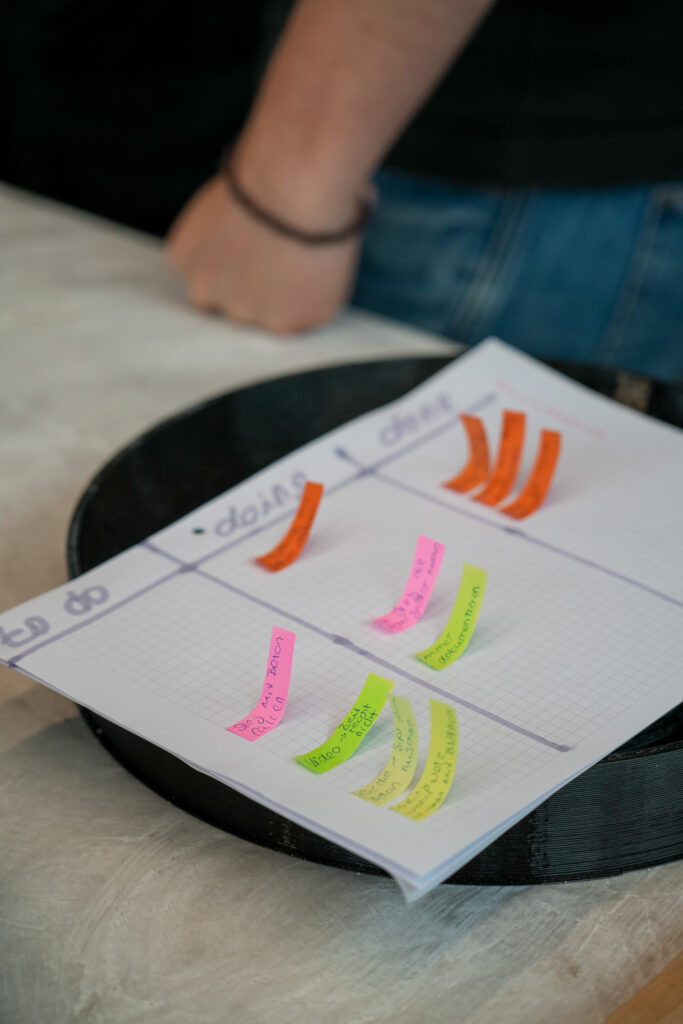
In addition to technical development, project management also played a central role. The student project leadership team handled coordination, scheduling, and quality control. This allowed the students not only to work on a technical problem but also to apply project management methods in practice.
“The project allowed us students to gain practical experience in the makerspace and to directly test our own solutions. The support we received from Professor Wimmer, Dr. Harvey Harbach, and René Göring in the makerspace was particularly valuable; we were able to rely on their support and insights even in difficult situations. WOOLSTONE has shown us that project development doesn’t always follow a straight path. That makes me all the more proud of the entire team and of what we’ve achieved together.”
Lea Gebert, student project manager
Challenges and Results
A key challenge was striking a balance between stability and buoyancy. The prototypes had to be sturdy enough to support plants while remaining light enough to float on the water continuously. The project was also challenging from an organizational standpoint: delays in the delivery of materials and the limited project timeline of ten weeks made adjustments necessary. As a result, the original goal of building a larger floating island with a diameter of about one meter could not be fully realized. In consultation with the client, the team focused on three smaller prototypes as well as a recommendation for further development. It was precisely these changes that made the project particularly instructive: decisions had to be reviewed, solutions adapted, and results repeatedly reevaluated.
In most course modules, the prevailing mindset remains: “Knowledge first, then practice.” The skills Dr. Harbach teaches turn this principle on its head: You learn through the process itself. Students experience what project management feels like when time and constraints become real, and what it’s like when time is tight or even too late. But above all, they learn how tests don’t merely confirm results—they make results possible in the first place—and thus drive progress in the project.
This is where this training differs from the past: It’s no longer about testing knowledge—but about taking action based on real feedback. Thus, this project is not an extension of theory, but a form of learning in which students must truly put their work to the test: with decisions that cannot be undone.
Dr. Harvey Harbach
The subsequent practical tests yielded important insights: Two of the three concrete islands developed proved to be buoyant. They were deployed in the rainwater retention basin at Hof University of Applied Sciences and examined after an eleven-day floating phase. The evaluation focused primarily on stability, buoyancy behavior, and potential material changes.
Bringing Sustainable Ideas to Life
WOOLSTONE demonstrates how an unusual idea can evolve into a concrete experimental setup. The prototypes provide a foundation for further developments in the field of floating plant systems and highlight how application-oriented teaching, sustainability, and technical creativity interact at Hof University of Applied Sciences. Through this project, the students are contributing to the question of how urban spaces can be designed in a more resource-efficient manner in the future. The floating prototypes exemplify how bodies of water can be conceived as additional usable spaces—for research, teaching, and potential applications in sustainable urban development.
The project makes it clear: Innovative solutions emerge when interdisciplinary teams boldly tackle practical challenges, push technical boundaries, and gain valuable insights from every test.
Students report: Reading is good, listening is better.
The students themselves share their journey—with its ups and downs, learning curves, tangible results, and learning moments—in a video series (link coming soon).