

New Year’s Lecture 2026 at Hof University of Applied Sciences: Professor Lutz Fügener calls for the courage to have a vision – and against fear of the future. It all begins with a song that is actually impossible. In Luc Besson’s science fiction film The Fifth Element, the alien diva Plavalaguna sings an aria that even trained voices can barely manage.
Only around 60 percent of the vocals come from a real singer, the rest was added digitally. A trick – and a symbol. Years later, the Chinese opera singer Jane Zhang sang the entire piece live. Apparently she didn’t know that it was considered “unsingable”.
Professor Lutz Fügener, vehicle designer, opens his New Year’s Lecture at Hof University of Applied Sciences with this cinematic vocal interlude – setting the tone for an evening that is all about visions, imagination and the question of why progress is inconceivable without both. Around 200 people registered for the event on Wednesday evening, January 28, to which the new Vice President for Research, Gerald Schmola, welcomed the guests in the lecture hall.

We don’t deal with visions properly, but we have to be able to deal with them.”
Prof. Lutz Fügener
Visions, he emphasizes, must be clearly distinguished from hallucinations. He defines visions as imaginations. They are not the result of the daily work of designers. Because without visions, work lacks direction and meaning.
Fügener, who has been a university professor since 2000 and Professor of Advanced Mobility Design in Hof since 2021, goes back a long way. He shows how ideas from literature, film and cartoons have repeatedly anticipated real developments. For example, the backwards-landing spaceship from the book Project Mars, which later shaped Hergé’s comic Objectif Lune. Hergé almost despaired of sending his hero Tintin to the moon in a physically correct way – in contrast to Star Wars, as Fügener notes with a wink. Today, rockets actually land backwards, controlled by autopilots and AI.
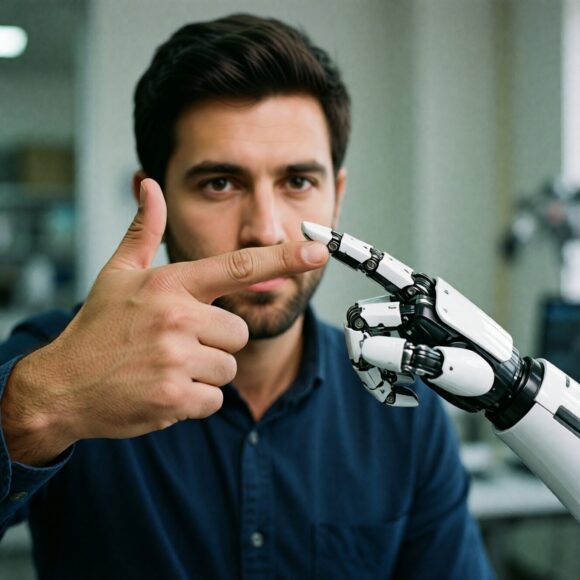
Fügener also recognizes early reflections on the fear of technology and the dominance of machines in the animated film The Wrong Trousers from the Wallace & Gromit series. According to his thesis, exoskeletons are nothing more than the logical continuation of an age-old human desire: to reinforce one’s own physique – from bicycles to humanoid robots, as developed today by companies such as Neura Robotics or Boston Dynamics.
The examples extend right up to the present day: flying cars from Slovakia that are approved for both road and air use; headphones that translate conversations in real time and thus fulfill a human dream – although they are still deactivated in Europe for data protection reasons. And then there is the “Volonaut”, a futuristic flying machine that can actually be ordered. Whether the video circulating on the internet is AI-generated or real was deliberately left open for a long time by the inventor in the spirit of guerrilla marketing.
He repeatedly points out that many technical achievements have their origins in military research – including autonomous vehicles. Fügener looks at failed or forgotten designs for the future, such as the rotating airports by designer Norman Bel Geddes or concept cars from 1897, which already offered comfortable elevated seating and solutions to travel sickness in cramped cities. “We have to look behind the facade,” says Fügener. “There are many useful things in the cellar. We just have to ask what the point is.”
In the lively final discussion, he gave a differentiated answer to the question of where mobility will be in ten years’ time: China will rely on centralized control, the USA on many individual vehicles, Germany – “turning the steering wheel”. But one thing is certain: “There will be more innovations in the next ten years than in the last thirty.” The future will not happen by itself. You can’t “sit like a rabbit in front of a snake”.
In the end, the thought from the beginning with the unsingable song remains: that the supposedly impossible is sometimes just waiting for someone to simply do it. Or, as Vice President Schmola puts it: Visions are better than fiction.