


Daimler Truck is investing several hundred million euros in hydrogen-powered trucks by the end of the decade, sending a clear signal. At the same time, the commercial vehicle manufacturer remains committed to battery-electric powertrains. So is hydrogen making a comeback—or is it merely a technology for specific applications? Prof. Dr.-Ing. Tobias Plessing, director of the Institute for Hydrogen and Energy Technology (iwe) at Hof University of Applied Sciences, puts this development into perspective. He explains where hydrogen actually offers advantages over batteries, why efficiency isn’t the be-all and end-all, and what propulsion strategy logistics companies should pursue with a view toward climate neutrality.
Prof. Plessing, is the Daimler investment a sign of a hydrogen comeback?
“Partly yes, but not in the sense of a renaissance for all truck applications. Daimler Truck is now explicitly pursuing a dual strategy of battery and hydrogen propulsion. CEO Karin Rådström has announced plans to invest several hundred million euros in hydrogen trucks by the end of the decade. At the same time, the company emphasizes that battery-electric vehicles remain the first choice for many applications. This is less a signal along the lines of ‘hydrogen beats batteries’ and more a recognition that hydrogen may continue to be indispensable for certain long-haul applications. “I therefore don’t foresee a widespread comeback, but rather a growing conviction that fuel-cell trucks will be needed on a long-term basis in certain segments.”
What are the technical advantages over battery-electric trucks?
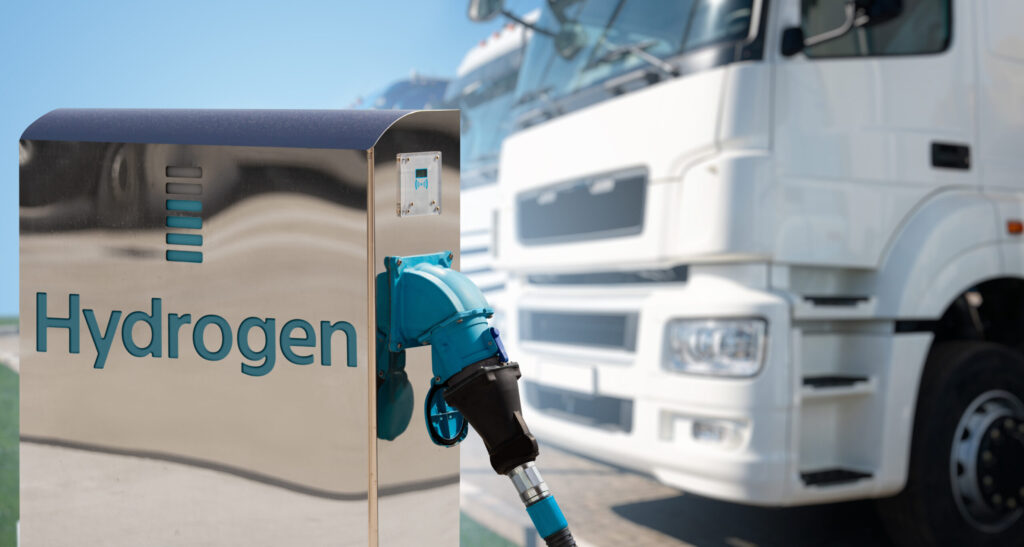
“A key advantage is range. The new Mercedes-Benz NextGenH2 Truck is expected to achieve ranges of well over 1,000 kilometers using liquid hydrogen. Battery-electric long-haul trucks can, in principle, also achieve long ranges, but they require very large and heavy batteries to do so. Hydrogen stores significantly more energy per kilogram, thereby enabling a lighter powertrain while still delivering very long ranges. This can allow for higher payloads, greater cargo volume, and thus improved cost-effectiveness for weight-sensitive shipments. Added to this is the short refueling time. Daimler estimates refueling times of about 10 to 15 minutes for its liquid hydrogen trucks. This is comparable to today’s diesel operation and is particularly appealing for international long-haul transport, just-in-time logistics, and vehicles that are in operation nearly around the clock.
Another point, of course, is the strain on the power grids. Large truck fleets require enormous charging capacity, and not every logistics location can easily provide several megawatts of additional power. Hydrogen can serve as an energy storage medium here and help circumvent certain grid bottlenecks.”
A common counterargument, however, is hydrogen’s significantly lower efficiency. Does it still make sense to use it?
“That’s probably the most important question. From a purely energy perspective, the battery clearly wins. For a battery-electric truck, typical overall efficiency ranges from about 70 to 80 percent, whereas for a hydrogen truck with a fuel cell, it’s more like 25 to 40 percent. With hydrogen, losses occur due to several conversion steps—from electrolysis through compression or liquefaction and transport to the fuel cell and the electric motor.
Nevertheless, energy systems should not be judged solely on the basis of maximum efficiency. With the rapid expansion of wind and solar energy, there are increasingly more periods of excess electricity. This energy can be stored, transported, or imported in the form of hydrogen. Furthermore, there are applications that are difficult to electrify directly.
The crucial question, therefore, is not: “Is hydrogen more efficient than a battery?” It is: “Is hydrogen the best available solution for a specific transportation task?” For very long distances, heavy loads, or an inadequate charging infrastructure, the answer may well be yes.”
Prof. Dr. Tobias Plessing
Furthermore, hydrogen can also be produced regionally from biogas. Based on this idea, we founded BtX-Energy GmbH, which is currently planning and having built the first commercial hydrogen refueling station between Kiel and Hamburg on the A1, a station that will be supplied with biogenic hydrogen from a biogas plant.”
How realistic is it to build a hydrogen infrastructure for trucks in Germany?
“Realistic, but significantly slower than originally expected. Germany already has more than 90 hydrogen refueling stations, most of which are operated by H2 MOBILITY. Some of them are already designed for commercial vehicles. In addition, the federal government launched a funding program in 2026 that provides 220 million euros to support the development of an initial network for heavy-duty vehicles. The program is intended to fund up to 40 refueling stations and around 400 vehicles. However, even Daimler has acknowledged that infrastructure development is proceeding more slowly than originally hoped. That was also one reason for extending the timeline for the industrial ramp-up. I consider a corridor network along major traffic arteries to be realistic by 2030. However, I do not foresee a nationwide infrastructure like that for diesel before the 2030s. For selected long-distance routes, however, such a network could already be sufficient.”
Is there a risk of competition between transportation and industry when it comes to hydrogen?
“Yes, that risk exists. Green hydrogen is needed particularly in the steel industry, the chemical industry, fertilizer production, and refineries. In some of these sectors, there are no better alternatives for decarbonization. That’s why many energy economists argue that hydrogen should initially be used where direct electrification isn’t feasible. For many truck applications, however, direct electrification is very much possible. Therefore, hydrogen will likely be concentrated in the most challenging transportation segments.
I believe the following division of labor is likely: Batteries will prevail in regional and distribution transport. They are also likely to be the predominant technology in long-distance transport up to about 500 to 800 kilometers. In contrast, for extremely heavy long-haul transport, international corridors, and certain specialized applications, I see good opportunities for hydrogen.”
When will hydrogen become economically competitive?
“That depends almost entirely on the price of hydrogen. Today, the total costs are usually still higher than for diesel or battery-electric trucks. For hydrogen to become economically attractive, several factors must align simultaneously: falling electrolysis costs, affordable green electricity, economies of scale for fuel cells, sufficiently utilized refueling stations, and rising CO₂ costs for diesel. Many market studies predict that hydrogen will become competitive for select long-haul applications no sooner than the early to mid-2030s. For battery-electric trucks, economic viability is likely to be achieved sooner in most segments. If gasoline and diesel prices rise above 2.5 €/l, hydrogen is already a good alternative.”

What would you recommend to a logistics company that wants to become climate-neutral by 2040?
“Quite clearly: a combination of battery and hydrogen. I would rely on battery-powered vehicles for about 70 to 90 percent of the fleet. This applies to regional transport, standard national routes, hub-to-hub transport, and distribution logistics. The advantages here lie in high efficiency, low energy costs, and the already rapidly growing market. The remaining 10 to 30 percent could be powered by hydrogen. This would be suitable for particularly heavy hauls, international long-haul transport, locations with poor grid connectivity, and operations with very high availability requirements.
If I had to advise a board of directors today, I would therefore say: Batteries will very likely be the dominant technology in heavy-duty transport by 2040. Hydrogen, however, will not disappear but will remain as a specialized complement for long-haul and heavy-duty applications.”
Prof. Dr.-Ing. Tobias Plessing
Daimler Truck’s strategy is currently moving in exactly this direction: “Battery first,” but hydrogen where range, payload, and fast refueling offer decisive competitive advantages.”
Thank you very much!