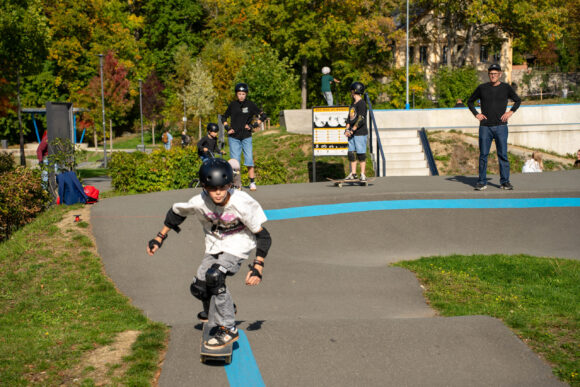


Hof University of Applied Sciences is launching a new research project at the Hof Skatepark to analyze the biomechanics of skating on pump tracks. The goal is to use artificial intelligence to visualize movement patterns, support training progress, and develop innovative learning opportunities for the skate community. The project focuses on workshops, modern sensor technology, and AI-based motion analysis conducted directly at the skatepark.

Skateboarding is a low-barrier sport: with a skateboard and a little space, you can practice almost anywhere. With the Hof Skatepark, the region also boasts one of the most modern facilities in Germany. The so-called pump tracks are particularly well-suited for beginners as well as fitness-oriented athletes. By shifting weight strategically, speed is generated without pushing off—while simultaneously training core and leg muscles.
“Pump tracks offer an ideal introduction to skateboarding because they promote a sense of movement, coordination, and fitness in a playful way. This is exactly where our research comes in.”
Prof. Michael Zöllner.
AI analyzes movements in real time
As part of the project, the “Interactive & Data Driven Systems” research group at the Institute for Information Systems (iisys) is utilizing modern 3D human pose estimation. Cameras capture and analyze the test subjects’ joint movements as a digital skeleton. This is supplemented by small sensors on skateboards and surfboards, which provide additional motion data.
The data collected is intended to help better understand movement sequences and specifically improve training methods. Plans include smartphone-based training guides and digital learning materials for workshops.
“We want to show how artificial intelligence and machine learning can be meaningfully applied in everyday life—not in an abstract way, but directly experienced in sports and leisure activities. At the same time, we’re inspiring young people to take an interest in technology, data analysis, and STEM subjects.”
Prof. Michael Zöllner
Research in collaboration with the skate community
The research group already presented its approaches live on-site at Skatedays 2025. Visitors could visualize their own biomechanics on an iPad and take the results home with them right away. More than 1,000 skaters of all ages attended the event. The new project now builds on these experiences and is being developed in close collaboration with the Hof skate community and the organizers of Skatedays. The results will later be made publicly available to all interested parties—including in the form of videos and digital training aids.

Science and Promotion of Young Talent
In addition to practical applications, the project also pursues scientific goals. The research results are to be presented, among other venues, at the International Workshop on Sensor-Based Activity Recognition and Artificial Intelligence.
The “Interactive & Data Driven Systems” research group at the Institute for Information Systems (iisys) at Hof University focuses on the analysis of human movement patterns, interactive data visualizations, and the development of cyber-physical sensor hardware. It is led by Prof. Michael Zöllner.