

Storing heat when it is available and using it again later: Latent heat storage systems can help make energy use more efficient. But what exactly happens inside such a storage system when it is charged or discharged? The Institute for Hydrogen and Energy Technology (iwe) at Hof University of Applied Sciences is investigating this question in a new research project supported by the Hans Viessmann Technology Foundation. An unusual measurement technique is being used: a glass fiber is designed to provide detailed temperature images from inside the storage unit.
The focus is on a so-called PCM latent heat storage system. The abbreviation “PCM” stands for “phase change material.” These materials store thermal energy through a reversible phase change. In the case of the commonly used solid-to-liquid PCMs, the material absorbs heat as it melts and releases it again as it solidifies—largely at a constant temperature. In heat storage systems, melting generally corresponds to charging and solidification to discharging; in cold storage systems, it is the other way around.
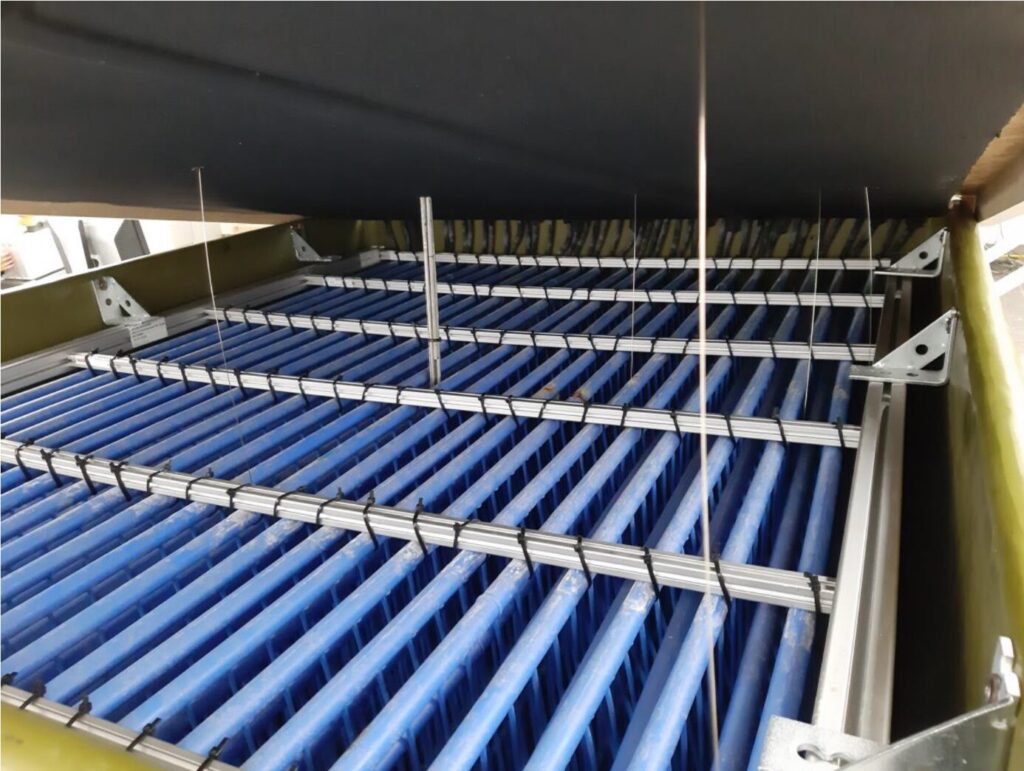
Organic paraffins or inorganic salt hydrates, for example, are suitable storage materials. To ensure that heat can be efficiently transferred into and out of the PCM, the largest possible heat transfer surface area is required. In the storage concept under investigation, the PCM is located directly inside the storage tank. Capillary tube mats are immersed in the material; a heat transfer fluid flows through these tubes, serving as an internal heat exchanger. The direct contact between the PCM and the capillary tubes eliminates additional transfer stages, such as those found in encapsulated PCM systems. The problem: Complex thermal processes take place inside the storage unit that are difficult to detect with conventional sensors. Individual temperature sensors measure only at a specific point. As a result, important information about temperature differences and the progress of the phase change remains hidden.
A Glass Fiber Becomes a Temperature Sensor
This is precisely where the research project’s unique measurement technology comes into play. Using a fiber-optic measurement system, a glass fiber is employed as a continuous temperature sensor. Instead of measuring at only a few points, it measures the temperature along the entire length of the fiber, thereby enabling a spatially high-resolution representation of the temperature distribution within the storage system.
“We want to understand as precisely as possible how the temperature is distributed within the storage system and how the phase change proceeds spatially and temporally.”
Matthias Kreuzer, Research Associate
The focus is on the question of how effectively the capillary tube mats thermally connect the entire PCM volume. The study examines what proportion of the material is actually involved in the phase change and thus in energy storage, how uniformly and quickly the PCM melts or solidifies, and whether areas with insufficient thermal connectivity arise.
Among other things, the researchers can observe how the so-called phase front moves through the material. This refers to the boundary between the regions where the storage material has already changed its state of aggregation and those where the process is not yet complete. The measurement is also expected to reveal local supercooling or undercooling.
Better Storage Through Better Data
The measurements are not intended merely to show what happens in the current experimental setup. The data obtained will then be compared with numerical models. This allows the researchers to verify how well computer simulations represent the actual processes occurring in the storage system.
Based on this, options for optimization will ultimately be developed—for example, in the design of heat exchangers or in the operational management of the storage facility. The results could later be applied to larger storage systems and other temperature ranges. To this end, the research team is first setting up a test rig, integrating and calibrating the fiber-optic sensor system, and then conducting defined charging and discharging cycles and evaluating the results accordingly.
The project is part of the Research Focus on Refrigeration Technology at the Institute for Hydrogen and Energy Technology at Hof University of Applied Sciences .