

How do you develop solutions for challenges that are so complex that no single discipline can address them alone?
This is exactly where the Ideation Week of the StartUpLab at Hof University of Applied Sciences comes in. Once a year, students from a wide variety of disciplines come together to work collaboratively on real-world challenges, bringing their diverse perspectives and skills to the table. This year’s theme: climate-resilient cities. With Prof. Günter Müller-Czygan serving as a technical facilitator from the newly founded ResilienceLab, participants developed ideas and solutions during the StartUpLab’s Ideation Week for urban spaces that can better address the consequences of climate change in the future.
Rising temperatures, longer dry spells, and more frequent heavy rainfall events are already showing today that the city of tomorrow needs new answers—and that is exactly what the participants spent a week searching for.
Nine degree programs, one challenge
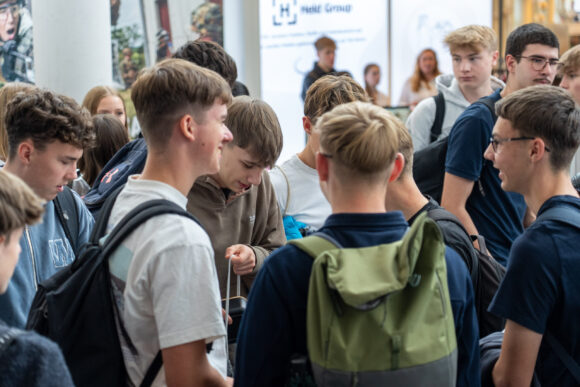
The basic idea behind Ideation Week is this: complex challenges require different perspectives. That is why students from a wide variety of disciplines are deliberately brought together here to work on a problem as a team. After all, climate resilience is not just a technical or ecological challenge. It also involves social, economic, design, and infrastructure issues.
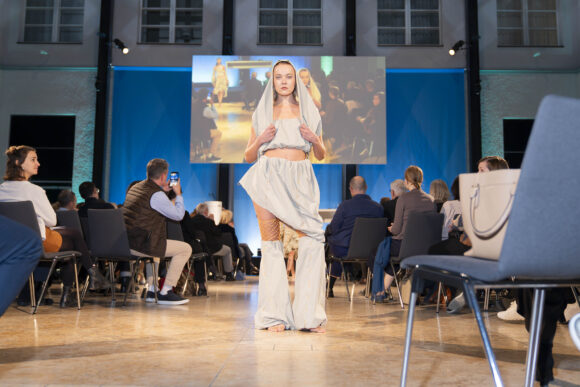
This was precisely reflected in this year’s group. The 13 participants represented nine different degree programs from a wide range of disciplines: The range of disciplines spanned from textile design and communication design to design & mobility, sustainable water management and engineering, and digitalization and innovation, all the way to business administration, business psychology, operational excellence, and international project management.

Whereas students typically work within their own disciplines during their daily studies, here technical, creative, economic, and social perspectives came together. This diversity made the week particularly valuable—and at the same time presented the teams with the challenge of first developing a shared understanding of the problem.
Understanding rather than rushing to a solution
The Design Thinking approach was therefore once again at the heart of Ideation Week. Unlike in traditional project work, this process does not begin with developing a solution, but with gaining the deepest possible understanding of the problem.
Following a technical introduction to the topics of climate resilience and the sponge city by Prof. Müller-Czygan, the students deliberately did not use the first few days of the week for brainstorming or prototyping. Instead, they conducted research, held discussions with potential user groups, and questioned their own assumptions.

For many, this shift in perspective was one of the most important experiences of the week. Time and again, it became clear that good ideas often only emerge once you truly understand the actual challenge and the perspective of those affected.
Creativity can be cultivated
Creativity, teamwork, and the constructive handling of uncertainty are among the most important skills in innovation processes. That is precisely why they are an integral part of Ideation Week and are not only discussed theoretically but also specifically put to the test. This year, the McGyver Challenge—offered by René Göhring in the Makerspace—was integrated into Ideation Week for the first time. Using specified materials, the teams were tasked with developing watercraft that could travel as far as possible. What initially seemed like a playful task had a clear purpose: experimenting together, making decisions under time pressure, discarding ideas, trying out new approaches, and remaining capable of acting as a team throughout.

At the same time, many participants were introduced to the Makerspace for the first time as a creative workspace and prototyping area. The experience with materials, tools, and experimental work prepared the teams for the next step of the week.
From Problem to Prototype
After the first few days filled with research, discussions, reflection, and idea development, things became increasingly hands-on toward the end of the week. At the Makerthon on Thursday, the teams transformed their concepts into tangible prototypes for the first time. Between 3:00 and 8:00 p.m., they built, tested, discarded, and refined their ideas in the Makerspace—always with the goal of making the previously identified problems as concretely tangible as possible and visualizing their own solution approaches.

In the process, three very different concepts came to life, all of which had one thing in common: they all viewed climate resilience from a different perspective.
New perspectives for existing roofs
A large portion of urban areas is already in use. This makes the question of how existing buildings can contribute more significantly to the climate resilience of cities in the future all the more exciting. The developed concept focuses on rainwater storage and the cooling of buildings directly via existing roof structures. This resulted in an innovative approach, particularly for densely built-up urban areas, that opens up interesting perspectives even beyond the Ideation Week.

Urban Oasis – Making Climate Resilience Tangible
Climate resilience does not have to remain invisible. The “Urban Oasis” gave rise to the idea of a multifunctional meeting place for public spaces. Greening, rainwater harvesting, shading, and quality of stay are all brought together in a single concept. The Urban Oasis combines ecological impact with social value and demonstrates how climate-resilient urban development can become visible and directly experienced in everyday life.

Fire Department Meets Sponge City
When discussing climate-resilient cities, the focus is usually on topics such as heat protection, heavy rain, or greening. However, the role of the fire department is rarely considered in this context. The developed concept therefore combines sponge city elements with fire safety requirements. In the future, stored rainwater could not only contribute to climate adaptation but also serve as an additional reserve of water for firefighting. The idea thus offers a new perspective on the question of what added value climate-resilient infrastructure can create for cities and municipalities.

More than just three ideas
The developed concepts met with great interest among experts in the field of climate resilience. The “Urban Oasis” was particularly impressive and was awarded the audience prize in the final vote by participants and guests from the Eintsein1 network. However, the true value of the week lay not solely in the results.
Ideation Week creates a space where students from different disciplines learn, discuss, question, and develop new perspectives together. Especially when it comes to complex challenges, innovation often doesn’t arise because someone knows the right answer—but because people from different backgrounds are willing to search for it together.