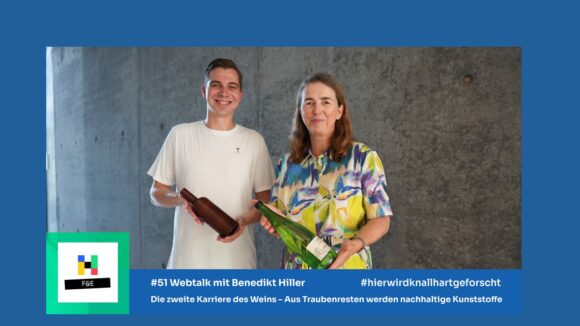


Since 2020, the “Forschende Hochschule Hof” podcast (available on YouTube, Spotify, and wherever podcasts are available) has been bringing science to places where it’s rarely so accessible: right into your ears. Launched as a “trial balloon,” the format has established itself—with 50 episodes to date, fascinating guests, and insights into research that too often remains behind lab doors. The varied episodes show just how diverse, practical, and sometimes surprising research can be—from AI and sustainability to student perspectives. To mark the series’ anniversary, we speak with its initiator, Anne-Christine Habbel, Head of Research Marketing, about the podcast’s concept, development, and impact.

Anne, do you still remember the moment when the idea for the podcast came about—what was the trigger back then?
“In 2019, we had just been awarded an INTERREG project for the first time, and our team had been discussing how we could further raise our profile among our European partner countries. And that’s how we came up with the podcast idea for our own region—via a detour through a short video for the European project. That was the beginning.
The funny thing was: During the first podcast at iisys, my cell phone was sitting on the table in front of us; Jörg Scheidt and I sat around it and recorded our discussion on the topic of the headache registry (#1), while Désirée Neeb made sure we didn’t forget anything. So no fancy tech—we just started out as enthusiastic amateurs with a cell phone. I listened to the episode again, and I’d say today that it’s actually pretty rough around the edges.”
The Webtalk originally started as a “trial balloon”—when did it become clear that the format was here to stay?
“Somehow it just went surprisingly well; we had a lot of fun during the recordings and learned a lot of interesting things from the research, which we also saw as exciting for sharing outside the university. We were very careful to avoid using jargon or difficult concepts; it was meant to be understandable, not intended for an academic audience. We’ve stuck to that approach to this day. It wasn’t—and still isn’t—hard to find “volunteers” from the university who are willing to chat about their research; these are often professors or research staff. Then we brought in a student to handle editing and ensure good sound quality, which made things a lot easier.”
Please walk us through it briefly: What does a typical podcast production look like—from the initial topic idea to the finished episode?
“Most of the time, these are research projects that have already yielded initial results or have been completed. I find them in lectures, at colloquia, or the Vice President for Research suggests them to me. Then I reach out to potential guests to see if they’d be interested in participating, and we set a recording date.
From there, I delve deeper into the topics, research what’s available, and formulate the questions: 10 questions, 10 answers—the structure is simple. The last question is always a personal one, so the guests can talk about their hobbies. That’s how you find out which professors are punk fans or have a goldfish pond at home, who likes to sail or play table tennis as a break from sitting in front of a screen all the time.
In a preliminary discussion, we check if everything is a good fit, and then we start recording just a few days later.


We almost always meet at iisys on the first floor. After Désirée Neeb, Katrin Müller was part of the team for a very long time. Now Christa Sprengard has taken over. They’re responsible for making sure the guests and I don’t forget anything, don’t make any logical errors, and that the doors at iisys don’t slam too loudly, etc. And now we also have Robert Bogler on board as a professional technician. He handles the sound and takes care of the editing. He also takes the photos that accompany the podcast when it’s shared. We couldn’t do it without the whole team.
Once the photos are done, we move on to the recording. Very important: The guests should be relaxed; we do a few voice tests to get everyone warmed up. Sometimes there are two guests, and then things get pretty lively in the recording room. Usually, everyone is in the right groove after two questions, and then things get exciting—we dive into the topics, and I don’t really notice what’s happening around me anymore; instead, I’m completely focused on the guests. The whole process never takes longer than two hours.
What’s particularly charming: Once the mic is off and we’re already packing up, the guests often just keep talking—they’re really in the zone, and that’s when some truly fascinating, often insider details come out.”
Are there any episodes or recordings that were particularly challenging—technically, in terms of content, or organizationally?
“For the past five years, I’ve been allowed to participate in Prof. Andreas Wagener’s marketing seminar as a fictional client. In other words: I act like a real company that assigns a project to the students. And I’ve actually commissioned quite a few podcasts as takeovers from the master’s students: For example, on the topic of what it’s like to study in Hof – Summer Edition 25 (#42). Or the presentation of student initiatives like eSports (#28) and HofSpannung (#17). There was even a children’s podcast, which was about fish, plants, and recycling (#27).
Since we have new students every summer semester, it’s always like a fresh start. And it’s great that we’ve had this time, because Prof. Wagener and I have gotten much better at defining the exact scope of the assignment. We’ve learned a lot, too.”
What criteria are used to select the topics and guests?
“There are various criteria: research topics must be ‘ripe’—results must already be available. Then there are developments within the university itself, or topics come to us from outside because they are socially or politically relevant.
We also like to invite research partners from the business sector from time to time, because that’s where the good collaboration between the region and the university is best demonstrated. The most recent example of this is #49: How Much Sustainability Is in a Car?


Topics like start-ups and entrepreneurship (#40) are particularly relevant to me right now, as they are playing an increasingly important role at Hof University of Applied Sciences. We want to better inform our researchers about these areas and are also offering seminars on the subject. The topic of water (#48) is also of great global importance, and we asked: How self-sufficient in water can a campus become?
Last but not least, the topic of Europe is also on my desk: This involves the Interreg and HORIZON funding programs, so we also created a podcast on this: #41 “Make the Most of Funding Instead of Missing Out—How to Succeed with EU Collaborations.”
Striking a balance between scientific depth and accessible communication for a broader audience is certainly not always easy…
“Oh yes, that’s true. Scientists naturally love to stick to their jargon, but we always intervene rigorously: ‘What does that abbreviation mean?’, ‘What is that foreign word?’, ‘Can you give concrete examples?’ I have to admit that sometimes we all jump in at once, as if on cue, and that really startles some of our guests. At least it shows that, despite our lack of expertise, we’re a well-oiled team.”
Is there anything from the past six years that has particularly stuck with you personally—and why?
“As a native of North Rhine-Westphalia, I speak much faster than people from Upper Franconia. I’ve often been told that I need to speak more slowly, especially on the podcast. So I went to speech training at the Hofer Theater. I learned to speak more clearly, with greater emphasis, and much more slowly, and I also know that I need to warm up my voice. My favorite exercise is ‘balali balalo balalü’—it really works!”
What kind of feedback do you get from listeners—and does it come mainly from the university itself or from beyond it as well?
“We listen to the podcast while baking, cleaning, doing laundry, driving, and also at the office and the gym”—those are the typical comments. We also regularly get feedback on which episodes are good or who speaks well. Our listeners include people from the region as well as from the university and its immediate surroundings. It’s also important in this context that guests share the podcast through their own channels; by doing so, they help raise awareness of themselves and the research at the university.
Clearly, we’re a niche podcast, and we approach it with passion and dedication. Also very important: Our guests trust us; nothing goes on the air unless they’ve given the go-ahead. It’s a huge privilege for us to be able to speak with the researchers; for me, it’s always like a glimpse into the future.”
Looking ahead to the 50th episode: How should the podcast evolve in the future—in terms of content or perhaps its format?
“We’re discussing making the podcast a bit more relaxed overall—more like a real conversation and less like a traditional interview. Maybe a live recording during the next Night of Science would be an idea? We’re also thinking about collaborating with another podcast; let’s see if that works out. Oh, there are so many ideas. But unfortunately, I’m not a full-time podcaster—the podcast only takes up a very small part of my workday, so I can’t really ask for too much. And we want to keep it fun, after all.”
Thank you so much for the interview!