

A flood forecast usually specifies a water level. However, emergency management agencies need to know which locations and roads will be flooded. The “RiFFER-EU” project, coordinated by the Institute for Sustainable Water Systems at Hof University of Applied Sciences (inwa) , is working to address this gap. In September, the German and Ukrainian partners met for their first workshop in North Rhine-Westphalia.
Heavy rainfall and river flooding are occurring more frequently throughout Europe. The flooding in western Germany in July 2021 demonstrated just how vulnerable even a well-equipped country can be. In some places, there were no short-term forecasts; in others, they were misinterpreted by disaster management authorities.
In Ukraine, the war has damaged monitoring stations. The bigger problem, however, lies elsewhere. Replacing outdated stations, improving forecasts, and connecting disaster management authorities to these systems are low on the priority list under wartime conditions—even though the protection of the population depends precisely on these measures. “RiFFER-EU” aims to change that. The results are also intended to benefit other countries in Europe.
From water levels to the question of what is affected
“RiFFER-EU” stands for “Risk-Based Flood Forecasting for Disaster Management in Europe” and will run from February 2026 to January 2028. In the future, a forecast will also show which areas will be flooded and whether, for example, a hospital or a substation is located in the floodplain. Only with this information can an incident command center decide whether to close a road or evacuate a neighborhood.
Initially, the partners are examining examples from Ukraine and Germany to see how the chain from measurement to response currently functions and where it breaks down. This will result in a concept that can be applied to other regions. The ultimate goal is to submit a proposal for a European research program involving additional countries and pilot regions. Inwa is coordinating the project under the leadership of Prof. Günter Müller-Czygan. Dr. Viktoriya Tarasyuk serves as the coordinator and maintains contact with the Ukrainian partners.
Visiting LANUK and HST
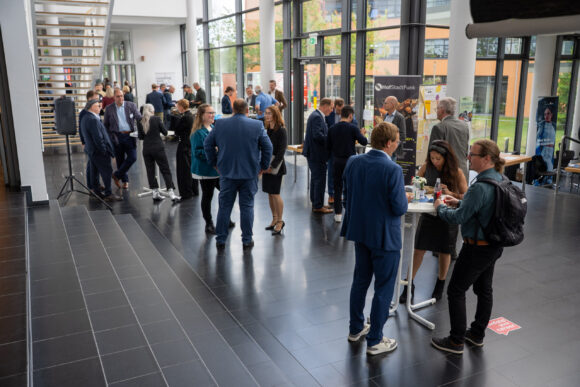
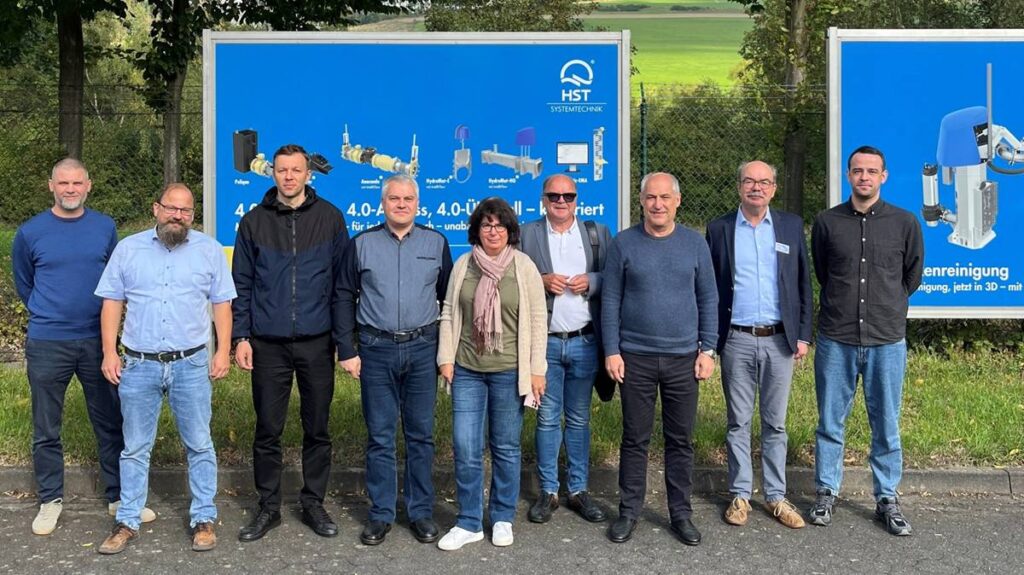
The workshop on September 21 and 22 was hosted by the State Office for Nature, Environment, and Climate of North Rhine-Westphalia (LANUK) and HST Systemtechnik GmbH & Co. KG in Meschede. A delegation from Ukraine attended, representing Taras Shevchenko National University of Kyiv, the State Emergency Service (SESU), and the Ukrainian Hydrometeorological Institute (UHMI). There is a reason for the choice of hosts. inwa has been collaborating with LANUK and HST for years on the DMeStHyA and NIQKI projects. Between 2021 and 2025, LANUK is upgrading its monitoring network of approximately 300 stations, and inwa has provided scientific support for this work.
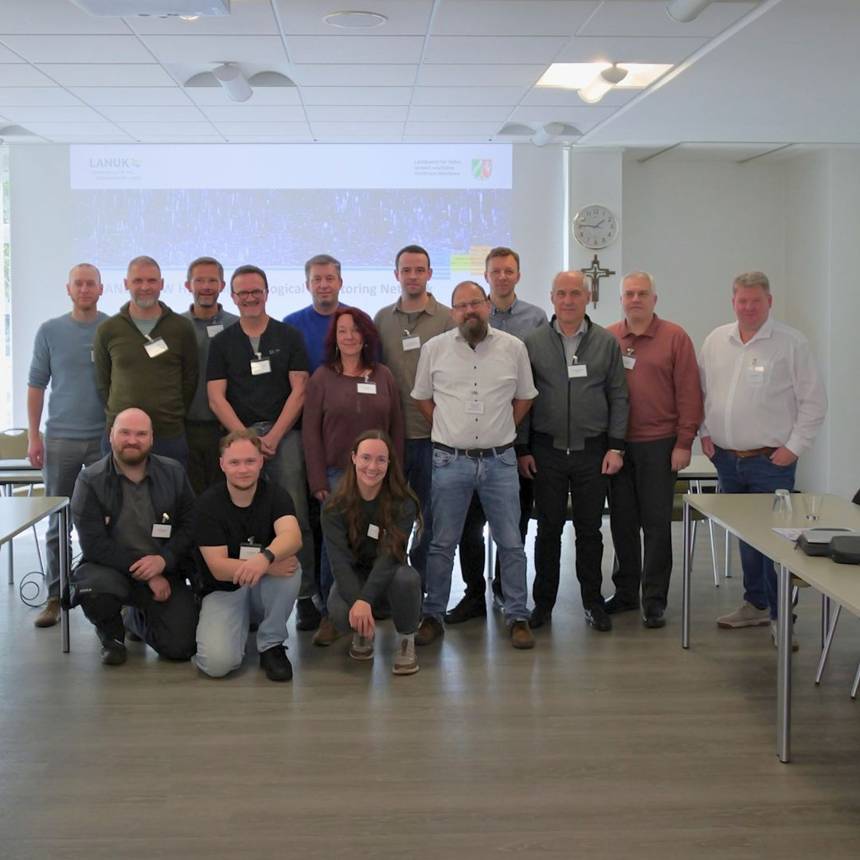
” inMagdeburg. Photo: LANUK;
“What we’re investigating in RiFFER-EU using Ukraine as an example affects Germany just as much as many other countries in Europe. Together with our Ukrainian partners, we’ve identified the basic concept—now we want to expand it to include other countries. LANUK and HST know from their own experience how much work goes into modernizing a large measurement network and what matters most in its operation. The fact that they are so willing to share this knowledge helps us greatly. We’ve worked together on several joint projects, and that really shows in our collaboration.”
Prof. Günter Müller-Czygan
On the first day, the experts from LANUK explained how the modernization was planned and implemented and how the staff experienced the transition during operations. A separate presentation addressed the question of how measurement data is collected and verified. Afterward, the group headed outside, first to a renovated precipitation station in Greven and then to the large lysimeter facility in Neuenkirchen-St. Arnold. There, for more than 60 years, parameters of the water cycle have been measured on three plots, each 400 m² in size, with different land uses.
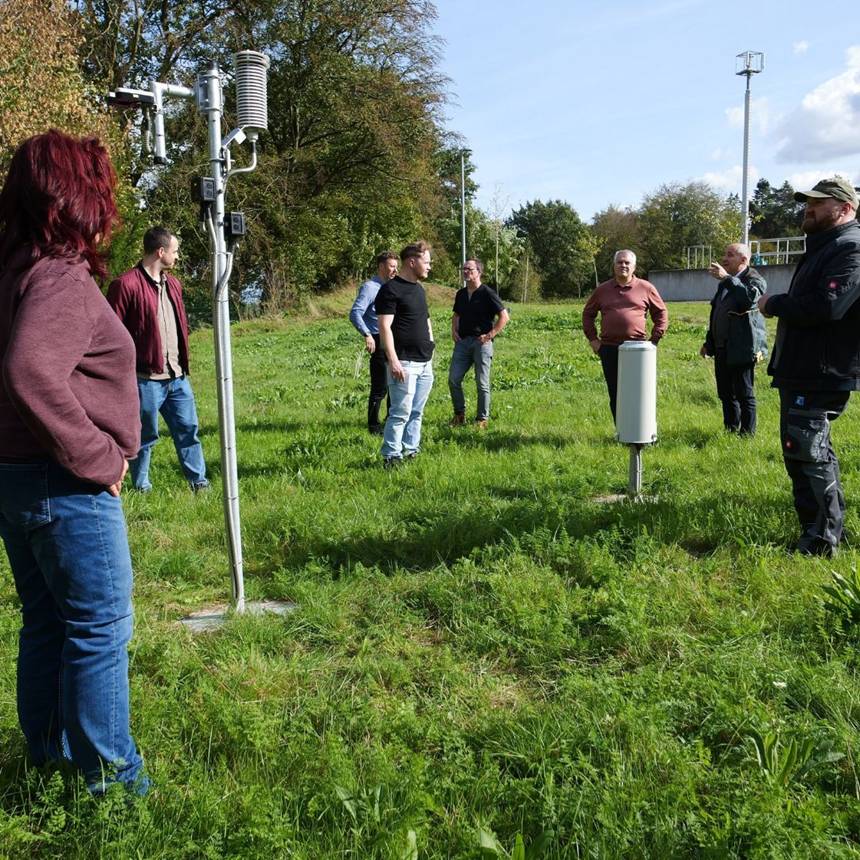
and operation. Photo: LANUK;
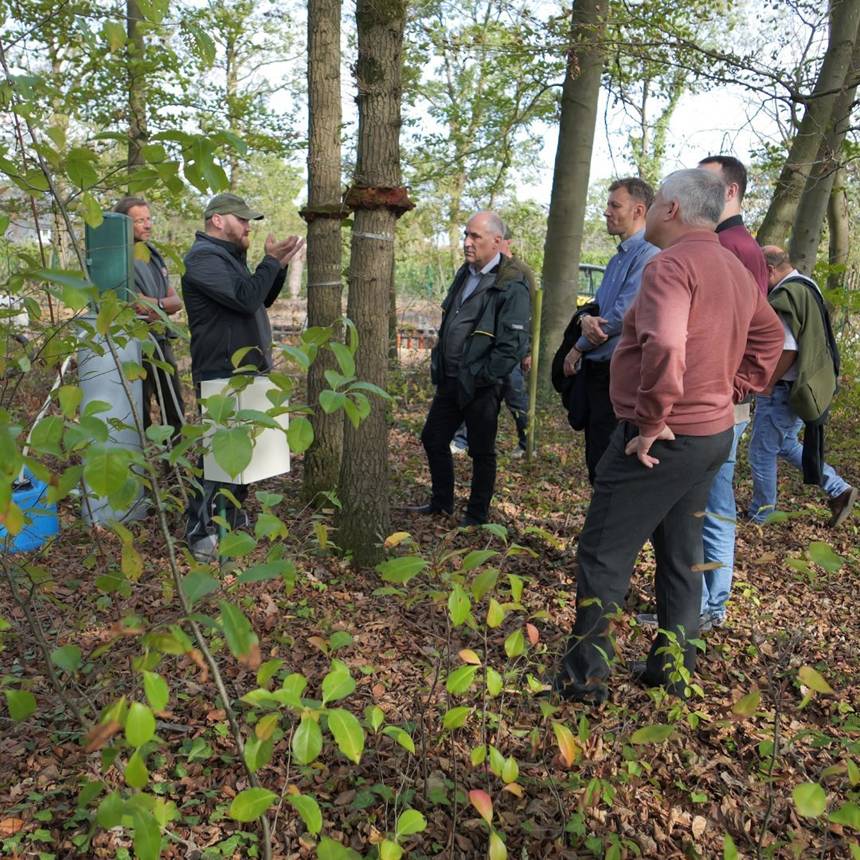
On the second day, HST demonstrated in Meschede the technology used by LANUK’s stations and how their data is transmitted. They also shared insights from international projects.
“A forecast is only as good as the data on which it is based. That’s why it was valuable for us to see the stations, the lysimeter, and the technology at HST with our own eyes and to speak directly with the people who work with them. That wouldn’t have been possible online. Collaborating with our German partners is an important step for us toward European research.”
Dr. Yurii Nabyvanets, Deputy Director for Science at UHMI
Partners for the Next Phase
There were many new developments for both sides: LANUK and HST aren’t waiting around—they’re already contributing their own ideas to the concept for the new European project. inwa would like to thank both for their hospitality and excellent organization. What was discussed over the two days will be incorporated into the analysis of the prediction chain and into the proposal for the second project phase.
“RiFFER-EU” is a joint project of Hof University of Applied Sciences and Magdeburg-Stendal University of Applied Sciences. It is funded by the Federal Ministry of Research, Technology, and Space (BMFTR) under the Bridge2ERA–Ea call for proposals.