

At Hof University, students don’t just study—they also conduct a great deal of research. That’s why in this podcast we’re talking about research topics, research facilities, and academic conferences at Hof University of Applied Sciences. Anne-Christine Habbel, the head of research marketing, chats with the researchers and offers a glimpse into their lives. And sometimes she hands the mic over to Hof University students: In the so-called “Takeover,” marketing students not only highlight research topics but also those that are of particular interest to the student audience. Let yourself be surprised!
Feel free to tune in again and again, because as you know: #thisplaceisallaboutresearch
Here are all the podcasts in the series:

#50 The Anniversary Podcast: From Idea to Institute: 48 Hours That Changed Everything
Prof. Richard Göbel, founder and first scientific director of the Institute for Information Systems (iisys)
50 podcast episodes—and a story that shows how research really comes to be. How do you build a concept for a research institute in just 48 hours? What does it take to turn initial ideas into sustainable structures? How does research evolve? And why do some projects continue to have an impact decades later?
In this anniversary episode, which also features the Webtalk team, Professor Richard Göbel discusses the establishment of Hof University’s first research institute—and how visions are transformed into concrete research. From the early days with just a few students to large-scale projects with international reach: it’s about courage, detours, and the question of what research must achieve today.
An episode about curiosity, perseverance—and why good ideas need one thing above all else: a person who can bring them to life and inspire others.

To the Institute of Computer Science…
To Prof. Richard Göbel’s research group…
#49 Bernd Trinkwalter and Prof. Thomas Meins:
How sustainable are cars?
Cars are supposed to become more sustainable—but what does that actually mean in concrete terms? The EU requires that vehicles contain significantly more recycled materials in the future. At the same time, components must remain durable, safe, and high-quality. Can recycled plastic really meet these requirements? And how can cars be designed so that their materials are turned into new vehicles at the end of their life cycle?
In the podcast, Professor Thomas Meins from Hof University of Applied Sciences and Bernd Trinkwalter, Head of Innovation at Motherson in Kronach, discuss the future of materials in vehicle interiors. They explain why biopolymers and recycled materials hold great potential—and where their research collaboration still faces real challenges. The conversation touches on the loves of life and a forty-year-old VW bus. It also addresses material innovations, the circular economy, and the question of how sustainable tomorrow’s cars can truly be.

Listen to the podcast…
To the Biopolymer Institute…
To the paper on “Structure and Properties of Recycled Polycarbonate Blends”…
#48 Andreas Aicher: Water Management of the Future – How Self-Sufficient Can a Campus Become?
Water from the tap seems like a given—yet that very supply is increasingly under pressure. Resources are becoming scarcer in Germany as well. That’s why a vision for the future is taking shape at Hof University of Applied Sciences: a campus that is gradually becoming water-self-sufficient—through rainwater harvesting, smart reuse, and innovative sponge city concepts.
Environmental engineer Andreas Aicher from Hof University demonstrates in the podcast how modern water systems already function today, what potential lies in smart infrastructure, and why sustainable water management must be scaled up now.
Because one thing is clear: the future of water won’t happen on its own. It needs ideas, research—and people who help shape it. This conversation invites you to rethink, think ahead, and become part of the solution for the world’s most important resource. Listen now and help shape the future of water!

To the podcast…
To the Institute for Sustainable Water Systems (inwa)…
#47 Prof. Dr. Heike Markus: “Frost on the Way! How AI Is Revolutionizing Winter Road Maintenance”
The first snow is falling, Bavaria is turning white—and suddenly every curve becomes a slippery slope. But what if we could predict icy conditions before they occur? Can artificial intelligence really predict exactly where conditions will become dangerous next? And how does that change safety on our roads—for winter road maintenance crews, drivers, and all of us?
In the new web talk, Professor Heike Markus discusses her project that could revolutionize winter road maintenance: AI-powered real-time slippery road forecasts, data from over 500 weather stations and sensors in winter maintenance vehicles, precise models from Bavaria—and a look at Scandinavia and North America.
To scale up the ice forecasts and bring them to the roads, Heike Markus is also actively seeking partners—such as cities, counties, mapping service providers, automotive companies, or other innovation leaders—who can take the project to the next level. An exciting podcast on a topic that affects us all.

Research group led by Prof. Dr. Heike Markus (Institute for Information Systems iisys)
#46 Prof. Matthias Drossel: “Care in Transition – Why Now Is the Time to Act”
Who will care for us tomorrow—when the baby boomers retire and more and more people need support? As early as 2029, a tipping point looms, when an increasing number of people in need of care will face a dwindling number of skilled professionals. How can care even function under these conditions? And why, despite all the reforms, has it been so difficult to make the profession more attractive?
In the new web talk from Hof University of Applied Sciences, Anne-Christine Habbel speaks with Professor Dr. Matthias Drossel about the big questions facing the future of care: from the academization of the field and international skilled workers to innovative solutions from science and practice. The experienced nurse and medical educator explains why 2029 could be a turning point—and how research, technology, and education can help ensure care provision.
An honest conversation about bottlenecks, opportunities, and new paths in a nursing system that affects us all.

Center of Excellence for Health and Sustainability…
Nursing degree programs launched in Bamberg…
#45 Prof. Sven Rill: “AI Made in Hof: Why Hof University Is Building Its Own AI”
Everyone knows ChatGPT, Mistral & Co.—but have you heard of “Lisa” and “Luis”? Hof University has gone ahead and built its own language models based on open source. Why? Because data protection, flexibility, and independence are more than just buzzwords.
But how does a campus AI really stack up against the big US giants? What surprising advantages does it offer when all data remains securely on campus? What happens when students learn to consciously challenge the AI from time to time? And how exactly is artificial intelligence transforming teaching, research, and administration at a university?
Professor Dr. Sven Rill from the Chair of Mobile Computing takes us behind the scenes in this podcast: from the initial idea to practical implementation. An exciting conversation about how to take innovation into your own hands, what opportunities are opened up by tailored solutions—and how responsibly developed AI can create a real competitive advantage.

Listen to the podcast: Prof. Dr. Sven Rill: Why Hof University is building its own AI
AI User Center – IISYS User Center
#44 Kronach Research Center:
When Research Becomes Real Solutions
How can scientific findings be directly transferred into business practice? The Kronach Research Center at Hof University of Applied Sciences demonstrates how innovative research becomes tangible—application-oriented, collaborative, rapid, and delivering real added value for companies.
In the latest podcast episode, Katrin Müller and Sarah Mohr discuss their work at the intersection of academia and industry. Together with regional companies, interdisciplinary teams develop solutions for real-world challenges—for example:
– Optimizing interfaces in autonomous vehicles
– Analyzing customer needs for air conditioning systems
– Developing AI-powered assistance systems for production machinery
But what makes this collaboration so special? How does one get started on a project? And why do companies of all sizes benefit? Answers to these and many other exciting questions can be found in this episode. Listen now and discover how academia and industry are creating innovation together!

Here you’ll find all the information about the research center’s projects and contact details: Kronach Research Center – Hof University of Applied Sciences
#43 Jette Petzold: “Ph.D., Professorship & Potential: Your Plan for the Post-Master’s Phase”
You’ve got your master’s degree—now what? For many, entering the business world directly seems like a given. But what if your next big opportunity lies in academia? How do you really get started on a Ph.D.—from finding a topic to securing funding? What opportunities do scholarships, research projects, or collaborations with companies open up? And why can Hof University be not just a place to study, but also an exciting workplace with real career opportunities?
Career advisor @Jette Petzold from Hof University of Applied Sciences discusses in the podcast how diverse, personalized, and achievable the path to research is. She provides insights into counseling services, shares the experiences of current doctoral students, and explains why a doctorate can be more than just a title: it’s a door opener for your personal academic career. Give it a listen—maybe you’ll discover your next step!

Listen to the podcast…
Academic Career at Hof University of Applied Sciences – Hof University of Applied Sciences
Interviews with PhD candidates at Hof University of Applied Sciences
Dream Job Category: How Do You Actually Get a Professorship
#42 Studying in Hof? Why studying at Hof University is worth it
Still looking for a degree program that’s right for you? Soon you’ll get an authentic look at student life at Hof University of Applied Sciences and what makes it special. Plus, a true Hof local tells us what the city and region of Hof really have to offer and which experiences you shouldn’t miss. Spoiler: affordable rent, modern degree programs, and a personal atmosphere where you’ll quickly make friends.
What to expect:
• Personal experiences instead of marketing jargon
• Tips on life, housing, and studying
• Favorite spots and real stories from students & locals
Whether you’re just exploring your options or simply curious—this podcast is your shortcut to real info, honest opinions, and authentic insights! So if you’d like to find out why studying at Hof University is worth it, check out our new podcast episode!

Go to the podcast…
To the program finder…
To the degree programs at Hof University of Applied Sciences…
#41 Make the most of funding instead of missing out—here’s how EU collaborations work
If you want to make research future-proof, you can’t ignore Europe: What role do alliances with democratic partners play in this? Hof University of Applied Sciences shows how to make the transition: Through targeted network management, strong EU consortia, and measurable impact for science and the region. Why are international collaborations no longer just an option today, but a prerequisite? How do grants make an impact where politics, business, and research go hand in hand? And what do funding agencies need to know to enable forward-thinking research? – Find the answers in a conversation with network manager Katrin Müller from Hof University of Applied Sciences. A podcast for everyone who doesn’t just want to talk about research, but wants to shape the future.

Link to the podcast
Europe Pages
Upper Franconia Economic Region
#40 From the Lecture Hall to the Startup: How Hof University Fosters an Entrepreneurial Spirit
How does a university manage to catapult itself from 43rd to 14th place in the German startup ranking by the renowned Stifterverband? Hof is emerging as a hotspot for entrepreneurship in Bavaria—thanks to a digital startup center, a makerspace, and professors with a startup mindset. In the future, research ideas are to be specifically transformed into marketable business models, supported by projects such as the new “Go Gründungshub Oberfranken.” In the Hof University web talk, Prof. Michael Seidel and Prof. Oliver Mauroner explain why entrepreneurship has long been part of modern higher education for them. They provide insights into their work, highlight successes, discuss challenges—and explain which structures truly drive startups at universities. Why are sheep’s wool and golf courses suddenly a topic in innovation studies? And what can other regions learn from Hof? Find the answers in the latest research podcast. It’s worth a listen!

Einstein1 Digital Startup Center
#39 Marc Lehmann
“How can cities be better prepared for climate change?”
How do heat islands form, and what role do artificial intelligence and sensor networks play in detecting and combating them? In the podcast, we discuss the “KLIPS” project, an innovative AI-based platform that provides real-time analysis services—such as locating current heat islands, provides machine learning-based forecasts for the next 48 hours, and enables simulations to run through the effects of construction or planning measures on the urban climate in advance. But how do you ensure that all this data is used in compliance with the law? Marc Lehmann, a doctoral candidate at Hof University of Applied Sciences, explains why data governance is crucial and what happens when flawed data is used. Look forward to exciting insights into strategies against heat islands, law, and technology—and a search for sensors in Dresden!

#38 Prof. Dr. Valentin Plenk
“Rethinking Transfer: How the University Brings Knowledge to Society”
In the new podcast from Hof University of Applied Sciences, Professor Valentin Plenk, Vice President for Research and Development, discusses the growing importance of knowledge transfer. Plenk explains why universities are needed today more than ever as a link between science, business, and society, and introduces the “Third Mission” of universities: actively shaping the exchange with society. But how does Hof University bring research results to the region? What role do events such as the Science Day of the European Metropolitan Region of Nuremberg, the Dies Academicus, or the networking meetings of “Frauen.Stärken.Hof” play? And what role do purely internal formats such as departmental colloquia or the “brain massages” play? Why is this exchange so crucial right now? The podcast offers insights into how the university is driving knowledge transfer through innovative formats, thereby providing new impetus for society—from technology and knowledge transfer to topics such as the circular economy, water management, and regional development. A must-listen for anyone who wants to know how knowledge transfer works today and why universities are far more than just places of learning.

Hof University of Applied Sciences Event Calendar…
#37 Corinna Anzer
Technology Meets Nature: Machine-Woven Wood
In this podcast takeover, students from Hof University of Applied Sciences speak with Corinna Anzer, technical director of the Weaving and Wickerwork departments, about the innovative process of technical radial weaving, which is being researched at the Institute of Materials Science (ifm) at Hof University of Applied Sciences. Robust and versatile: This process can be used to produce wooden structures from willow wood that could find applications in various industrial sectors in the future, such as aerospace or recycling. The biggest challenge was producing a homogeneous and stable willow thread capable of withstanding the high bending stresses involved in weaving. Through specialized processing steps, a suitable thread was ultimately developed.
Compared to conventional materials like cotton, willow wicker offers the advantage of being a renewable, locally available raw material that requires minimal resource consumption. In the future, it could replace energy-intensive fibers and make a significant contribution to sustainability. The project is now moving into a second phase, which will focus on industrialization and expansion into other textile processes. Students also have the opportunity to participate as assistants and gain valuable experience. Find out what other potential this technology holds in today’s podcast.

#36 Prof. Dr. Michael Nase
“Circular Economy and Bioplastics”
In the latest episode of our podcast, we dive deep into the world of bioplastics and the circular economy. Our guest is Professor Michael Nase from Hof University of Applied Sciences, founder and scientific director of the Institute for Circular Economy at Bio:Polymere.
What challenges arose when founding the institute? What goals is Michael Nase pursuing, and why are bioplastics and recycling his passion? These and other questions are answered in the conversation. Learn through examples why short-lived products should be made from bioplastics and long-lasting ones from conventional plastics, and exactly how research is being conducted on these innovations.
Professor Nase also explains how he manages to protect the environment while working closely with regional industry. How does one avoid downcycling, and which projects have particularly shaped him and his team? Let yourself be inspired by these insights into the research landscape.
Tune in and discover how biogenic waste materials like wine and coffee waste are turned into valuable resources and what innovative recycling strategies are being developed for plastics.

To the podcast…
To the Institute for Circular Economy of Bio-Polymers…
#35 Prof. Dr.-Ing. Tobias Schnabel
“Safe, Clean Water”
Today’s topic is human waste: What happens to our waste? Feces and urine contain excellent fertilizers—namely phosphorus and nitrogen—and currently, through our use of toilets, they are mixed with other wastewater containing pollutants in the sewage system. How can we better separate these materials into fractions, and which process is best for recovering important raw materials? Would different types of toilets than the ones we use today perhaps be better? “My research focuses on safe water reuse,” says Professor Dr.-Ing. Tobias Schnabel of Hof University of Applied Sciences, who holds a professorship in Urban Water Resources Management. You’ll hear in today’s podcast what role light and heat can play in this process.
Listen to the podcast…
To the Photonics and Water Research Group…
The Catavolt and UVPHON projects…

#34 Anja Grabmeier
“Sustainability is always a shared responsibility”
“Already 25% of universities have a sustainability strategy, and another 64% are in the planning stages,” says the German Association of University Founders. Sustainability has been a key component at Hof University since 2015, in line with the “Green-Tech University” mission statement. Since 2022, greater emphasis has been placed on sustainability, and a sustainability management system has been established. In a concept developed by Anja Grabmeier, the sustainability manager at Hof University of Applied Sciences, the campus is to be designed as a living space, a place of learning, and a space for knowledge transfer with a focus on Green Tech—ecological, social, and economic—with all members of the university community involved.
In the web talk, the research assistant explains how awareness and interest on campus have changed in a very short time. She highlights how the research institutes focused on sustainability topics right from their inception and sheds light on what other sustainability-related activities are already taking place today.
Listen to the podcast…
Sustainability at Hof University of Applied Sciences…
Institute for Sustainable Water Systems…
United Nations Sustainable Development Goals…

#33 Katharina Schiller:
“Traditional phishing works via email”
“Phishing is all about the human factor,” says Katharina Schiller from Hof University of Applied Sciences. She researches the theft of login credentials, which are obtained from users through fake emails. She explains why preventive measures—such as employee training—as well as other steps are particularly important. In the podcast, she discusses potential attack vectors, security concepts, and countermeasures for identifying vulnerabilities. As a doctoral candidate, she is collaborating with Friedrich-Alexander University Erlangen-Nuremberg on a study of various support systems to help users better protect themselves. “When emotions are involved, people act differently,” says the security expert. She also explains why she has since developed a greater distrust of technology.
Listen to the podcast…
To the research group…
Federal Office for Information Security…
Consumer Advice Center…

#32 Prof. Marco Linß
The Hof MINT Steering Wheel 2.0 – Navigating Your Studies Safely!
With over forty degree programs, Hof University offers a highly diversified and target-group-oriented curriculum in the fields of mathematics, computer science, natural sciences, and technology—known as STEM. The Hof STEM Steering Wheel brings together various measures aimed at reducing the dropout rate. Grade monitoring, in particular, has proven to be a suitable tool for alerting students at an early stage to potential risks to their academic success. This is because around one-third of students drop out of their studies, a figure that Prof. Marco Linß from the Faculty of Engineering at Hof University considers far too high.
To reduce dropout rates, the mechanical engineer with a Ph.D. has been researching for many years—using the “Hofer MINT Steering Wheel”—which specific factors contribute to academic success and which do not. He no longer wanted to rely on gut feelings but instead to generate reliable data on the matter. This has resulted in measures that begin even before students start their studies, accompany them throughout their academic journey, and continue to have an impact long after graduation. The model is so effective that other universities are following its example.

#31 Norbert Kühl
Successful nonwoven cooperation: “IFM has the greatest focus on nonwovens in the German-speaking world”
The Austrian company Lenzing has been a research partner of Hof University of Applied Sciences for many years. As a global producer of textile fibers for both traditional apparel and nonwovens, the company sought to establish a close relationship with the Münchberg-based Research Institute for Materials Science to gain access to its nonwoven pilot plants. The collaboration was formalized with the signing of a cooperation agreement in 2019. The tests conducted at the pilot plant are intended to help improve the processing properties of Lenzing fibers and gain a more precise understanding of how the fibers influence the functionality of a nonwoven fabric. This significantly shortens the time from concept to final product.
Norbert Kühl, Senior Manager in the New Business Development division at Lenzing, explains in today’s podcast why the textile industry has always fascinated him and how the collaboration began at the Hof Nonwovens Days and subsequently evolved. He also explains the topics Lenzing is currently researching: for example, the EU’s Single-Use Plastics Directive, which aims to prevent the use of plastics and replace them with compostable and sustainable alternatives.
Listen to the podcast…
About Lenzing…
To the Institute for Materials Science (ifm)…

#30 Jonas Othmann
The student initiative Consulting Hochfranken
Our students in the Master’s program in Marketing Management have created a brand-new podcast in collaboration with the student initiative Consulting Hochfranken. It offers exciting insights into the world of consulting and is an absolute must-listen for all consulting enthusiasts, students, and companies alike. In this podcast, Jonas Othmann (former board member of Consulting Hochfranken) shares his extensive knowledge, best practices, and first-hand experiences to offer you valuable and practical insights.
Whether you’re an aspiring student looking for new strategies, running a business, or simply want to expand your knowledge—this podcast is for you!
Listen to the podcast…
To the Consulting Hochfranken initiative…

#29 The Ice Battery – More Than Just a Conventional Energy Storage Solution
A resource-efficient and simultaneously infinitely scalable option for energy storage? That is exactly what the ice battery—part of a research project at the Institute for Hydrogen and Energy Technology—aims to offer.
In this podcast episode, which is another part of the Hof University of Applied Sciences takeover, you’ll not only learn more about how the ice battery works and its advantages, but also how this storage technology could be socially relevant in the future.
In addition, our interview partner Michael Dölz provides insight into his daily responsibilities as a senior technician at the Institute for Hydrogen and Energy Technology and into other exciting research projects he is working on together with his colleagues.
Institute for Hydrogen and Energy Technology at Hof University

#28 The eSports Initiative (HUe)
Studying isn’t just about sitting in lectures and studying for exams: At Hof University of Applied Sciences, there are numerous student initiatives, including the eSports HUe initiative. The Marketing Master’s students take the microphone and interview the founder of the eSports initiative, Vincent Tischler. How are strategies for tournaments developed? Why is it worth checking out the initiative? These and more questions are answered in the podcast!
Listen to the podcast…
To the HUe eSports Initiative and other student initiatives…

#27 Dr. Harvey Harbach and Paul
Fish, Plants, and Recycling – Hydroponics Explained in Simple Terms
Finally, an episode for the little listeners among us!
In today’s episode, Dr. Harvey Harbach talks about the NaLea educational project. We dive deep into the world of fish, plants, and recycling. Together with Paul (age 10), our co-host, this episode explains hydroponics and other exciting phenomena in a way that’s easy for kids to understand. NaLea is the educational project of the internationally oriented master’s program “Sustainable Water Management and Engineering” at Hof University of Applied Sciences. Using a participatory and independent approach, the project addresses the planning, construction, and operation of an aquaponics system. This combined production process—combining fish aquaculture with plant hydroponics—is designed to present challenges related to nutrient recycling, with solutions that can be applied in an interdisciplinary manner. Digital and management skills are taught through innovative, semi-virtual, and self-directed learning content.

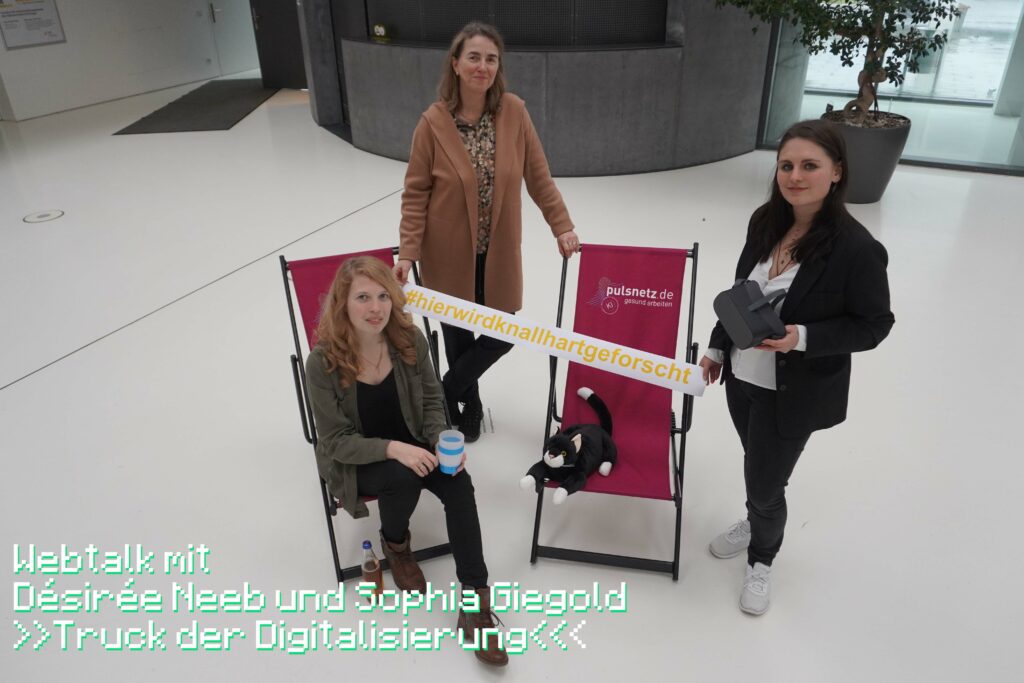
#26 Désirée Neeb and Sophia Giegold
“We didn’t talk people into anything”—dispelling concerns about digitalization in care with Trudi
They care for us when we are no longer able-bodied or simply old. But how do we keep them fit in the long run? We’re talking about caregivers in the health and social care sectors. This is where the pulsnetz AI project comes in: new ways of working—which rely in particular on digital tools to support specific tasks—are designed to simplify caregivers’ work lives.
Two research assistants from Hof University have delved deeply into the subject and are showcasing around sixty different digital aids, including an assistive floor that calls for help in the event of a fall or automatically turns on the lights. The project also features a robot cat and VR glasses for relaxation or therapeutic training. Désirée Neeb and Sophia Giegold from the Institute for Information Systems (iisys) traveled about 10,000 km across Bavaria, visiting 25 facilities and holding introductory courses there. Why one of the two is nicknamed “Tech Mom” by the team and who TruDi actually is—we’ll explain that in this podcast.
Innovative Health Systems Research Group
#25 Prof. Dr. Daniel Werner
Category: Dream Job: How Do You Actually Get a Professorship?
It’s not that hard: Daniel Werner, founding director of the Bavarian-Indian Center and now a professor of economics specializing in Asia, explains in the podcast how he went from an apprenticeship, to technical college, then to university and a PhD, ultimately landing his professorship. Not exactly a straight path, but still very much possible, as he himself says. A lot of things just fell into place. Trade between developing countries was and remains his focus; it has been a constant in his life, and he says: If you have your niche and find a professorship in that field, you simply have to apply—positions with the right topics are just too rare.
He didn’t have a grand plan to become a professor, but several years in industry are an important formal requirement. The phase of the two trial lectures he had to give as part of his application was exciting for him. Today, he appreciates the freedom and flexibility of his job at a practice-oriented university.
Professor Daniel Werner is an example of how one can achieve a professorship even without an academic background or family role models.
To the podcast…
Link to his CV…
To the Bavarian-Indian Center…

#24 Dr. Dirk Reinel
How an idea became a startup: “We just took the plunge and started the company.”
Starting a business is no easy feat, yet they did it six years ago: Dr. Dirk Reinel from the IT company smartlytic GmbH talks about how he and his two fellow students first worked together as research assistants at the Institute for Information Systems after graduation, then earned their doctorates, and finally founded the company together. “I wouldn’t do much differently,” he says, because smartlytic was built up alongside his job, starting a family, and pursuing his doctorate. In the podcast, we hear why the three managing directors took a calculated risk, where they sought support, and why you don’t necessarily need an EXIST startup grant. Regarding Hof University of Applied Sciences, Dirk Reinel, who is responsible for data analysis projects, says: “It remains very important to us, for joint projects and, above all, for exchange,” because in the beginning, the three founders first had to make a name for themselves. The team finds a balance at the ping-pong table, which is located in one of the new office spaces.
To the DMKG Headache Registry…
Startup support from Hof University of Applied Sciences…

#23 Prof. Günter Müller-Czygan
Sponge Region and Sponge City: A New Solution to Floods and Droughts?
The impact of climate change on cities and rural regions is one of the top issues in our society today. Due to the consequences of a steady increase in extreme weather events such as droughts, floods, and heat waves in recent years, water management in urban planning must now be reimagined. The transformation of urban spaces into so-called sponge cities or sponge regions is increasingly being recommended as an effective means of making cities and regions more climate-resilient. Water expert and endowed professor Günter Müller-Czygan discusses examples such as Berlin, Bamberg, and Selbitz, and explains how green roofs, retention basins, playgrounds, and infiltration trenches are being utilized not only in these locations but also in industrial facilities and at Hof University of Applied Sciences.
To the article “Sowieso Strategy”…

#22 Prof. Dr. Frank Ficker
Nonwoven and Fleece: What’s the Fuzzy Difference?
Why they sound exactly the same but are completely different: fleece and nonwoven fabric. They differ fundamentally in both production and application. What’s the difference, how is research conducted on nonwovens, and what are they used for? In this podcast, we’ll explain how their use has changed in the age of COVID-19—think face coverings and masks. We also discuss technical nonwoven applications in cars, feminine hygiene products, diapers, and wet wipes. All of these have contributed to the development of a unique European research infrastructure in Hof and Münchberg.
The Hof Nonwovens Days took place for the 35th time in the fall of 2022: a traditional conference that brings around 500 guests from all over the world to Hof every year. As the scientific director of two research institutions, Prof. Frank Ficker, together with his teams, is the driving force behind these activities. Under the motto “Thin-film technology in Hof meets textile technology in Münchberg,” he achieved his greatest coup: the reflector antenna for use in space, designed to ensure better communication with Earth.

#21 Michael Bitzinger
Hof University of Applied Sciences as a Partner to Businesses
He describes himself as a “Hof University fanboy,” and indeed, hardly anyone knows Hof University as well as he does: As a former student of business informatics, he founded his company while still in school and recently celebrated its 20th anniversary: Michael Bitzinger of the digital agency Bitzinger. For quite some time now, in addition to many other networking activities, he has also served as the volunteer chair of the Hof Chamber of Commerce and Industry (IHK) committee and now views “his” university from this new perspective.
In the podcast, he explains why, from the IHK’s perspective, Hof University of Applied Sciences is a “magnet for young people” and, at the same time, a bridge to businesses when it comes to research projects and contract research. “The Hof Chamber of Commerce and Industry committee leads a robust yet self-assured life of its own,” says Bitzinger, noting that it focuses on topics such as digitalization, innovation, and networking—areas in which Hof University of Applied Sciences also conducts research. The IHK supports companies interested in research by providing innovation consulting to bring together partners from business and academia. He explains why he himself is involved in two research projects at iisys and why he values Hof’s business-oriented and practice-oriented approach.
Listen to the podcast…
To the IHK Hof Committee…
To the IHK for Upper Franconia (Research) …

#20 Prof. Dr. René Peinl
On computers reading aloud and the “health status” of machines
With its many years of experience across a wide variety of research groups, the Institute for Information Systems at Hof University of Applied Sciences (iisys) supports companies in the region and beyond. The DAMMIT project, led by Prof. Dr. René Peinl, focuses on image and speech processing; in its seven subprojects, for example, text was translated into speech, physical objects were visualized online, and the “health data” of machines was recorded. Prof. Peinl, who is also the scientific director of iisys, talks about his favorite DAMMIT project, about working in projects without red tape, and how, after two successful projects funded by the European Regional Development Fund (ERDF), he hopes to launch a third one as soon as possible: “Trilogies are all the rage these days,” as he puts it.
To the podcast…
To the DAMMIT project…

#19 Lucas Großmann
“We are all biopolymers!”
Four kilograms of plastic are released into the environment per person per year in Germany. To reduce this amount, the Institute for Biopolymers (ibp) is conducting research on new bioplastics. In the podcast, Lucas Großmann, deputy director of the institute, discusses research on bioplastics for food packaging, agricultural films, and bioplastic components in general, as well as how these are manufactured using the injection molding process. “Bioplastics can be a lucrative niche,” says the Hof-based researcher, which is why he sees the university’s main task as helping companies in the region find these niches. With this objective in mind, there are already diverse collaborations with innovative companies in the region. To reach even more companies in the region, Lucas Großmann’s team organizes the “Bioplastics” conference every two years in addition to regular networking meetings. Unlike other conferences, this event focuses equally on science and industry. The aim is to specifically promote interfaces, joint projects, and general collaboration between industry and academia. After all, meaningful collaboration is only possible when one understands the other party and their challenges and problems.

#18 Dr. Enrico Putzke
Heart, keep beating!
Stroke or heart attack: Around 6 million people in Germany suffer from coronary heart disease. In about 300,000 of these cases, a coronary artery becomes blocked. Dr. Enrico Putzke, Managing Director of the Institute for Materials Science (ifm), explains in the podcast the new approaches the ifm is taking in the manufacture of cardiac stents and what candle wicks, ropes, and the new stents have in common in this context. He also explains the important role that bobbins play in the production process and which new patents the ifm has recently filed.
The ifm’s Weaving and Braiding Research Group has laid the groundwork for production to take place in a continuous process. The podcast explains how this works and how to handle stents that have a diameter of 5–6 mm.
For many years, the Institute for Materials Science has been involved as a co-organizer of the Nonwovens Days in Hof. European specialists from the textile and related sectors, as well as around 70 exhibitors, will accept the invitation to Hof on September 20 and 21, 2022. The focus of this year’s conference is “Sustainability.” The ifm cordially invites you to attend!
Link to the GeVeS and KISS projects…
Link to the 35th Nonwovens Days…

#17 Lea Schmidt
HofSpannung e.V.
The combination of research and development can be found at HofSpannung—a student initiative dedicated to the development and optimization of a race car. To mark the rollout of the newly developed race car Clyde, this episode focuses on a somewhat different kind of “research.” Our guest is Lea Schmidt, the first chairwoman of HofSpannung, who provides insight into the challenging yet exciting creation of Clyde. Learn more about racing and get a firsthand look at the development of a race car!

#16 Katrin Müller
Digital Regions
Digital Regions, a networking project that was part of the Europe-wide “Interreg” initiative, recently came to a close. As part of this effort, best practices in the field of digitalization from European locations were funneled into a shared knowledge pool and ultimately applied to a wide variety of regions. When applying these insights to the Upper Franconia region, Hof University was also involved in the international networking effort.
In this episode, which is another part of the Hof University of Applied Sciences’ podcast takeover, we speak with Katrin Müller, network manager of the Digital Regions project . Listen to this podcast to learn more about the transnational project. You’ll gain exciting first-hand insights and discover details about the project’s concept, implementation, and results.

#15 “Dies Academicus” – A Day Dedicated to Research
This day is designated as an academic holiday, during which the university’s research areas are presented and awards are presented. At Hof University’s “Dies Academicus” on April 26, 2022, 150 guests had the opportunity to engage directly with research in the fields of engineering, business/law, and IT/digital data collection. In this takeover, students from Hof University of Applied Sciences report “live” from thefirst Dies Academicusat the research-oriented Hof University of Applied Sciences. Tune in to the various topics and get exclusive insights!
Our guest is Prof. Dr. Valentin Plenk, Vice President for Research and Development at Hof University of Applied Sciences. He shares more background information about Dies Academicus. Additionally, you can learn about the “Digital Bee Protection Portal” project from Prof. Dr. Heym.
More about Dies Academicus …
To the podcast…

#14 Stephanie Kitzing
Legally compliant use of resident registration data – example: public transit
Municipalities could better serve their citizens with local transit and infrastructure if they were allowed to use residents’ registration data. However, for data protection reasons, data from resident registration offices may not be automatically queried for statistical purposes—such as population distribution. For the first time, Hof University has developed a legally verifiable automated query system that solves this problem. Using dummy data, computer scientist Stephanie Kitzing created a blueprint for many other municipal applications in the Aktmel project, which includes a three-step anonymization process. The Bavarian Ministry of the Interior has indicated that this legal loophole will be addressed in the near future, so that real resident registration data can also be used for statistical purposes. Other potential applications could include social planning and vacancy management.
More about the Aktmel project…
More about the MobiDig project…
More about the Multimedia Information Systems research group…

#13 Marcin Czaban
“Elbow out the window, like a gangster”: Driving simulation with a fun twist
A driving simulator was recently installed at Hof University of Applied Sciences. Marcin Czaban, a research assistant, aims to investigate which product features are well-received by car buyers and how they can be further improved. The goal is to reduce manufacturing costs and avoid misguided and costly production processes—especially in the automotive industry. Listen to the web talk to learn how the driving lab conducts market research projects and what it feels like to take a curve at 200 km/h in the simulation. The researcher also explains how to deal with simulator sickness and how critical driving situations can be artificially recreated that would otherwise be impossible for safety reasons. The researcher, who works at the Institute for Information Systems, aims explicitly to “make customers happy” as a marketing expert.
More about the driving simulator…
Moreabout the ERUX research group…

#12 Prof. Dr. Manuela Wimmer
The Green Technology Workshop – Water and Energy as Strategic Research Fields
Did you know how to establish a research institute? What strategic decision led to the founding of the Institute for Water and Energy Management (iwe)? How was it implemented? The institute’s founding director, Professor Manuela Wimmer, discusses this. She explains how, together with five colleagues, a brainstorming session led to the proposal for the large-scale project “The Green Technology Workshop (GTW)” comprising twenty individual projects, and why EU funding such as the European Regional Development Fund (ERDF) played a major role in this. She talks about her favorite project—the app for the water master—and explains that even today, a traditional brewing process at a Hof brewery can be optimized using new methods. Following the completion of the GTW, the work continues with new EU funding: three additional projects with colleagues were recently secured through the European Social Fund (ESF) program.
More about the Green Technology Workshop and twenty individual projects…
More about the new ESF projects…
More about the planned iwe building…

#11 Prof. Dr. Beatrix Weber
Enabling technologies through legislation: “Putting a stop to food waste”
In Germany, around 11 million tons of food are destroyed each year before they are even finished. The REIF project, in which Professor Beatrix Weber and her research group at Hof University of Applied Sciences are participating alongside around 20 partners, is aimed at combating this food waste. The goal of the project is to establish a digital ecosystem that uses artificial intelligence to enable more accurate needs assessments, demand forecasts, and improved plant control for manufacturers. As a specialist in data governance and the implementation of legal requirements into processes, Beatrix Weber aims to contribute to reducing the “insane amount of food waste.” REIF is part of Gaia-X, an originally German-French cloud initiative that aims to safeguard the data sovereignty of EU citizens and build trust in data usage. In addition to her research work, the legal scholar is also a member of the joint ethics committee of Bavaria’s universities.
More on Prof. Beatrix Weber’s research…
To the podcast…

#10 Oliver Stark:
The construction site on campus – the new building for water and energy management
The construction sign on campus confirms it: the new Institute for Water and Energy Management (iwe) has been under construction here since 2020. The Bavarian state is investing around 25 million euros in the new building, which will itself serve as a research subject. Oliver Stark, the research assistant responsible for the construction, discusses heat and ice storage systems as well as outdoor collectors in the web talk—systems designed to ensure the institute is as energy self-sufficient as possible in the future. Once construction is complete and the move from various locations in Hof and Münchberg is finished, all researchers in the fields of water and energy will be centrally housed at the iwe. This way, corporate partners will find everything under one roof in the future, as they are the very ones for whom the institute will conduct research. He explains what “third-party funding” actually is and why it is so important for research using three examples: the collaboration with the Winterling Areal in Schwarzenbach/Saale, the outdoor pool in Stadtsteinach, and the continuation of his own position.
More about the Institute for Water and Energy Management…
To the podcast…

#9 Prof. Dr. Claus-Ekkehard Koukal:
Nonwovens
To continue using the historic halls on the Münchberg university campus while still having more space, a new development center for textile research was built: the Technikum. In the building, with its many specialized machines, research can be conducted on a wide variety of topics, such as wet wipes, cleaning wipes, and feminine hygiene products, as well as on satellite booms, special filters, and high-strength fabrics. As an endowed professor in the field of “Innovative Textiles,” Professor Dr. Claus-Ekkehard Koukal is responsible for nonwovens here. In the podcast, he explains why it is a special honor for the Münchberg team to collaborate with the Fraunhofer Application Center, and he discusses why knowledge management is his particular passion. He also explains why companies don’t have to shut down their entire production line right away when they want to test new ideas.
More about the Technical Center…
To the podcast…

#8 Isabell Kleiber:
Agricultural stretch films
She is determined to ensure that, by the end of the season, agricultural films no longer simply lie in ditches at the edges of fields—this is what Isabell Kleiber from the Institute for Biopolymer Research (ibp) at Hof University is fighting for. With the help of a feasibility study, she is researching ways to ensure that the “fast food for animals”—the so-called “silage bales” seen in the fields in the fall—are no longer made from increasingly scarce fossil raw materials, but instead utilize renewable raw materials. For these films, which are so important to the agricultural sector, the end-of-life phase must also be considered from the very beginning of the project. She goes on to explain why the still-young ibp, with its specialized focus, can comfortably join the illustrious ranks of Fraunhofer and Max Planck Institutes, and why the reach of new media should not be underestimated for young scientists.
More about the project…
To the podcast…

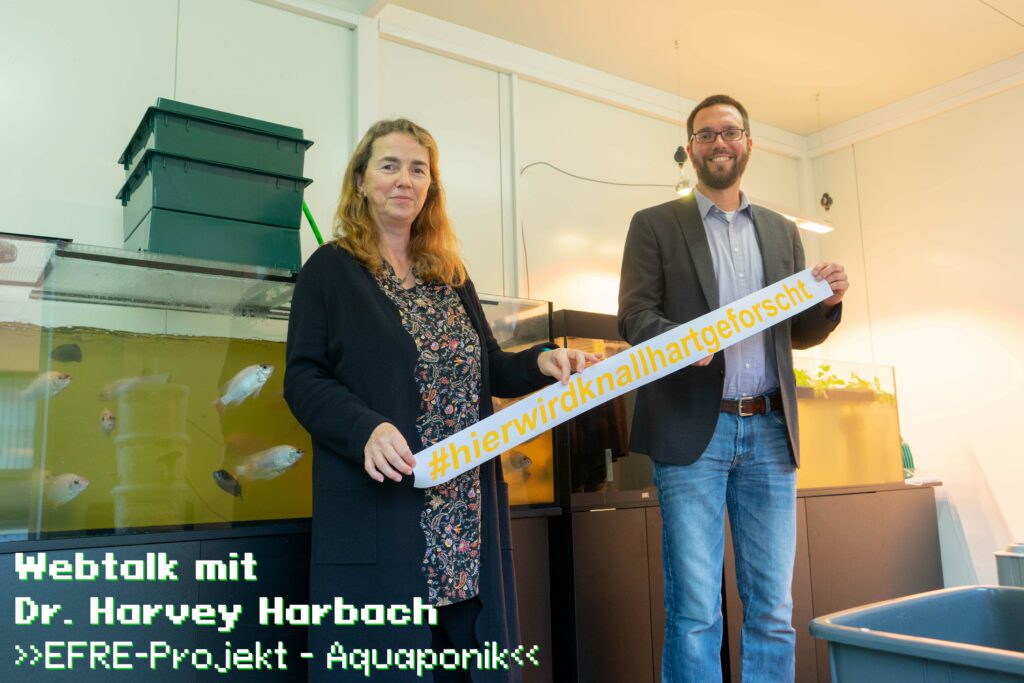
#7 Dr. Harvey Harbach:
Research Projects: Aquaponics
Food production through resource-efficient fish farming is an important contribution to sustainable human nutrition. In closed water cycles, known as “aquaponics,” fish, plants, and worms form a system in which even waste materials are profitably utilized. Dr. Harvey Harbach, a research associate at Hof University of Applied Sciences, explains exactly how this works. He discusses the connection between hair curlers and bioplastic elements for bacteria—so-called growth media—and outlines the educational and knowledge-transfer projects being implemented at Hof University of Applied Sciences. On the one hand, this takes place with children through the program “Aquaponics for Beginners: Fish and Vegetables at School.” On the other hand, it happens at the Hof Zoo in the Savanna House, where there is a real innovation: a system that conserves water, energy, and fertilizer while producing feed. And Dr. Harbach also talks about why he dreams of conducting his own research in the ponds on the green campus of Hof University of Applied Sciences.
Listen to the podcast…
#6 Dr. Eva Max:
“Textile 4.0” Research Project (July 2021)
What does a “radial weaver” actually have to do with a “Stargate”? And what do European funding grants in the field of Industry 4.0 specifically mean for the Upper Franconia textile region? Dr. Eva Max, project coordinator of the Textile 4.0 project, explains what the terms “warenschau,” “vorwerk,” and “warp beams” mean. Together with her, we discuss the textile tradition at the Münchberg campus, which dates back to the 19th century. You’ll also hear why the who’s who of the European Nonwovens Days meets once a year in Hof at the Freiheitshalle. Learn more in the new web talk. Further information about the project is available here: https://www.hof-university.de/forschung/institut-fuer-materialwissenschaften/efre-forschung-die-zukunft-industrie-40.html

#5 Kübra Aslan:
“LigNutz” Research Project (June 2021)
She is passionate about her topic, even if the material itself smells more like a campfire: Researcher Kübra Aslan is intensively studying kraft lignin, the most important component in wood alongside cellulose, which is responsible for tensile strength. It is used, for example, in concrete and in pet food as a binding agent. However, since the highly cross-linked structure of lignin can become a problem during further processing of the material, the industry partner—which manufactures plastics for urns and toys—approached the research institute and suggested investigating how this material could be made more moldable without chemical treatment while remaining biodegradable. The Institute for Biopolymer Research at Hof University expressed interest, primarily because this would also make the material’s use—for example, in the production of films for agricultural applications—possible in the first place.

#4 Prof. Dr.-Ing. Valentin Plenk:
Vice President of Hof University of Applied Sciences (March 2021)
Why is research fun? Why should we talk about it? What are Hof University of Applied Sciences’ highlight projects? The Vice President of Research & Development, Prof. Dr.-Ing. Valentin Plenk, discusses these questions. He explains what happens when old knowledge is applied to new problems and the important role Hof University plays in the region. He outlines why the connection between the university and industry needs to become even closer and why the Bavarian High-Tech Agenda is bringing new momentum to Hof University. Find out more in the web talk.

Information on research and development at Hof University…
#3 Jessica Wittmann:
Research Project “KH Bett” (Jan. 2021)
“Just save the world”—that’s the attitude Jessica Wittmann, a research assistant at Hof University of Applied Sciences, brings to her “KH Bett” research project. This ambition is more than justified in the age of COVID-19, as around 70% of hospital patients fear germs more than they fear incorrect treatment or the mixing up of medical records. She is working on antibacterial coatings for hospital beds. In the web talk, she explains what crabs, toothpaste, and fungi have in common and why cleaning isn’t always the best solution. She also explains why it’s fun to “dive into a topic with passion” and why she recommends that every female STEM student in Hof participate in the university’s mentoring program.

More information about the project is available here…
#2 Dr. Andy Gradel:
“AutAllo” Research Project (Dec. 2020)
The new web talk from Hof University of Applied Sciences is here! This time, the guest is Andy Gradel, senior engineer at the Institute for Water and Energy Management#iwe at Hof University of Applied Sciences. Can electricity and heat be generated from wood waste? “Yes,” says Andy Gradel. In his doctoral thesis, he explored the topic of#biomass gasification. His idea for the#AutAllo project is to gasify biomass—specifically waste wood—in a sustainable manner using compact small-scale plants. Learn more in the web talk.

More information about the project is available here…
#1 Prof. Dr. Jörg Scheidt:
DMKG Headache Registry (Sept. 2020)
One of the seven research groups at the Institute for Information Systems at Hof University focuses on headaches. Recently, this group played a key role in creating a nationwide headache registry. We asked Prof. Dr. Jörg Scheidt, iisys research group leader in the field of “Analytical Information Systems,” what the registry is all about, why a “hangover” isn’t a subject of research, and how the project saves time for patients and the medical community.