

Kübra Aslan and Lucas Großmann from the Institute for Circular Economy of Bio-Polymers (ibp) recently represented Hof University at two major industry events in Berlin. At the 5th Innovation Dialogue 2026 and the ZIM Innovation Day for SMEs 2026, the focus was on exchanging ideas with experts from academia and industry, as well as presenting the successfully completed BioSlide research project.

Photo: Hof University of Applied Sciences;
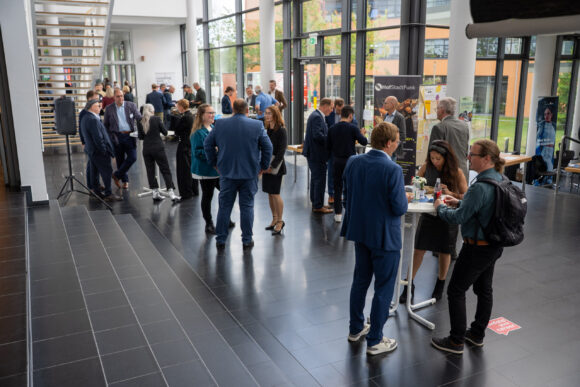
Organized by the Lüdenscheid Plastics Institute and ZENIT GmbH, the 5th Innovation Dialogue brought together experts from research, business, and industry. The focus was on current developments in sustainable plastics, bio-based materials, and circular economy concepts.
For the two ibp staff members, the event offered numerous opportunities to make new contacts and expand existing networks. It became clear in many discussions that sustainable material solutions and resource-efficient production processes are now among the industry’s key topics for the future.
“Direct exchange with companies and research institutions is always incredibly valuable. It highlights the challenges currently facing the industry and identifies new opportunities for joint projects.”
Lucas Großmann
During the evening social event, discussions continued in a relaxed atmosphere, and initial ideas for potential collaborations were explored in greater depth.
BioSlide Generates Great Interest
On the second day, Kübra Aslan and Lucas Großmann, together with project partner CPS GmbH, presented the BioSlide project at the AiF Innovation Day for SMEs. The development impressively demonstrates how biogenic waste materials can be used as raw materials for high-performance technical products.
BioSlide is an innovative sliding surface made entirely from renewable or biogenic waste materials. The project thus combines sustainability with high functionality and opens up new possibilities for the use of resource-efficient materials.
Potential areas of application include plant and mechanical engineering, skiing and snowboarding, as well as various applications in water sports and boat building.
There was considerable interest at the booth. Numerous visitors learned about the material’s technical properties and the potential for using sustainable materials in industrial applications in the future.
“The positive feedback has shown that sustainable material innovations are no longer a niche topic. Interest in practical solutions for a functioning circular economy is growing steadily.”
Kübra Aslan
Valuable Impetus for Research and Collaboration
For the team at Bio’s Institute for Circular Economy, the two events were far more than just an opportunity to present their own research findings. They offered valuable insights into current market trends, technological developments, and the requirements of potential users.
At the same time, both events underscored the central importance of collaboration between universities, research institutions, and small and medium-sized enterprises. Particularly in the field of sustainable materials, innovations often emerge where scientific expertise and industrial practice work closely together.