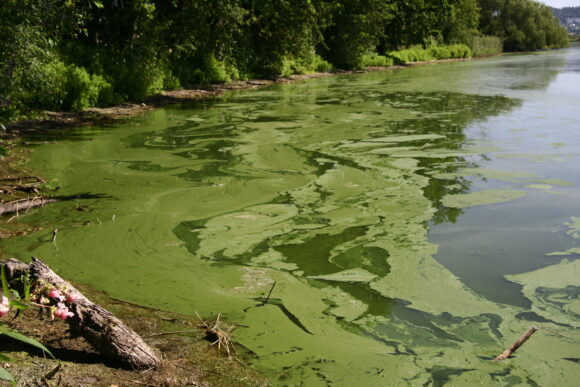


Around four kilograms of plastics per capita end up in the environment in Germany every year – with some serious consequences for nature, people and water. How can we reduce this pollution? This was the central question of the S³Rem innovation network. The project at the Institute for Sustainable Water Systems at Hof University of Applied Sciences (inwa) took a holistic approach to reducing the emission of man-made substances into the environment. We spoke to Dr. Julia Frank from inwa about the solutions developed by the network, what was important in the process and what can come out of it in the future.

What was the project about?
“The aim of the S³Rem network was and continues to be the development of innovative, intelligent, efficient and sustainable solutions to reduce the input of anthropogenic particulate materials and dissolved trace substances into the environment. These include micro- and macroplastics, abrasion particles from tires or paints, for example, as well as ultra-fine particles from various types of waste. Sources include consumer products, building materials, transportation, infrastructure, agriculture and industry. S³Rem is not limited to emissions from sewage treatment plants, but considers all relevant emission pathways that are responsible for the entry of these substances into the environment.”
Who funded the project?
“The project was funded in two project phases from April 2022 to March 2025 by the Federal Ministry of Economics (BMWE), then BMWK, and by the participating SMEs that made up the network. The project manager was Professor Günter Müller-Czygan, the head of inwa.”
What topics were researched?
“Research was conducted on a wide variety of topics, e.g. on the efficient treatment of highly contaminated wastewater from the pharmaceutical industry in India, on innovative process combinations for water purification in order to be able to reuse the water, on further removal of trace substances in the wastewater treatment plant, taking into account the efficient use of renewable energies or on the development of a new type of control system for the 4th purification stage of a wastewater treatment plant, which also takes into account the optimum energy consumption depending on the desired purification quality of the treated wastewater.”
What are the results?
“In the case of the efficient treatment of highly contaminated wastewater from the pharmaceutical industry, a German technology from the company up2e! was successfully adapted to the Indian market. Very good degradation rates were achieved for both COD (chemical oxygen demand, a parameter for wastewater contamination) and API (parameter for active pharmaceutical ingredients) in order to purify the heavily contaminated wastewater from the pharmaceutical industry. The wastewater technology is currently being marketed further in India. As the majority of the projects that were applied for and approved during the project period have not yet been completed, it remains to be seen what further results can be achieved in future research projects.”
What was a particular challenge?
“A particular challenge in the project with India was the customs regulations between Germany and India. These meant that the pilot plant only arrived in India around three months later, which led to considerable delays in the implementation of the project. Thanks to a cost-neutral extension towards the end of the project and excellent cooperation between up2e! and Hof University of Applied Sciences, all milestones were nevertheless achieved.”
Who are the network partners in detail?
“The network partners are all German SMEs that are active in a wide variety of sectors: Drinking and process water technology, water treatment and filtration systems, industrial and process water technology, water treatment of problematic wastewater, small hydropower plants, technologies for wastewater reuse, IT and automation, intelligent control systems for water management, use of hydropower and wastewater heat, retention systems for wastewater and process water treatment, fully biological small wastewater treatment plants, e-learning, web-based training and implementation of learning platforms. The aim was to network the partners in the projects in the best possible way in order to achieve a high degree of innovation for new research applications.”
What happens now ?
“At the request of the network partners, the network will continue without funding. The inwa supports the partners in preparing the applications and benefits from the research applications itself as a network partner. There will continue to be regular virtual meetings of all network partners once or twice a year to initiate further research projects. The IFAT trade fair, which takes place every two years in Munich, will also be a place where many of the network partners will be present for further exchange.”
Further information on the project can be found here: https://s3rem.de/index.html