

After three and a half years of intensive research, the joint project InSchuKa 4.0 is coming to an end. The aim is to use AI to help sewer networks react better to heavy rainfall and dry spells in future – and thus cope with climate change more intelligently.

Climate change poses growing challenges for municipal water management: Increasingly heavy rainfall events are flooding the sewer system, while longer periods of drought are drying out pipes and causing damage. The research project InSchuKa 4.0 (“Intelligent control of sewer networks”) has tackled precisely this problem.
For three and a half years, municipal practice partners, technology companies and research institutions worked together to investigate how wastewater systems can be operated safely, efficiently and in a climate-resilient manner in the future. One focus was on integrating operational knowledge into an AI-based case-based reasoning (CBR) system – a method that learns from comparable situations and derives control recommendations for sewer networks.
The project, funded by the Federal Ministry of Education and Research (BMBF, now BMFTR), was coordinated by Hof University of Applied Sciences. The Institute for Sustainable Water Systems (inwa) took over the scientific management and ensured that the contributions of all partners were brought together to form a functional overall system.
Intelligent flaps instead of expensive concrete ceilings
At the heart of the project is an innovative concept for digital sewer network management. In Jena, two large stainless steel flaps were installed in the main collector. These can be controlled digitally and in future will be regulated by an AI-based control system.
The system processes measured values, modeling and weather forecasts to decide whether water should be stored in the sewer network or discharged. The aim is to overcome two opposing but equally urgent challenges posed by climate change:
- Heavy rain management: relieving overloaded sewer systems to prevent flooding.
- Dry phase management: retaining water in the network to protect pipes from drying out and deposits.
We wanted to show that it is possible to work with existing networks without having to build new retention basins. The intelligent control system makes our sewer network more flexible and robust in the face of extreme weather.”
Robert Köllner, Deputy Plant Manager JenaWasser
The system has been in live operation in Jena since September 2025 – an important step from research to practice.
Knowledge transfer: AI solutions must also be implemented
A central goal of InSchuKa 4.0 was not only the technical development, but also the transfer into municipal practice. The Hof University of Applied Sciences team therefore investigated decision-making processes in municipal utilities and administrations: What are the expectations of AI-supported control systems? What opportunities are seen – and what hurdles?
A nationwide online survey of 154 experts from municipalities, engineering offices and authorities showed that intelligent sewer network control is recognized as a necessary step towards climate adaptation. At the same time, the participants cited obstacles such as a shortage of skilled workers, scarcity of resources and transparency requirements for AI decisions.
Closing event in Jena: research meets practice
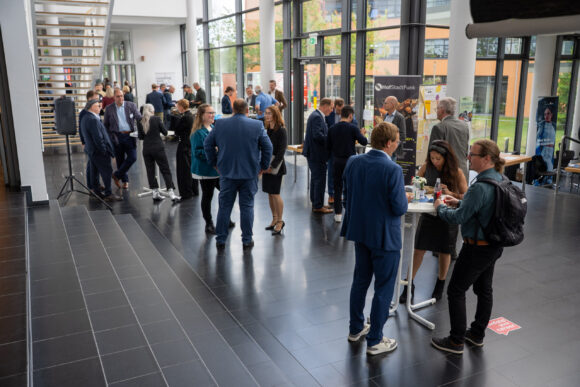
At the end of the project in October 2025, JenaWasser hosted a closing event. Representatives from local authorities, professional associations and engineering firms were able to see as well as hear the results: A live demonstration in the sewer network showed how the system activates storage space, throttles drains and triggers targeted flushing waves.
With InSchuKa 4.0, we were able to show that AI in the sewer network is not a vision of the future, but is already working today. The solution is explainable, transferable – and ready for use in other cities.”
Prof. Günter Müller-Czygan, Head of the inwa

From research to application: What happens now…
Even though InSchuKa 4.0 has officially been completed, the collaboration between the partners will continue. The network plans to continue the developed concepts and control approaches in further projects – with a focus on knowledge transfer, training for operating personnel and the further development of AI algorithms. Hof University of Applied Sciences will remain active as a driving force: the coordination has become a network for climate-resilient water management.
Funding and partners
The “InSchuKa4.0” project was funded by the Federal Ministry of Education and Research (BMBF) and ran until 31.10.2025. The project partners were
- HST Systemtechnik GmbH & Co
- Pegasys Gesellschaft für Automation und Datensysteme mbH
- Nivus GmbH
- JenaWasser
- Magdeburg-Stendal University of Applied Sciences, Department of Water, Environment, Construction and Safety Chair of Urban Water Management
The Federal Ministry of Education and Research (BMBF) is funding the joint project “InSchuKa 4.0” as part of the “WAX” funding measure of the federal program “Wasser: N”. “Wasser: N” is part of the BMBF’s “Research for Sustainability (FONA)” strategy.

Further information: