

Sustainability, energy efficiency and cost-effectiveness have characterised research at the Institute of Materials Science (ifm) at the Münchberg campus for years. Textile recycling in particular is becoming increasingly important – fuelled not least by graduates who are driving forward textile innovation processes in regional and national companies.

A current example of the successful collaboration between university and industry is the WEBKARR project, which was realised at ifm together with Weberei Theodolf Fritsche GmbH from Helmbrechts. The company produces special fabrics for protective clothing – especially for the fire brigade, police and military. During the production of these high-performance meta-aramid fabrics, large quantities of so-called selvedges are produced, which until now have been a valuable but hardly utilised waste material.
Development of high-performance ring yarn
In an interdisciplinary team, Münchberg textile specialists have developed a world-leading method for processing these selvedges and spinning them into new, high-strength ring yarns. This is a particular technological challenge, as meta-aramid is considered to be demanding in terms of further processing. Thanks to the specific expertise in Münchberg spinning technology, however, it was possible not only to utilise the selvedges, but also to produce yarn qualities that exceed previous expectations.
Until now, meta-aramid selvedges – whose material value is around 50 euros per kilogramme – were either processed into nonwovens or even disposed of in a cost-intensive thermal process. WEBKARR now opens up a high-quality, economically viable and sustainable recycling route.


An astonishing result
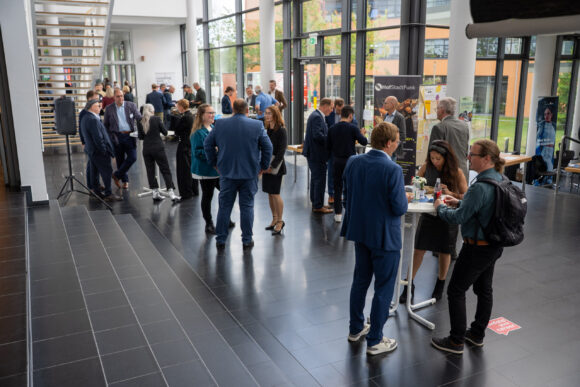
The project was presented to the public for the first time at the end of October – in the presence of District Administrator Dr Oliver Bär and Münchberg’s Mayor Christian Zuber. Both were among the test subjects who were asked to blindly assess both standard reference yarns and the new WEBKARR recycled yarns on a weaving machine. The results were met with enthusiasm: the recycled yarns performed just as well or even better than the conventional reference products.
Mayor Christian Zuber was impressed:
“Münchberg’s textile expertise can be used to create something new and of high quality from supposed waste – that makes us more resilient.”
Christian Zuber, Mayor of Münchberg
District Administrator Bär also emphasised the importance of the project:
WEBKARR is an ideal example of the kind of collaboration between research and business that we would like to see in our region.”
Dr Oliver Bär, District Administrator of the district of Hof
Outlook: From the lab to protective clothing
Based on the ifm results, the Fritsche weaving mill intends to further develop the WEBKARR threads from the new year. Due to the excellent test results, the company is planning to use the recycled yarns not only in the lining fabric, but also in the outer fabric of protective clothing. This could make WEBKARR an important step towards sustainable and efficient material cycles in the textile industry.
Project partners at a glance
- Weberei Theodolf Fritsche GmbH (idea provider), Helmbrechts – Sonja Hübner & Andreas Will (both Münchberg graduates)
- Institute for Materials Science (ifm), Hof University of Applied Sciences – Project supervision: Stephan Fichtner (Münchberg graduate)
- RVN Faserproduktion GmbH, Neuenmarkt – Project supervision: Bernd Witzgall (Münchberg graduate)
- Rieter, Winterthur (Switzerland) – associated partner in spinning machinery construction; chief technologist: Michael Will (Münchberg graduate)
- Spinnerei Otto, Dietenheim (Baden-Württemberg) – subcontractor
- AGATEX, Austria – as supplier of WEBKARR textile auxiliaries; application technology manager: Thomas Maier (Münchberg graduate)
WEBKARR is sponsored by the Bavarian joint research programme “Materials and Material” of the Bavarian Ministry of Economic Affairs.