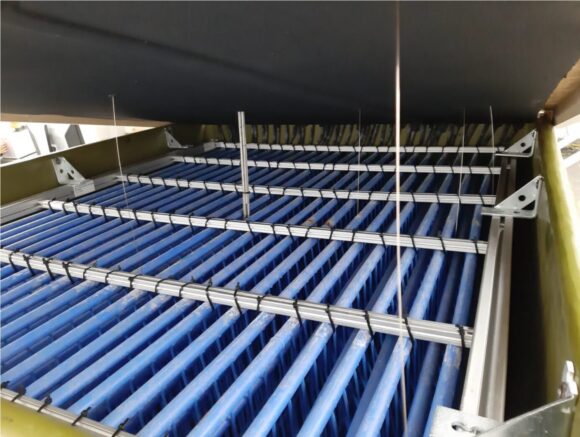


Scientists from Hof University of Applied Sciences and engineers from the company Hydrotec in Selb want to optimize the treatment of so-called clear water – for example in intensive freshwater aquaculture. For their UVPHON project, several tests have now been carried out and water samples taken with a specially developed prototype, a new type of UV-C reactor, at the Teaching Institute for Fisheries. The aim is to develop an innovative system for water treatment.

“Our teaching institute for fisheries is a renowned educational and research facility for all aspects of fisheries, pond management and water. I am delighted that we are able to support the scientists in this project,” said District President Henry Schramm, emphasizing:
“Especially in view of climate change and the ever-increasing drought, it is important to use water as a resource sparingly, and water treatment is an important pillar of this.”
District President Henry Schramm
Three research groups at Hof University of Applied Sciences are working together on the project, led by Prof. Dr. Tobias Schnabel, Dr. Harvey Harbach and Alexandra Luft from the Institute for Sustainable Water Systems (inwa) and the Institute of Materials Science (ifm) respectively. The common goal is to advance the new technology of UV LEDs for disinfecting water. HydroTec Gesellschaft für Ökologische Verfahrenstechnik mbH from Selb is responsible for overall coordination. The research project is funded by the Federal Ministry of Education and Research as part of the “KMU-innovativ: Sustainable Water Management” program.
Although UV light has long been known for its germicidal effect, its use with turbid wastewater has so far been less efficient. This is precisely where the research project comes in: the multi-stage UVPHON process is characterized by its combination of ecological filtration, photocatalytic pre-treatment and modern LED-based UV disinfection. In the first treatment stage, the water passes through filter modules made of sheep’s wool. These newly developed filters effectively remove suspended particles that could attenuate the subsequent UV radiation. The sheep’s wool filters are also biodegradable – a clear ecological advantage over conventional plastic filters. In the second stage, photocatalytic oxidation takes place: using UV-A radiation and titanium dioxide, so-called hydroxyl radicals are produced – highly reactive molecules that decompose dissolved organic substances or trace substances in the water.

Only then is the water passed through the newly developed UV-C LED reactor, which reliably disinfects it. In contrast to conventional UV lamps, which contain mercury and require a warm-up time, the LEDs used work without the use of mercury. Disinfection with UV-C radiation ensures that potentially pathogenic microorganisms are killed – a prerequisite for the treated water to be safely reused in aquaculture or agriculture.
David Raithel from HydroTec Gesellschaft für Ökologische Verfahrenstechnik mbH is convinced that this method has great potential. However, the appropriate technical conditions must now be created and the cost efficiency of this method increased. Practical trials with clear water from a fishery have now been carried out for the first time at the Aufseß Training Institute for Fisheries. A test system for water disinfection was set up and water samples were taken from various points in the pond system. These samples are now being analyzed in the HydroTec laboratory.
The tests in Aufseß not only provide findings on the specific effectiveness of the technology, but also valuable insights into the technical feasibility of operating a fishery facility. The UVPHON process can be used in fish farming and aquaculture, but also in sewage treatment plants, for example.
We see a great benefit, especially in the improvement of water quality for the young fish in the hatchery, as these always suffer from the entry of turbidity and possible pathogens during heavy rainfall.”
Dr. Thomas Speierl, fisheries consultant for the district of Upper Franconia
In general, the new method could improve the water quality in trout farms and recirculation systems. Water availability and water quality have in some cases changed critically for the trout pond industry in recent years due to the weather scenarios.