

As part of a practical project, students at Hof University’s Münchberg campus digitally recorded the air quality in seminar rooms and offices and translated it into innovative, interactive applications. The aim of the project was to make environmental and room data visible, tangible, and understandable—and thus to raise awareness of healthy indoor air in the long term.

Following in the footsteps of naturalist Alexander von Humboldt and inspired by the novel of the same name, “Measuring the World,” the students, led by Prof. Michael Zöllner, embarked on their own “measurement of the world” – starting with their own campus in Münchberg. Supervised by Prof. Zöllner and lecturer Moritz Krause, they received support from the London-based start-up AmbientWorks. The young company provided modern environmental sensor technology, including the Red Dot Award-winning air quality monitor “ambient one.”
Precise measurement data as a basis
Using Sensirion SEN66 sensors, the students recorded room temperature, CO₂ concentration, fine dust particles, and volatile organic compounds (VOCs), among other things, in real time and in time series.
This data collection clearly showed how quickly elevated CO₂ levels can be reached, especially in well-insulated rooms, with a direct impact on concentration, motivation, and well-being.
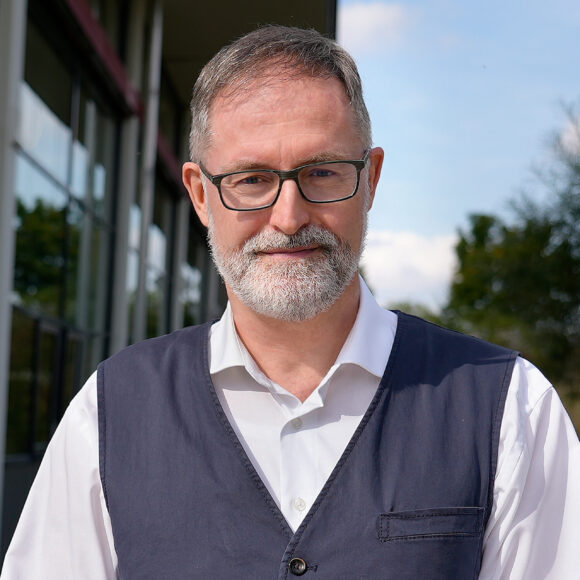
Prof. Michael Zöllner

From data to experiences: CleanAir as an interactive experience
Based on the measured values, the students developed so-called data stories and interactive information systems on the topic of “CleanAir.” The aim was not only to present air quality in abstract terms, but also to make it intuitively tangible.
The following prototypes were created, among others:
- Pieces of music that change dramatically or subtly depending on the air quality
- Smart light installations whose mood adapts to the indoor climate
- A digital “miracle tree” in the car that encourages ventilation breaks
- A painting in which the weather and vegetation change according to air values
- A digital plant whose leaves rise or fall depending on the CO₂ level
- A smart cloud that flashes and glows depending on the current CO₂ level

These creative approaches show new ways of data communication: Instead of rows of numbers, the focus is on sensory, emotional, and immediate experiences.

Image: Hof University of Applied Sciences;
Entrepreneurial spirit and sustainable insights
In addition to technical support, the project benefited from direct exchange with the founders of AmbientWorks, who provided valuable feedback during the final presentation. This gave the students insights into the path from the initial idea to the prototype to the development of a viable business model, including a pitch deck.
A key insight from the project: fatigue in seminars is not necessarily due to long nights or the quality of the lecture. It can often be objectively measured by increased CO₂ levels. This insight led many participants to become more conscious of ventilation in their everyday student life.