

The digital start-up center Einstein1 has a new managing director. Achim Hager, a familiar face with extensive experience in the telecommunications and start-up scene, took over the baton on July 1. He not only takes over the management of a running start-up center – but also the task of sharpening its profile and revitalizing the regional networks with fresh energy. We talk to him about his priorities and what students and start-ups can expect from him in the future.

Mr. Hager, you have beeninvolved with Einstein1in the past, for example as a consultant at “meet & eat”.How does it feel to be returning now as Managing Director?
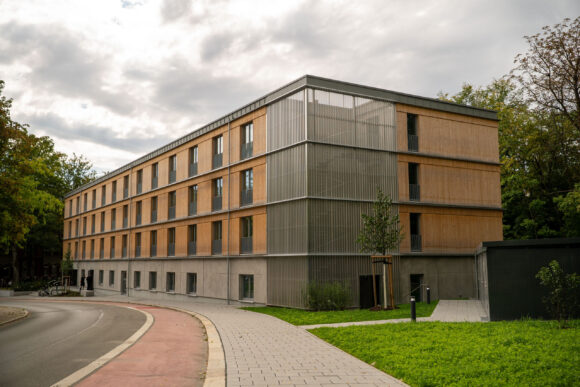
“It’s super exciting. I had to think back to the site inspections when I first heard about the project in the snowy winter a few years ago. And the many times I’ve been here in the meantime as a sponsor, a BusinessAngel, a guest speaker or an event organizer. It is a fascinating building that deserves a lot of life and use. I’m looking forward to contributing my network here.”
Your arrival follows four managing directors in just five years – what was your first impression when you took over the center? Where do you see the most urgent construction sites?
“Providing stability is the most important thing. 5 changes in 5 years is not a good basis for a stable direction for a company like Einstein1 that is invested in the long term and sustainability. In addition, the connection to the stakeholders must be put on a new footing – both the government and the shareholders must pull together here and give Einstein1 maximum development opportunities. I also have to deal with the personnel changes in the team. Both my predecessor Werner Fugmann, who is an outstanding digital expert, and Niko Emran, who will be moving into self-employment in August, will remain involved in the project and are available for presentations and activities.”
One focus of your work is to be stronger networking with regional companies. How would you like to implement this in concrete terms?
“I am also Chairman of the Board of the HochFranken economic region and Deputy Chairman of the Economic Committee of the Upper Franconia Chamber of Industry and Commerce. Together with my team from the economic region, we will complement Team Einstein1 and work hand in hand in the coming months to plan events, i.e. organize events and workshops. I will also involve the StartUpLab and organize ongoing communication between everyone who has anything to do with start-ups. Not forgetting our scientific brain, Professor Dr. Michael Seidel, who has been our mouthpiece both inside and outside the university with a great start-up reputation for decades.”
How specifically can Einstein1 support young people who are facing the double burden of studying and founding a company, for example?
“First of all, the very first support is to put their business idea through its paces. If an idea is promising, but financing is absolutely necessary, this must also be considered first and one or more contacts must be made between potential financiers and the potential founder. Starting a business at any price makes no sense if you then hardly have any time left to study.”
We have to encourage them with everything our institution has. We have to support them, be it spatially, be it through permanent coaching or be it through public relations work.”
Achim Hager
And he continues: “Because one thing is my motto: a lot of things in life need the right coincidence. Our task is to create as many opportunities as possible for this coincidence to occur. Coincidences arise from opportunities. This could be an investor, a potential co-partner who joins such a project or a player from the regional economy who wants to support the founder. I’m thinking of our business angel network.”
Your professional background, including at HFO Telecom AG and as a Senior Advisor, shows a wide range. Will you also personally invest in projects – or is your focus more on building structures?
“My focus is primarily on building structures, clear processes and coordination. Founders need clear contact persons who accompany and guide them from phase to phase. From the gateway to ongoing coaching, from the initial assessment to financing, from the room to the video clip.
If opportunities arise that are exciting and fit in with my background, but also with the topic of AI, I can also imagine investing in one or two topics myself, but I will always push the topics in my network to possibly find the right person.”
Which start-ups from Einstein1 or Hof have particularly impressed you in recent years and why?
“NedgeX as a spin-off of our outstanding partner Netzsch and BTX Energy, as a forward-looking, sustainable company that is in tune with the times. Netzsch is impressive because it is a local player with determination and capital that dares to do new things and simply goes for it. This is part of the DNA of Moritz Netzsch and Christian Baier, who is locally responsible here, and is fascinating and more than worthy of recognition. Questioning yourself in a targeted way, disrupting yourself before others do it to you and playing on new playgrounds in the process, that’s a piece of controlled chance for something new.”
How do you want to measure the success of your work in future?
“I’d like others to do that. If you’re satisfied yourself, that’s not a measure of how others perceive you. For me, it is crucial that there is life in Einstein1, that it is a meeting place for ideas and exchange. If we find and motivate new founders from this and then the public perception shifts to “Something is happening”, then we have certainly done more right than wrong. The interwoven interaction with the university is also important. The students are the basis for life on campus and therefore life at Einstein1.”
How can the digital start-up culture in Hochfranken be strengthened and what can Hof University of Applied Sciences do to help?
“We have to be aware that we are not comparable with the centers in terms of socio-demographics. There are far more young people in Munich, Berlin or Nuremberg than here. In this respect, we should actually also motivate older people to dare to do something. Only then can we say from the pure population figures, well, with 1 million inhabitants in Upper Franconia and 200,000 in Upper Franconia, 10 to 12% of the almost 400 start-ups per year should come from Upper Franconia and 8 from Upper Franconia every year. And if 2 to 4 of them want to go to Einstein every year, then we can expand. It is absolutely impossible to achieve this from the students alone. In addition, there are often financiers in the centers – like in Munich at TUM with Susanne Klatten, who with her BMW background can throw in almost unlimited funds of her own, or the Schwarz Foundation in Heilbronn with its AI Center, financed by the Lidl-Schwarz Foundation. Money is definitely a magnet. Clustering is the other magnet. The many start-up centers that were funded and built in Franconia after Einstein1 or are still being built, as in Bayreuth, have of course weakened the planned pull effect of the individual centers, which were few at the time.”
…which means what in consequence?
So we have to develop our own strengths, work out our own USP’s, for example, and above all with the university, these are low-hanging fruits.
The professors see all the ideas of the students, and in many degree programs reasons have already become a core element of teaching. Which university can claim that? And yet not all areas work together harmoniously. The will, expressed in words, is always and everywhere present, but the actions are often lacking in the interaction with start-ups and ideas. The university and its institutes, for example, must finally resolve the issue of IP and intellectual property – I experienced this myself years ago. Others too. Anyone who enters into a cooperation project with the university and develops something for the market needs a clear legal basis afterwards to be allowed to use it without having to publish the entire development in detail, for example. The copyright should always belong to the person who introduces and pushes the idea, the institute generates project positions in this system and can continue to develop and become better and more multifaceted. More successful than other institutes that don’t get it right. I think a clear approach is necessary here, then you can also generate start-ups here together with industry and bring them onto the market more easily.
What incentives do you want to offer so that founders “stay in the region”?
“Everything I have described here in this interview is the basis for the start of each individual. The next step is for the HochFranken economic region with the economic development of the supporting local authorities to take action, be it with vacancy management or with tax incentives and further support with subsidies to give the advanced founders the feeling that “they care, I’m staying here”.
Thank you very much for the interview and good luck with your task!