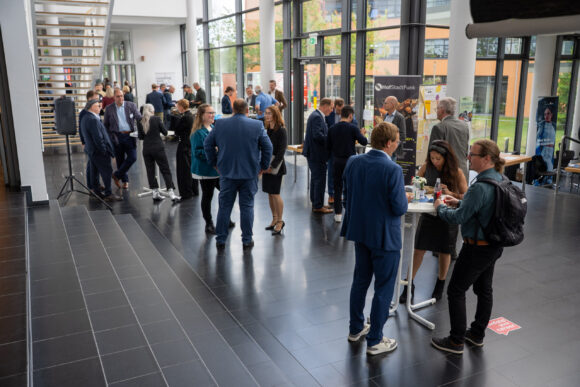


The most inconspicuous everyday movement – reaching for the toilet flush – can have consequences that extend far beyond the bathroom. On November 6, 2025, the Hof University of Applied Sciences city lecture at the Münchberg Schützenhaus showed what these consequences are. Under the title “When the toilet flush becomes a pharmacy – ways to a sustainable water cycle”, the event was dedicated to a danger that you can neither smell nor see, but whose effects have a profound impact on the ecological balance: micropollutants in the water cycle.

Pharmaceutical residues, household chemicals, microplastics or multi-resistant germs – substances that enter wastewater from households, hospitals or agriculture – are becoming increasingly important for ecotoxicology and public health. The city lecture made it clear how complex the interplay between chemistry, biology, geology and toxicology has become.
Ecotoxicology tries to understand how the environment itself behaves – and what happens when humans introduce substances whose effects have long been underestimated.”
Prof. Dr. Tobias Schnabel
A historical look led to Rachel Carson, whose book Silent Spring in 1962 first revealed the ecological consequences of the insecticide DDT and ushered in a new era of environmental awareness. To this day, examples such as endocrine disruptors and persistent chemicals illustrate how sensitively natural systems react. Particularly impressive: even nanogram quantities, i.e. a few trillionths of a gram per liter of water, can have serious effects on fish or amphibians – such as altered sexual development or disruptions to the hormone system.
What do painkillers mean in flowing waters
Tobias Schnabel, Professor of Urban Water Resource Management at Hof University of Applied Sciences, used real measurement data to show how widespread pharmaceutical residues are today. Painkillers such as diclofenac, antibiotics and contrast agents can be found in almost all watercourses in Germany. Some substances are barely broken down in the human body, while others pass through sewage treatment plants virtually unchanged. “We are not talking about individual cases here, but about long-term pollution,” he emphasized.
The fragility of the ecological balance was illustrated by the example of vulture populations in South Asia: vultures that ate the carcasses of cattle treated with diclofenac (especially cows) quickly died due to the toxic effect of the drug. As a result, their population decreased significantly. There are also cases in Europe where persistent industrial chemicals have rendered entire drinking water areas unusable.
New approaches for a sustainable water cycle
However, the city lecture not only painted a gloomy picture for the forty or so guests, but also presented approaches for a more sustainable water cycle: improved treatment technologies, targeted collection of hospital wastewater directly at the point of origin and not only after dilution, new analytical methods, but also better education in everyday life. According to Tobias Schnabel, it is crucial that chemical innovation and environmental knowledge work together.


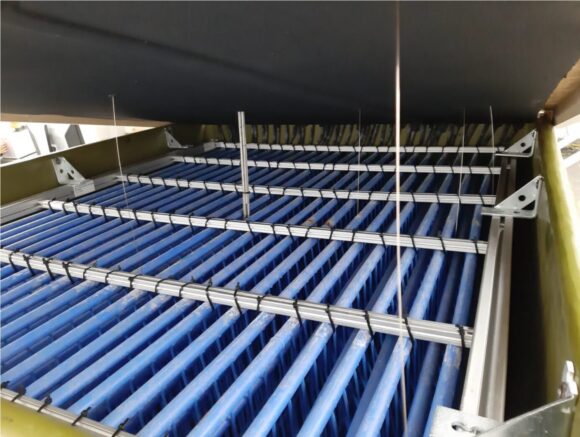
Born in Gotha, he presented his new approaches, which are being developed together with the German Aerospace Center, for example. Technologies that were originally intended for closed water circuits on a future moon station could also help in German clinics in the future: For example, diamond-coated electrodes that are able to break down drug residues and pathogenic germs highly efficiently. In addition, photocatalytic processes are used that can mineralize almost all organic trace substances up to CO₂ and water – with the exception of extremely stable fluorine compounds (PFAS).
And microplastics?
The speaker made it clear that microplastics do not predominantly come from sewage treatment plants, but are mainly caused by tire abrasion on traffic surfaces. There was a lively discussion with the audience about what future models based on the polluter-pays principle could look like in order to finance cleaning measures.
Hof University of Applied Sciences wants to continue the discussion. After all, every tablet, every ointment and every cleaning agent does not begin and end in the household, but in a global cycle that affects us all. Flushing the toilet, as became clear on this evening, has long been more than just a technical process – it is an indicator of how consciously our society deals with substances that leave the smallest traces but can have the greatest impact.