

How can digital technologies help make wastewater treatment in rural areas more reliable, efficient, and sustainable? This is the focus of an exciting new research project at the Institute for Sustainable Water Systems at Hof University of Applied Sciences (inwa).

Small-scale wastewater treatment plants play a central role in water protection in regions without access to a central sewer network. Until now, their maintenance has been performed at fixed intervals—regardless of whether there is actually a need for action. This creates extra work, ties up specialized personnel, and hinders the efficient use of resources. This is where the newly launched“BIK3I”project comes in: The researchers’ goal is to be able to assess the actual condition of a system more accurately in the future. To this end, operational and measurement data are collected, linked together, and analyzed using AI methods. This is intended to enable the early detection of changes and potential malfunctions. In the long term, maintenance could be planned more effectively, outages avoided, and operational safety increased.
AI as Support for Operators and Specialized Staff
The project thus contributes to a key future challenge in water management: How can existing infrastructure be sustainably developed in the face of rising demands, limited human resources, and advancing digitalization?
“We want to demonstrate how employees’ experiential knowledge can be a vital component of digitalization in the water sector and make a significant contribution to addressing specific challenges. Using the example of operational and maintenance support, we are developing a transparent and reliable digital solution together with our industry partner, in which experiential knowledge, sensor data, and AI methods are effectively and purposefully integrated.”
Prof. Günter Müller-Czygan, Head of the Water Infrastructure and Digitalization Research Group (inwa)
Practical expertise meets scientific data analysis
utp Umwelttechnik Pöhnl GmbH brings its many years of experience in the development and support of small wastewater treatment plants to the project. With solutions such as the SBR small-scale wastewater treatment plant “klärofix” and the “klärcontrol” control system, the company already possesses extensive expertise in the areas of remote monitoring and telemetry.
The new project builds on this experience and expands it with scientific methods of data analysis and artificial intelligence. The focus is not on the automation of decisions, but on a better understanding of plant conditions. The research aims to identify which information can already be utilized today, what additional data is required, and how this can lead to reliable recommendations for action.
Acceptance and Trust as Part of the Research
In addition to technical issues, Hof University is also examining the acceptance of such AI-supported systems. After all, digital innovations can only realize their potential if they are understandable, transparent, and practical for operators, maintenance companies, and technical staff.
Kick-off for a forward-looking research project
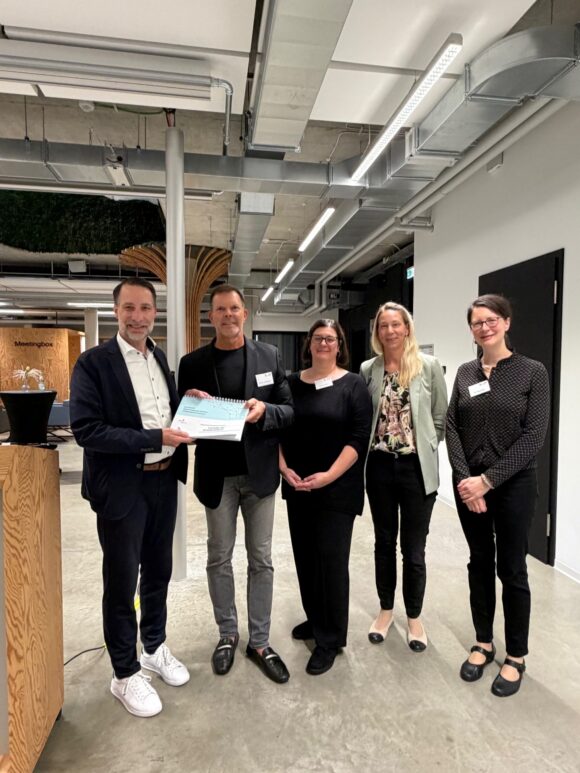
Prof. Günter Müller-Czygan, Paola Acosta Carrascal, and Pavel Timofeev represented Hof University at the kick-off meeting. utp Umwelttechnik Pöhnl GmbH was represented by Thomas Parchent, Roland Pöhnl, and other members of the project team.
“As a practical partner, we contribute our many years of experience in the operation, maintenance, and remote monitoring of small wastewater treatment plants. For us, the digital transformation is an important step toward securing the future.”
Thomas Parchent, utp Umwelttechnik Pöhnl GmbH

Seybothenreuth; Photo: Hof University of Applied Sciences;
Launched on April 1, 2026, the project is funded as part of the Central Innovation Program for SMEs (ZIM). It combines scientific research with practical application and serves as an example of how digital technologies can help make water infrastructure in rural areas future-proof—for greater operational reliability, more efficient use of resources, and ultimately for the sustainable protection of our waterways.