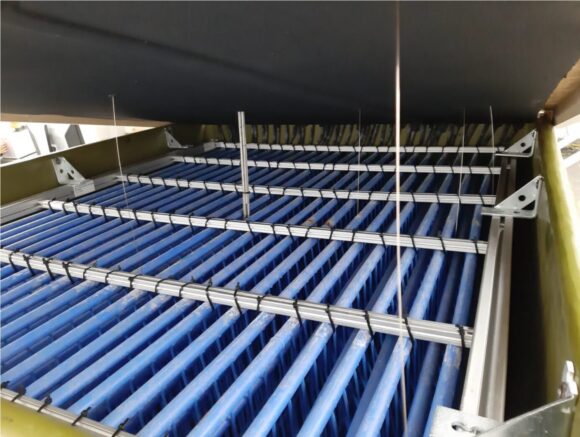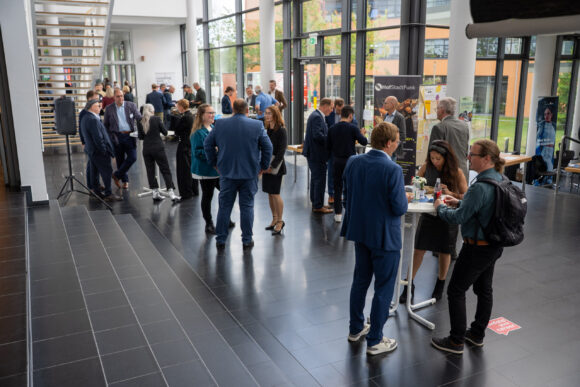


As part of a network meeting of the EnerNET project at the end of June, a new test and research facility with a propane refrigeration system was inaugurated and put into operation at the Münchberg campus, in whose high-tech laboratories the Institute for Hydrogen and Energy Technology at Hof University of Applied Sciences (iwe) is currently still based until the new building at the Hof campus is completed.

The EnerNET project is managed by iwe and consists of three individual networks: local and district heating, air conditioning and refrigeration technology and energy management. It offers specialists from these areas various free further training courses and the opportunity to network. EnerNET is funded by the European Social Fund Plus (ESF ) and the Upper Franconia Foundation. The network for air conditioning and refrigeration technology has been in existence since 2018. In addition to major manufacturers in the region, trade companies and refrigeration colleges are also part of the network. The refrigeration network now extends from Kulmbach to Chemnitz.
Natural refrigerants, including propane, carbon dioxide and ammonia, are environmentally friendly alternatives to conventional synthetic refrigerants. They are characterized by their low environmental impact and are increasingly being used in refrigeration technology. However, each of these refrigerants has its own challenges: Propane, for example, is flammable, which is why special safety precautions are required. For this reason, propane refrigeration systems are very rarely part of research laboratories and there is still a great need for research in this area. This fact makes the new test facility in Münchberg particularly valuable and the team has already received many requests for contract research.
The future home of the iwe is currently being built on the Hof campus – the new Center for Water and Energy Management (ZWE), which will house large laboratories and test halls for air conditioning and refrigeration technology, among other things; this research area will also be further developed there in the future.
The campuls editorial team spoke to Michael Dölz, Head Technician at iwe, about the goals and challenges of researching natural refrigerants and the new test facility in Münchberg.
Mr. Dölz, can you briefly explain to our readers what a propane refrigeration system is and where these systems are used?
Michael Dölz: A propane refrigeration system is a machine that can provide refrigeration for various applications. It can be used in the area of food refrigeration, i.e. in the temperature range -20 °C to 5 °C.
What is the aim of your research on the propane refrigeration system?
The focus is on increasing efficiency in the provision of refrigeration using this type of refrigeration system. To this end, we are developing new components and testing them using our test system.
What were the main reasons for purchasing and building this test system?
Due to legal requirements (F-Gas Regulation), so-called natural refrigerants will be used more and more in the future. Propane belongs to the group of natural refrigerants and will therefore be widely used.
How does this contribute to improving energy efficiency and sustainability?
The thermodynamic properties of propane are very good and result in a highly efficient refrigeration system. The most important property, however, is the low GWP (Global Warming Potential) of propane compared to currently used refrigerants. The use of propane reduces the greenhouse gas effect and thus helps to limit climate change.
Were there any particular challenges that you had to overcome during the development or construction of the propane refrigeration system?
The refrigeration system was installed by the refrigeration specialist Genes, which first had to familiarize itself with the new technology. In contrast to a standard application, we installed a large number of measuring devices. Installing, electrically connecting and evaluating these was a challenge.

Can you tell us about the safety measures that were taken when operating the propane refrigeration system?
Propane (R290) is a safety group A3 refrigerant and is highly flammable. For this reason, the chiller was installed in our explosion protection room, which is equipped with a gas warning system and safety ventilation.
What innovations or special technical features characterize this test system?
In addition to the use of the natural refrigerant propane, the test stand is designed for flexibility. The main components of the refrigeration machine can be replaced by test specimens as part of a series of tests and the effects on the refrigeration machine can be determined using measured values.
What are the next steps now that the system has been put into operation?
Over the next few months, we will measure and further optimize the system with regard to the entire performance spectrum. At the same time, we will prepare an initial project in which we will use the system for contract research.
To what extent is the propane refrigeration system used for training students?
Two students have already helped with the construction of the refrigeration system as part of a student research project. To support teaching, we regularly carry out practicals in the energy laboratory, where we present the special features of the system to students and carry out experiments.
How do you see future developments in the field of refrigeration technology and what role does the new test facility play in this?
The use of natural refrigerants, such as propane, will play an increasingly important role in the future. The system enables us to participate in this development. We are already seeing this in the first industrial inquiries regarding our new propane refrigeration system. It is a first step and will be supplemented by further systems for natural refrigerants in the future.
Thank you very much for the interview!